
Heated extension floors on Rushden semis
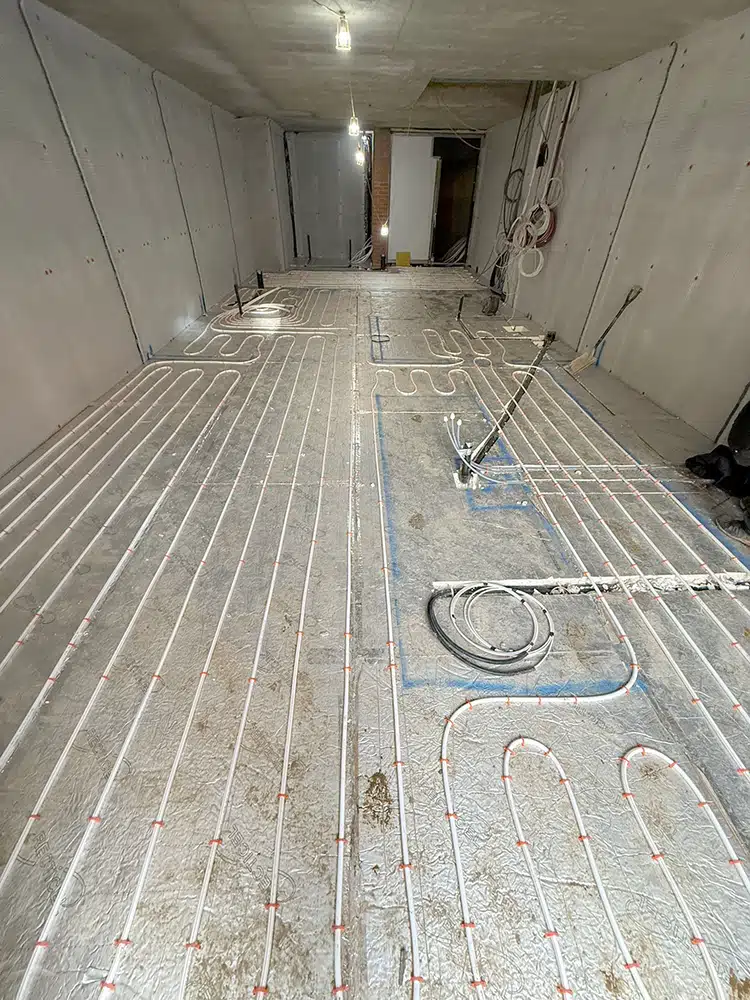
A new extension slab gives a clean start. Insulation goes over the slab, then a membrane, then the heating pipes clipped in place and pressure tested by the heating engineer, with an edge strip around every wall. The screed goes on last, over the whole build-up.
How deep it goes depends on the pipes. Liquid screed has to cover them by 25mm or more, which typically means 45 to 50mm in all. Sand and cement wants roughly 45mm of cover, so it finishes thicker. Too little cover leads to cracks along the pipe lines and cold stripes on the floor.
Because liquid screed surrounds each pipe without trapping air, it is the normal pick for a heated kitchen or family room on the back of a semi. It also warms up faster and uses the heat more efficiently. On a mid-century Rushden semi, where the extension often joins an older floor at the back of the house, we check the finished level so the two rooms meet without a step.
Sand and cement still suits some heated floors, particularly small rooms or areas that will be wet. Whichever you choose, we look over what sits beneath it, the insulation, the membrane and the strip around the walls, before pouring, and supply any of it that is missing. For the pumped option, see our liquid screed page for Rushden.
Retrofitting heating in older Rushden terraces
An older terrace is a harder place for underfloor heating than an extension, since doors, stairs and the street level outside all pin the floor height. Where the old floor lacks a membrane or has decayed, it has to come out anyway, and that creates room for insulation, pipes and a screed. When height is short, liquid screed's smaller cover over the pipes is normally what makes everything fit.
The heating cannot go straight on. Commissioning can begin about 7 days after a calcium sulphate pour, while sand and cement needs 21 days or more. From then the temperature climbs in small increments spread over several days. Rushing this cracks screeds and delays flooring. Ask the heating engineer to record each step, because the flooring fitter will want that record before laying tiles or engineered wood on a heated floor.
It also helps to decide the final floor finish early. Tiles, LVT and timber each have their own limits for surface temperature and moisture, and the screed depth and drying plan can be set to suit.
Our drying time guide explains the numbers in more detail. If your build is south of the town, see our page on heated screed in Bedford.
Underfloor Heating Screed prices in Rushden
Liquid screed over underfloor heating: £20 to £35 per m² supplied and laid (trade2base, June 2026), so £700 to £1,230 for 35 m². trade2base gives these figures excluding VAT. See our floor screeding cost guide or screed calculator.
Who lays your underfloor heating screed in Rushden
K & B Screeding’s own team, led by director Donatas Bardisevicius. Founded 2019, company 12298780.
See what customers say in our Google reviews and on our testimonials page.
Underfloor Heating Screed from Slough to Rushden
As the crow flies, our yard in Slough is about 52.5 miles from Rushden, which lies to the north. Postcodes here include NN10, and Wellingborough (4.1 miles), Raunds (4.6 miles), Burton Latimer (6 miles) and Kettering (9.3 miles) are close by.
More on underfloor heating screed, part of our screeding services.
