
Heated extensions on later Raunds houses
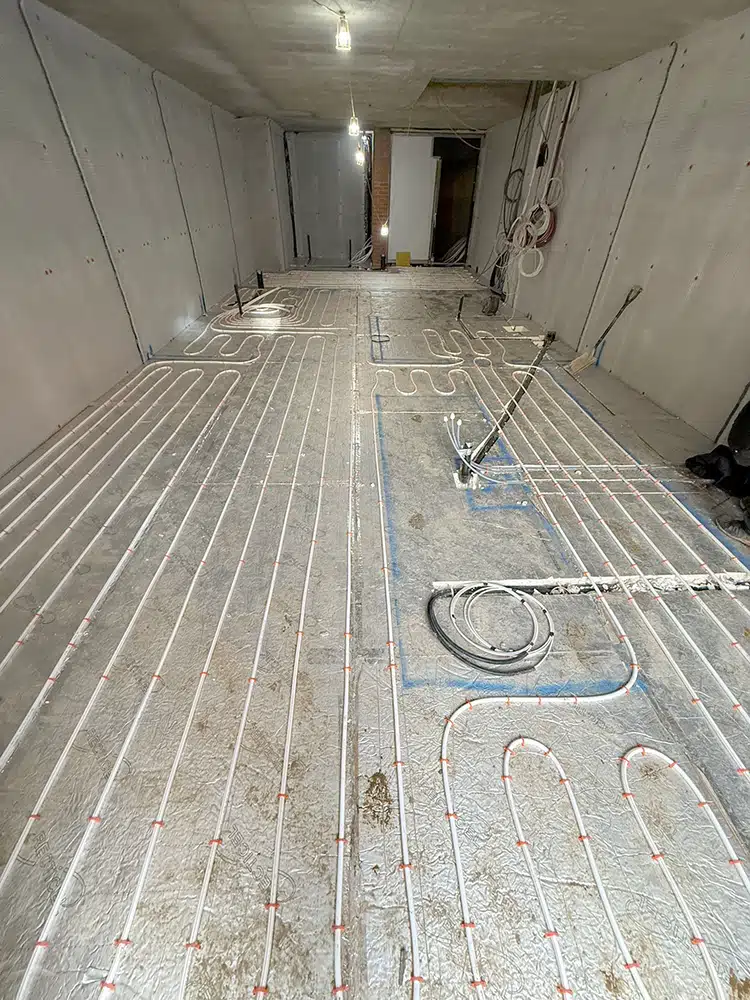
A rear extension or garden room is the easiest place to fit underfloor heating, because the floor is being built from scratch. The build-up runs from the slab up: insulation, a membrane, the heating pipes clipped to the insulation, an edge strip around the walls, then the screed.
The screed does two jobs. It keeps the pipes safe, and it carries their warmth out evenly across the floor. For that it needs enough cover over the pipes. On liquid screed the pipes need a 25mm minimum on top of them, which makes the whole layer roughly 45 to 50mm. Sand and cement needs closer to 45mm on top, so it builds up deeper. Too little cover leads to cracking along the pipe runs and patchy warmth.
Because liquid screed wraps every pipe without leaving air gaps, the room heats up faster. So for a heated kitchen extension, liquid is normally the pick. Sand and cement still has a place, particularly where part of the floor is a wet area.
On a new build house, heating is usually planned into the floor from the outset, and the drawings may name a calcium sulphate screed. In an extension, agree the screed type with the heating engineer before the pipes go down, because it sets the pipe cover and the finished floor height. For what that material needs, see our anhydrite flow screed page for Raunds.
Retrofitting heating in older Raunds homes
Adding heating to an older house near Church Street or Thorpe Street is harder, because the existing floor height is fixed by doors, stairs and thresholds. Usually the old solid floor comes out so that insulation, pipes and screed can all fit under the same finished level. Where height is very tight, a liquid screed with its thinner cover is often the answer.
That first warm-up has to be slow. Calcium sulphate lets the heating engineer commission the system once about 7 days have passed since pouring. Sand and cement holds you back for at least 21 days. Then the heating engineer brings the temperature up in small stages over several days, never straight to full, so the screed dries evenly and stays free of cracks. Keep a written note of the dates and temperatures, because many flooring fitters ask to see it before they start.
Flooring waits until the screed is dry, and the heating can help with that once it is running. Timings are set out in our drying time guide. If you are building in the next town along, read about heated floor screed in Wellingborough.
Underfloor Heating Screed prices in Raunds
Liquid screed over underfloor heating: £20 to £35 per m² supplied and laid (trade2base, June 2026), so £700 to £1,230 for 35 m². trade2base gives these figures excluding VAT. See our floor screeding cost guide or screed calculator.
Who lays your underfloor heating screed in Raunds
K & B Screeding’s own team, led by director Donatas Bardisevicius. Founded 2019, company 12298780.
See what customers say in our Google reviews and on our testimonials page.
Underfloor Heating Screed from Slough to Raunds
As the crow flies, our yard in Slough is about 56.4 miles from Raunds, which lies to the north. Postcodes here include NN9, and Rushden (4.6 miles), Burton Latimer (6.2 miles), Wellingborough (7.3 miles) and Kettering (9 miles) are close by.
More on underfloor heating screed, part of our screeding services.
