
Floor height when retrofitting Bedford's semis
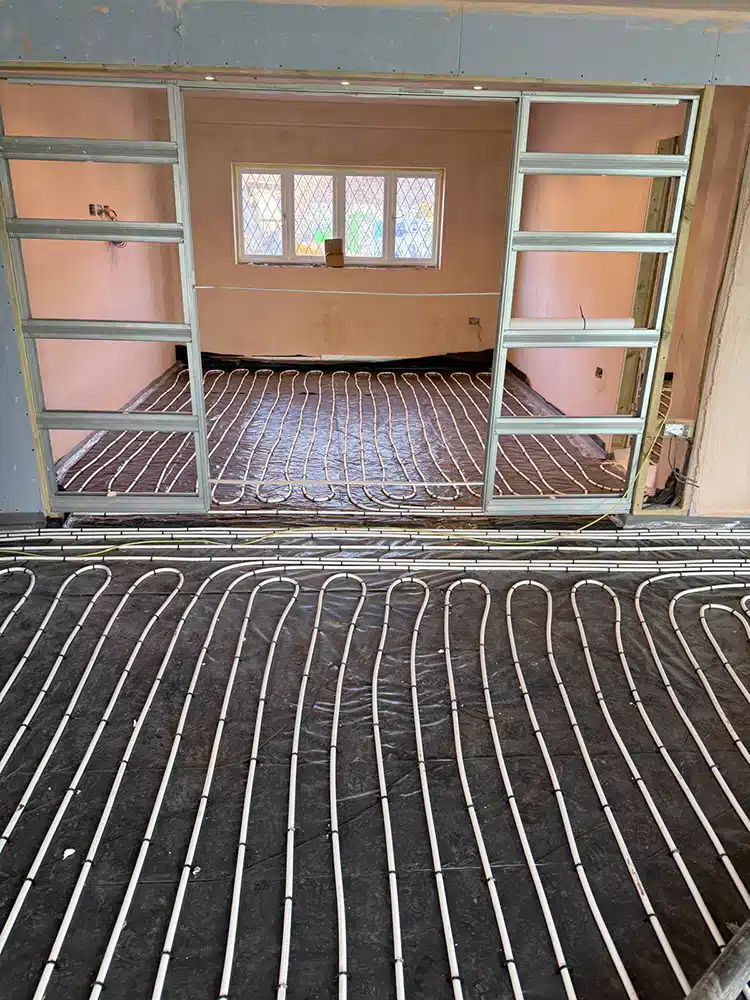
Adding underfloor heating to a house that is already built mostly comes down to finding the height. With 31% of Bedford's homes semi-detached, a typical retrofit is a suburban semi where the ground floor is being opened up and the owners want heating throughout. Insulation, pipes and screed all have to fit under the same door thresholds and the same bottom stair that were there before.
Here the screed you pick makes or breaks it. Pumped liquid wants a minimum of 25mm over the pipes, so about 45 to 50mm in all, while a trowelled cement screed wants about 45mm on top of them and finishes thicker. On a tight retrofit, liquid is often the easier way to keep the insulation thick enough to be worthwhile.
Encapsulation is the other reason. Liquid closes around every pipe and leaves no trapped air, so the warmth spreads through the floor fast and evenly. A hand-laid screed can do the job, but it needs careful compaction around every run of pipe, and any gap left there slows the heat.
Where the old floor is being dug out anyway, check the base and the damp-proofing before anything goes back in. Our liquid screed page for Bedford covers how the pour itself works, and the thickness guide for heated floors goes further into depths and build-ups.
Heated extensions and garden rooms across Bedford
On a Bedford kitchen extension, the same thinking applies at a smaller size. A single-storey kitchen extension is usually the easiest place to add underfloor heating, because the floor is new and its levels can be designed from scratch. The same goes for insulated garden rooms, which need their own insulation, membrane and edge strip before any screed goes in.
After the pour, leave the heating off for a while. Calcium sulphate can usually take warmth from about day 7; sand and cement must sit for 21 days or more first. Commissioning then starts low, with the flow temperature lifted in stages across several days instead of jumping to maximum. You get those stages on paper from us, and your heating engineer carries them out.
Hurry it and the screed can crack or come loose. Take it steadily and the same heating becomes the fastest way to get a calcium sulphate floor dry enough for its covering.
For a heated floor in liquid screed, published prices sit between £20 and £35 per m². For costs in more depth, read how much floor screeding costs, and if tiles or LVT are going on top, our floor levelling in Bedford handles any final smoothing.
Underfloor Heating Screed prices in Bedford
Liquid screed over underfloor heating: £20 to £35 per m² supplied and laid (trade2base, June 2026), so £700 to £1,230 for 35 m². trade2base gives these figures excluding VAT. See our floor screeding cost guide or screed calculator.
Who lays your underfloor heating screed in Bedford
K & B Screeding’s own team, led by director Donatas Bardisevicius. Founded 2019, company 12298780.
See what customers say in our Google reviews and on our testimonials page.
Underfloor Heating Screed from Slough to Bedford
Bedford is about 42.5 miles north of our Slough base as the crow flies, with postcodes including MK40, MK41 and MK42. The nearest towns to it are Kempston (2 miles), Sandy (7.7 miles), Flitwick (9.3 miles) and Biggleswade (9.4 miles).
More on underfloor heating screed, part of our screeding services.
