
Heated extensions and garden rooms at King's Reach
The screed does most of the work in a wet heating system. It holds the pipes in place, spreads their warmth and gives the floor finish a stable base. Get the cover wrong and the floor either cracks over the pipes or heats slowly and in stripes.
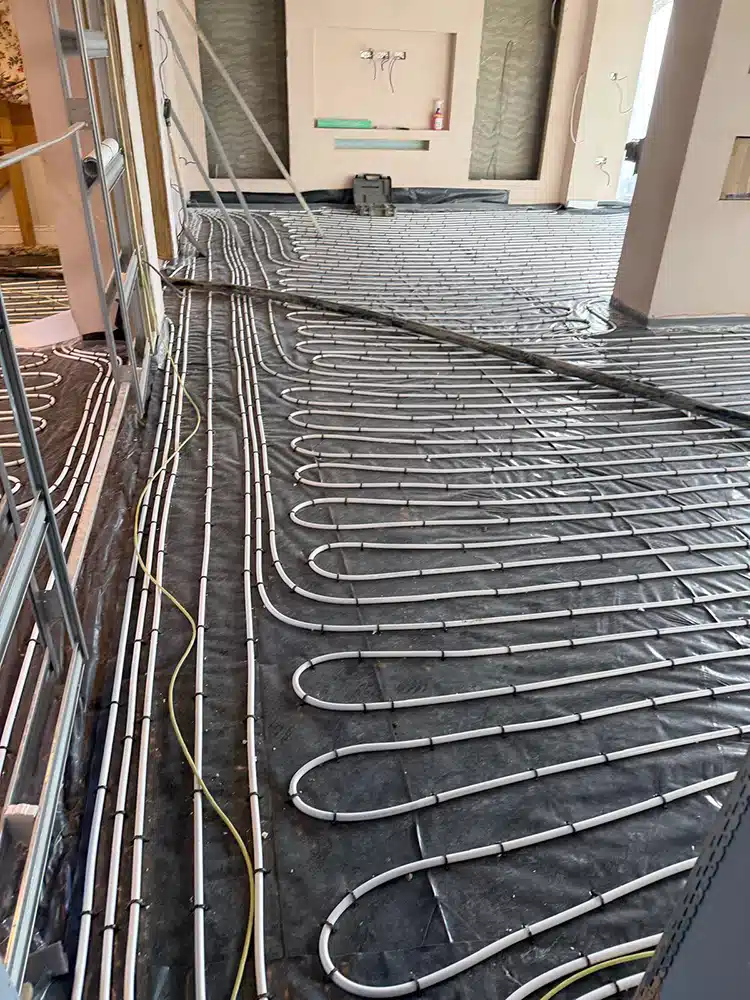
Two rules govern depth. With liquid, the pipes must sit under at least 25mm, so the floor ends up 45 to 50mm deep overall. A hand-laid sand and cement floor needs closer to 45mm over the loops, so it builds up deeper. Liquid tends to have the edge on heated floors because it flows round every pipe with no air pockets, and a thinner, denser layer warms up faster. See liquid screed in Biggleswade for how it is pumped in.
Newer houses around King's Reach suit this well. A kitchen extension or garden room added to one of them can often follow a similar build-up to the house, so the new floor meets the old at the threshold without a step. Homes built between 2000 and 2014, 16% of the town's stock, are another place where a heated extension can match a modern floor construction.
Ahead of pouring we check the insulation, the membrane and the edge strip, or supply them, and the loops should be full and pressurised on the day so a leak would show straight away. Our insulation and membranes service covers that preparation if your builder has not already done it.
Retrofitting heating under older Biggleswade floors
Adding heating to an existing house is trickier, since doors, stairs and neighbouring rooms already dictate where the floor has to finish. Under an older solid ground floor, digging out to make space for insulation, pipes and screed is often the only honest way to fit heating without raising the whole room.
Where height is tight, a flowing screed keeps the build-up down, and a specified alpha hemihydrate product can reduce depth further. Those products follow their own data sheet for minimum thickness, so we work from it.
Heat-up is the step most often rushed. A calcium sulphate floor can normally have its first warmth at about 7 days, whereas a sand and cement one stays cold for at least 21. In both cases, begin with a low flow temperature and nudge it up over several days before any flooring is laid; turning it straight up to full can crack a fresh screed. Our guide to screed drying times goes into more detail.
Thin finishes such as LVT show every ripple, so if the dried floor needs a skim to reach the flatness they demand, floor levelling before LVT is the next step.
Underfloor Heating Screed prices in Biggleswade
Liquid screed over underfloor heating: £20 to £35 per m² supplied and laid (trade2base, June 2026), so £700 to £1,230 for 35 m². trade2base gives these figures excluding VAT. See our floor screeding cost guide or screed calculator.
Who lays your underfloor heating screed in Biggleswade
K & B Screeding’s own team, led by director Donatas Bardisevicius. Founded 2019, company 12298780.
See what customers say in our Google reviews and on our testimonials page.
Underfloor Heating Screed from Slough to Biggleswade
On the map, Biggleswade sits north-north-east of Slough, about 41.7 miles from our base in a straight line (postcodes including SG18), next to Sandy (3.1 miles), Stotfold (5.1 miles), Baldock (7.4 miles) and Letchworth (7.7 miles).
More on underfloor heating screed, part of our screeding services.
