
Adding heating to older Hitchin ground floors
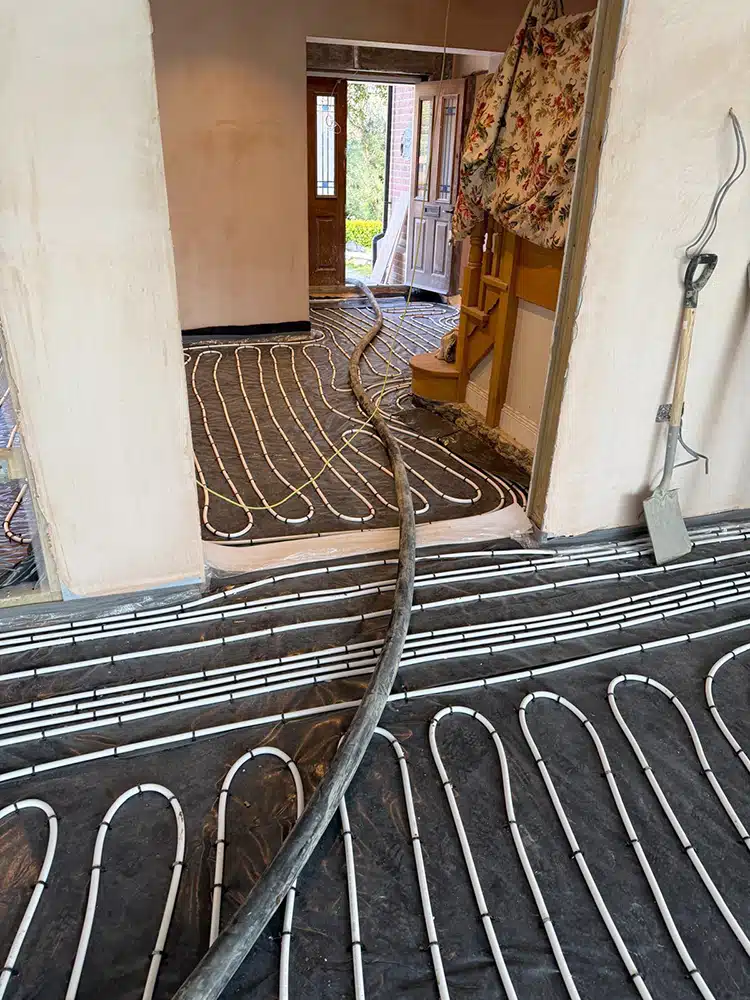
When a Victorian or Edwardian ground floor near the centre is lifted, whether it was suspended timber or early concrete, the new floor is built up from scratch: membrane, insulation, pipes and screed. Including heating at that stage adds little extra work, and it frees the wall space that radiators would otherwise take.
The constraint is height. The finished floor has to meet the old thresholds, so the dig depth must allow for insulation, the pipes and the screed cover above them. Liquid screed must bury the pipes by 25mm or more, which makes roughly 45 to 50mm in all. Sand and cement has to cover them by around 45mm, so the floor ends up thicker. In a tight retrofit, the thinner pumped liquid screed often makes the difference.
What sits under the pipes deserves as much care as the screed on top. Insulation boards should be tight together, the membrane continuous and an edge strip fitted around every wall so the screed can expand. Each gets checked before we pour, and we can provide any that are missing; see insulation and membranes for what we look for.
The pipe test happens before our visit, not after. A leak found at that point costs a fitting, not a floor. It also pays to photograph the pipe layout, so anyone fixing into the floor later knows where the circuits run.
Heated extensions from Hitchin Hill to Oakfield
Detached houses account for 18% of homes, and a heated kitchen or garden room is a natural addition to a larger house. Newer houses may have the heating planned in from day one, though just 5% of homes in the town date from 2015 or later. Whether the house is on Hitchin Hill, in Oakfield or at Lower Green, a heated extension needs the right cover, full encapsulation and a gentle first warm-up.
Switch-on is where problems start. On calcium sulphate the heating can normally come on, gently, around day 7; with sand and cement it stays off for at least 21 days. In both cases the flow temperature is raised in small steps and held, not turned to full on the first day. We leave a written schedule with every heated floor. During the first weeks, keep rugs, boards and furniture off the surface so moisture can escape evenly, and keep the room ventilated.
Minimum depths for every type of screed, commercial floors included, are listed in our guide to screed thickness. Just up the road, we cover heated floor screed in Baldock too.
Underfloor Heating Screed prices in Hitchin
Liquid screed over underfloor heating: £20 to £35 per m² supplied and laid (trade2base, June 2026), so £700 to £1,230 for 35 m². trade2base gives these figures excluding VAT. See our floor screeding cost guide or screed calculator.
Who lays your underfloor heating screed in Hitchin
K & B Screeding’s own team, led by director Donatas Bardisevicius. Founded 2019, company 12298780.
See what customers say in our Google reviews and on our testimonials page.
Underfloor Heating Screed from Slough to Hitchin
On the map, Hitchin sits north-north-east of Slough, about 32.8 miles from our base in a straight line (postcodes including SG5 and SG4), next to Letchworth (2.9 miles), Stevenage (4.7 miles), Baldock (4.8 miles) and Stotfold (5 miles).
More on underfloor heating screed, part of our screeding services.
