
Thin heated screeds in Flitwick renovations
In a Flitwick house that is already lived in, heating is harder to add than on a new build: the doors, stairs and thresholds leave no freedom over where the floor finishes. In a Flitwick renovation, that usually means taking up the old ground floor finish, and often the old screed, to make room for insulation, pipes and a new screed.
A liquid screed helps here. Over the pipes it wants 25mm at minimum, so 45 to 50mm overall. Sand and cement, by contrast, has to bury them under about 45mm, which adds depth. Liquid also surrounds each pipe completely, leaving no trapped air, and that keeps the warmth even across the room. A specified alpha hemihydrate product can reduce the depth further, following its own data sheet.
Because floors from the 1970s to 1990s vary, the first step is checking what sits under the existing finish. Some can be taken down to the slab; others need more work. That check decides how much height is available for the new build-up, and whether the heating can run through the whole ground floor or only part of it.
Newer homes are simpler. Only 8% of Flitwick's homes were built since 2015, and those, along with new plots off Steppingley Road, tend to have modern floor build-ups. For a new single storey extension, see liquid screed for Flitwick floors, and for the layers underneath, our insulation and membranes service.
Commissioning a new heated floor in Flitwick
Warming a new heated floor is done slowly. The first heat can normally go into calcium sulphate about 7 days after pouring, but not into sand and cement until 21 days have passed. The flow temperature begins low, climbs by a few degrees daily and is then held steady before any flooring is fitted. Your heating engineer draws up the timetable; the screed side of it comes from us in writing.
A rushed warm-up puts a new heated floor at risk of cracking. The same applies to flooring: tiles, wood and LVT should not go down until the screed has been dried and tested.
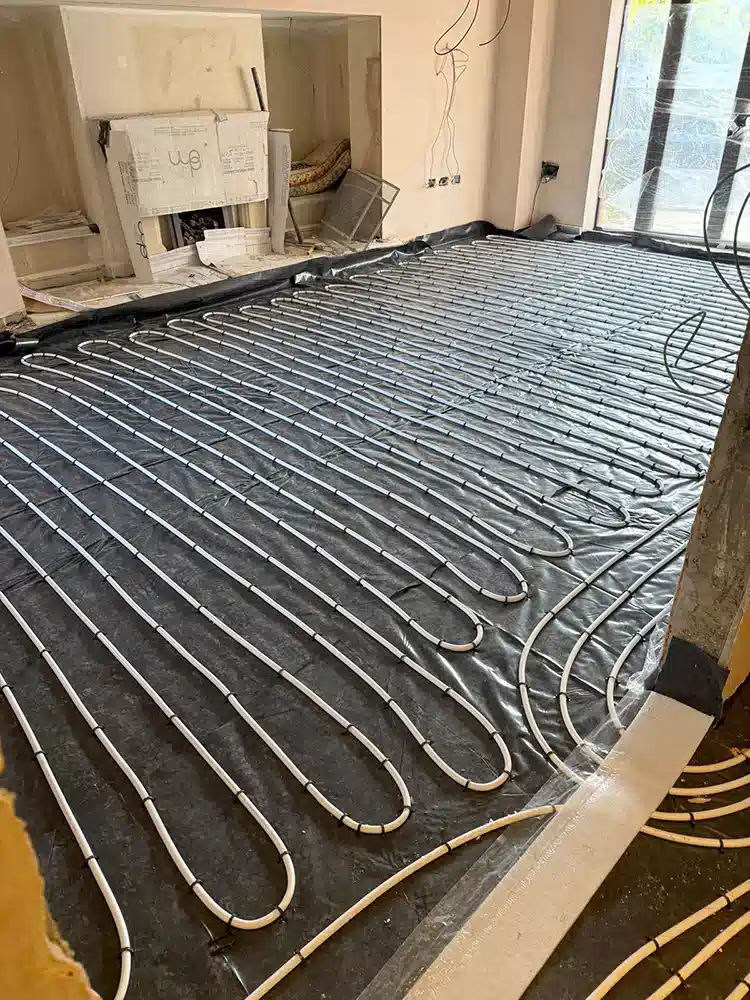
Garden rooms and kitchen extensions follow the same rules as a whole ground floor. The loops should be filled and tested ahead of the pour and kept under pressure, so any leak would be obvious immediately. We either check what has been laid underneath, from insulation to membrane and edge strip, or supply it.
For more on drying, read our screed drying guide. For thin floor finishes over a heated screed, floor levelling may be needed once it is dry.
Underfloor Heating Screed prices in Flitwick
Liquid screed over underfloor heating: £20 to £35 per m² supplied and laid (trade2base, June 2026), so £700 to £1,230 for 35 m². trade2base gives these figures excluding VAT. See our floor screeding cost guide or screed calculator.
Who lays your underfloor heating screed in Flitwick
K & B Screeding’s own team, led by director Donatas Bardisevicius. Founded 2019, company 12298780.
See what customers say in our Google reviews and on our testimonials page.
Underfloor Heating Screed from Slough to Flitwick
As the crow flies, our yard in Slough is about 33.2 miles from Flitwick, which lies to the north. Postcodes here include MK45, and Houghton Regis (6.8 miles), Kempston (7.8 miles), Dunstable (8.1 miles) and Luton (9.2 miles) are close by.
More on underfloor heating screed, part of our screeding services.
