
Specifying anhydrite on Steppingley Road and Froghall Road plots
Each calcium sulphate screed is classed by strength, using codes from the standard covering screed materials. Read the C figure as compressive strength and the F figure as flexural, each in N/mm2. A lightly trafficked domestic floor takes CA-C20-F4, a typical home, apartment or office CA-C25-F5, and a hard-used floor CA-C30-F6. Some drawings name an alpha hemihydrate product to dry sooner or go thinner, in which case its own product sheet governs the work.
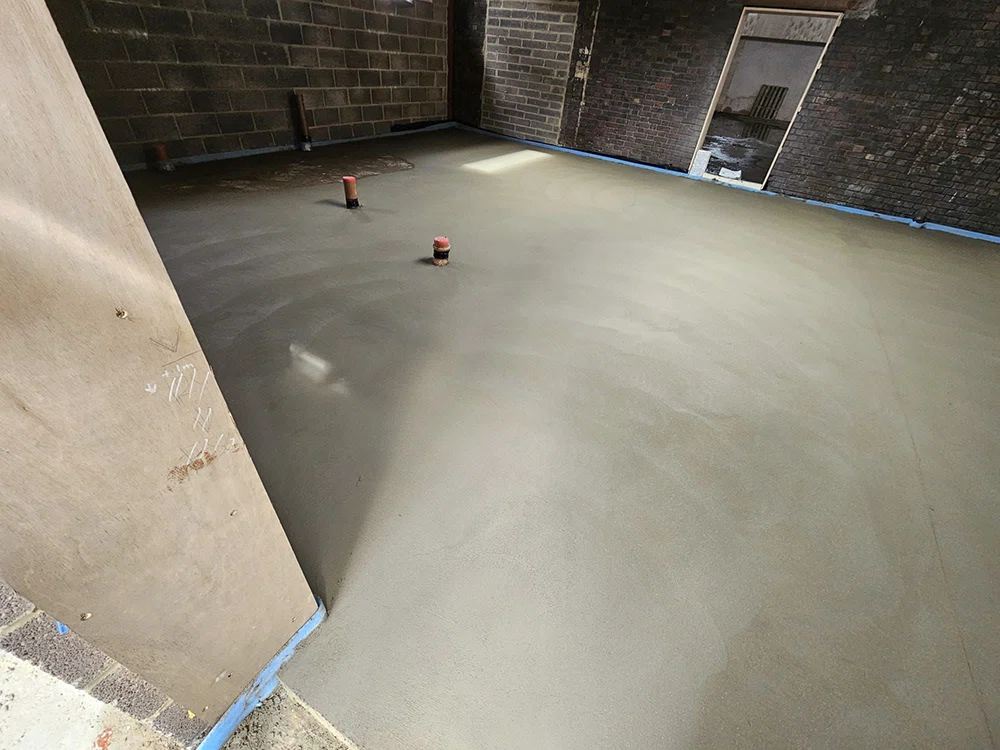
On new plots such as those off Steppingley Road and Froghall Road, the engineer or developer sets the grade, and we pour it to the letter. Its low shrinkage while setting is why new houses suit it: big bays go down with hardly any joints. It flows round heating pipes fully and gives a flat surface for tiles, LVT and wood. Joints that are needed, at thresholds or between heating zones for instance, are set out before we start pumping.
Flats make up 9% of Flitwick's homes, a small share, so apartment floors are a smaller part of the picture. Here the material is more likely to appear in houses on new plots and in heated renovations, where one open ground floor can be poured in a single visit.
Pump access and the wider liquid screed picture are on our Flitwick liquid screed page. Bedford, 9.3 miles away, works to these grades too: see calcium sulphate screed in Bedford.
Finishing anhydrite floors in Flitwick homes
Once the anhydrite is down, there is still finishing to do. Drying leaves a soft film on top, called laitance. Adhesive or compound laid over that film grips the film, not the screed, and can let go. With the screed dry enough to work, we sand that laitance off, vacuum up, and apply a primer designed to work with calcium sulphate.
Moisture testing follows. Many floor covering manufacturers want calcium sulphate drier than they would accept for cement. We test with a hygrometer to confirm the floor is ready, rather than guessing from the calendar. If underfloor heating is fitted, running it from about day 7 can usually force the drying on.
Calcium sulphate has no place in a Flitwick bathroom or any other floor that might get wet. Wet rooms, showers you walk straight into and certain utility floors take a flowing screed made with cement instead, or a sand and cement floor laid by hand. The material is covered in depth in what anhydrite screed is and how it behaves. Your flooring fitter gets a written record from us of the drying, sanding and priming, so nothing is left to guesswork.
Anhydrite & Flow Screed prices in Flitwick
Liquid flowing screed (which includes anhydrite): £24 to £31 per m² supplied and laid (MyJobQuote, August 2026), so £960 to £1,240 for 40 m². MyJobQuote does not say whether these figures include VAT. See our floor screeding cost guide or screed calculator.
Who lays your anhydrite and flow screed in Flitwick
K & B Screeding’s own team, led by director Donatas Bardisevicius. Founded 2019, company 12298780.
See what customers say in our Google reviews and on our testimonials page.
Anhydrite & Flow Screed from Slough to Flitwick
As the crow flies, our yard in Slough is about 33.2 miles from Flitwick, which lies to the north. Postcodes here include MK45, and Houghton Regis (6.8 miles), Kempston (7.8 miles), Dunstable (8.1 miles) and Luton (9.2 miles) are close by.
More on anhydrite screed, part of our screeding services.