
Heat pumps and screed at Tickford Fields
An air source heat pump works most efficiently at low water temperatures, which is why heat pump homes so often use underfloor heating. The large, warm floor gives out heat gently across the room. The screed is the part that holds and spreads that heat, so its depth and contact with the pipes decide how well the system performs.
Pipe cover is the first figure to check. Over the pipes, liquid screed must be at least 25mm deep, so the floor normally totals 45 to 50mm. Hand-laid sand and cement wants around 45mm over them, giving a deeper and heavier floor. On timber frame homes, the weight and depth of the floor are fixed early in the design, and the specification will say which screed the frame is built for.
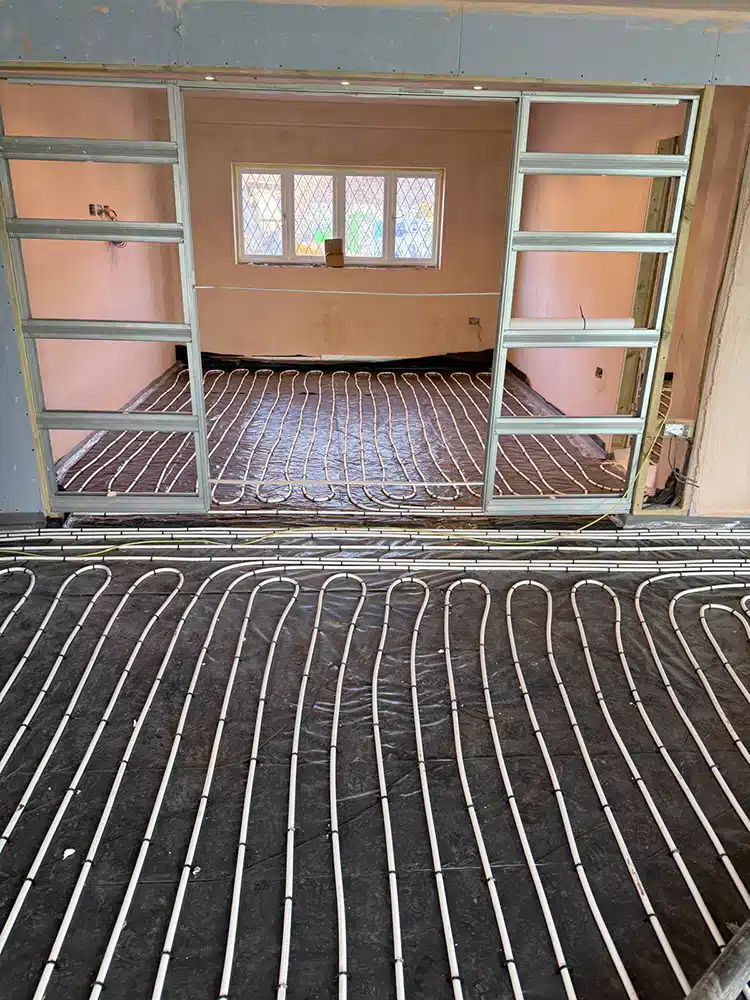
Depth is only half of it; the pipes also have to be fully surrounded. Any air gap around a pipe slows the warm-up and leaves cooler patches. A pumped liquid screed around heating pipes flows under and between them, which is one reason it is common on new heated floors.
On the day we look over what sits under the pipes first, the insulation, the membrane and the edge strip, and bring anything that is missing. Laying the pipes and testing them under pressure is the heating engineer's part, done before we arrive. If the specification for a new home quotes a CA grade for calcium sulphate, our anhydrite screed page explains the code.
Adding underfloor heating to a Newport Pagnell semi
For an existing home, underfloor heating usually arrives with a rear extension or a knock-through kitchen. The problem is height. Insulation, pipes and screed together have to finish at the same height as the floor of the old house. Check the numbers before anything is ordered.
A thinner liquid screed often makes the build-up fit where sand and cement would not. Agree the insulation thickness with the heating engineer at the start. Boards that are too thick leave too little depth for screed over the pipes, while boards that are too thin let heat escape into the ground.
Commissioning is gradual. Heat can normally go into a calcium sulphate floor about 7 days after pouring; sand and cement must be left for 21 days or more. The engineer then lifts the flow temperature gradually, in small steps spread over several days, letting the floor dry evenly without cracking. The heating engineer should record the heat-up for the flooring fitter.
For published prices and what affects them, see our guide to floor screeding cost.
Underfloor Heating Screed prices in Newport Pagnell
Liquid screed over underfloor heating: £20 to £35 per m² supplied and laid (trade2base, June 2026), so £700 to £1,230 for 35 m². trade2base gives these figures excluding VAT. See our floor screeding cost guide or screed calculator.
Who lays your underfloor heating screed in Newport Pagnell
K & B Screeding’s own team, led by director Donatas Bardisevicius. Founded 2019, company 12298780.
See what customers say in our Google reviews and on our testimonials page.
Underfloor Heating Screed from Slough to Newport Pagnell
Newport Pagnell is about 38.5 miles north of our Slough base as the crow flies, with postcodes including MK16 and MK14. The nearest towns to it are Milton Keynes (3.3 miles), Bletchley (6.5 miles), Kempston (9.6 miles) and Flitwick (11.3 miles).
More on underfloor heating screed, part of our screeding services.