
Screed over the heating at Clipstone Park
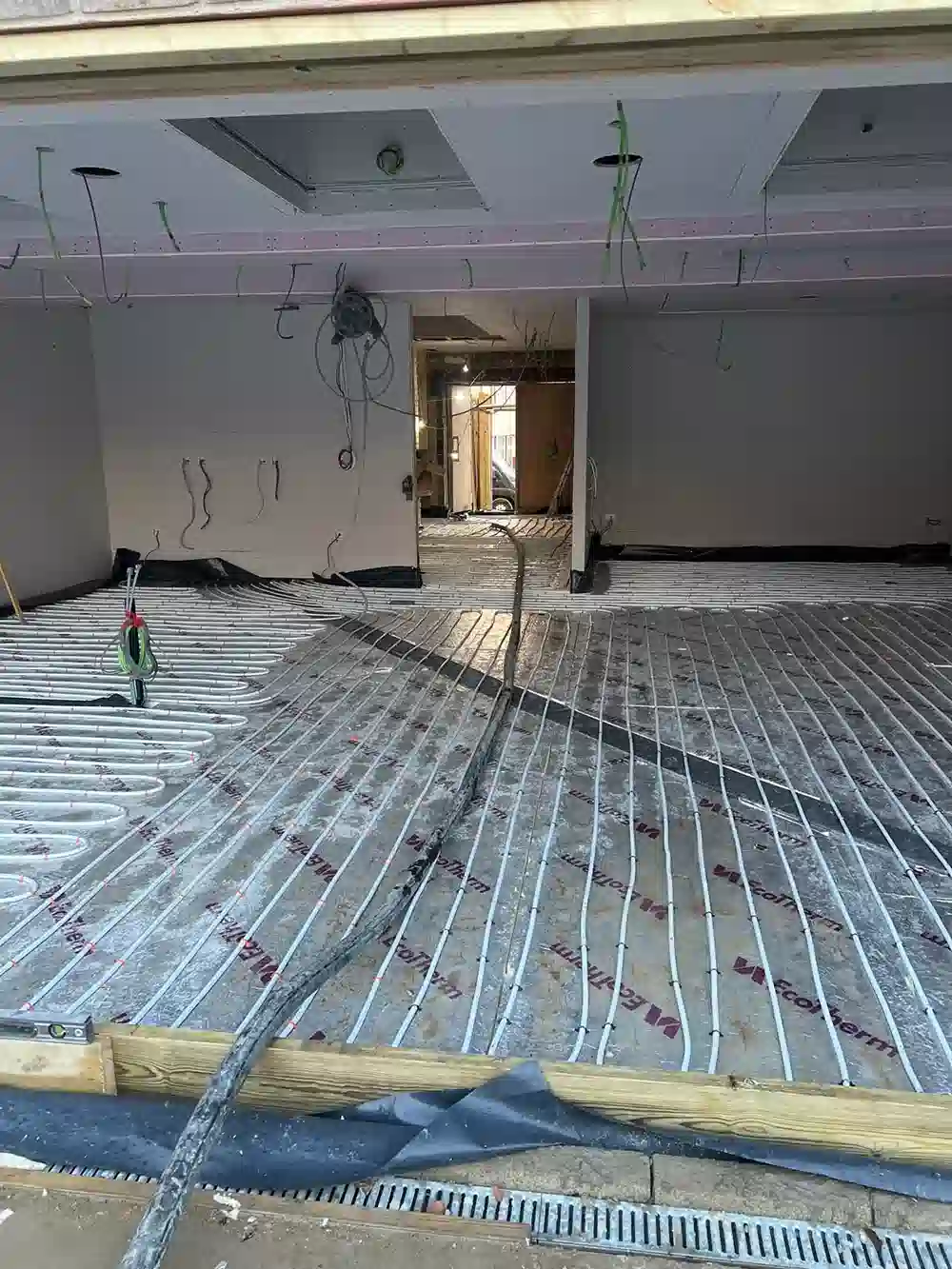
On new plots at Clipstone Park, between Vandyke Road and Stanbridge Road, the ground floor is typically insulated with the heating pipes fixed down across it. The screed covers the pipes, spreads their heat and gives the flooring a flat base.
Cover is the first check. With liquid, there must be 25mm or more above the pipes, so the total depth comes out at roughly 45 to 50mm. Trowelled sand and cement is different: allow about 45mm above the loops. Go thinner than that and the screed may crack along the pipe lines.
The second check is contact. Air pockets around the pipes reduce heat output. A pumped liquid screed runs into every gap around the loops and leaves none behind, which is why new plots commonly specify it.
On the day, we want to find the loops pressure tested and still held under pressure, edge strip fixed along every wall and the membrane joints taped.
Commissioning comes after. Once poured, calcium sulphate will usually accept warmth from roughly a week in, at about 7 days, whereas sand and cement asks for a minimum of 21 days. The temperature is then raised gradually in small steps. If your Clipstone Park drawings quote a calcium sulphate grade, our page on anhydrite grades translates it.
18% of homes in the town were built between 2000 and 2014, and where a house of that age gains a heated extension, the new floor has to be planned to meet the existing one.
Retrofitting underfloor heating in older Leighton Buzzard homes
Adding heating to an existing house is usually harder than building it in. The pipes, insulation and screed all need depth, and an older floor rarely has spare height.
Detached houses are 25% of Leighton Buzzard's homes, and in a larger house the heating is often split into zones across a big ground floor. We plan screed joints to follow the heating circuits so the floor can move without cracking.
In an older Leighton Buzzard house, that usually means taking up the existing floor and rebuilding it from the bottom: insulation, pipes and a new screed set at the right height. Picking liquid for that rebuild saves height, since its pipe cover is thinner than a hand-laid mix demands.
An extension is simpler. Its floor is new, so the heating and screed can be designed together and finished flush with the house. Where the heated floor meets an old one, the threshold may need attention before the flooring.
Laying and testing the loops is for your heating engineer; checking the build-up and screeding over it is down to us. Our guide on drying screed explains how the heating can be used to dry the floor once it is safe to switch on.
Heated floors in Leighton Buzzard apartment blocks
Purpose-built flats make up 15% of Leighton Buzzard's homes, and where an apartment scheme is designed with wet underfloor heating, screeding the floors has its own set of checks.
Weight and depth are tightly controlled on upper floors, so the designer sets the build-up, including any sound insulation layer beneath the heating. Our part is to check that what is on site matches the drawing before the pour, because a thicker insulation board or a raised pipe run eats into the screed depth the designer allowed for. A pumped liquid screed is the usual choice, since the hose can be run up the building rather than carrying material up the stairs.
Each flat is poured as its own area. The edge strip goes around every wall, including internal partitions, so the screed is kept off the walls and can expand when the heating runs. The membrane laps up behind the strip, and joints are formed at doorways where heating zones change.
Sequencing across a block needs thought. The heating installer tests each flat's pipes before we arrive, and the screed is poured flat by flat in the order the site team needs. Commissioning then follows the same order, each flat brought up slowly to temperature, and a moisture reading in each one confirms when the flooring can go down, so handover dates for different flats can be planned separately.
Underfloor heating screed prices in Leighton Buzzard
Liquid screed over underfloor heating: £20 to £35 per m² supplied and laid (trade2base, June 2026), so £700 to £1,230 for 35 m². trade2base gives these figures excluding VAT. See our liquid screed cost per m² guide, the floor screeding cost guide or the screed calculator.
Who lays your underfloor heating screed in Leighton Buzzard
K & B Screeding’s own team, led by director Donatas Bardisevicius. Founded 2019, company 12298780.
See what customers say in our Google reviews and on our testimonials page.
Underfloor heating screed from Slough to Leighton Buzzard
Leighton Buzzard is about 26.6 miles north of our Slough base as the crow flies, with postcodes including LU7. The nearest towns to it are Houghton Regis (6.1 miles), Dunstable (6.2 miles), Bletchley (6.2 miles) and Tring (8.5 miles).
On Leighton Buzzard streets where the screed lorry cannot park off the road, a suspension or dispensation comes from Central Bedfordshire Council (parking suspension and dispensation). We confirm on the quote whether it is needed. For an extension in Leighton Buzzard, the floor usually needs building regulations approval, including Part L insulation in England. Local building control is Central Bedfordshire Council Building Control.
More on underfloor heating screed, part of our screeding services. For every screed we lay locally, see floor screeding in Leighton Buzzard.
Further reading: screed thickness guide and underfloor heating on a concrete floor.
