
Relaying earth floors around Newport Pagnell High Street
In the older houses around the High Street, a solid floor that sits directly on the ground has neither a damp proof membrane nor insulation beneath it. It may feel cold, show damp patches or crack as the ground beneath it moves. Covering it with new flooring rarely lasts, because moisture keeps rising and the surface keeps breaking up.
The lasting fix is to dig the old floor out to a set depth, lay a membrane and rigid insulation, then finish with a floating sand and cement screed. For a house, we lay it at around 65mm, compact it by hand and power float it until it is dense and level. Our floor preparation service covers breaking out and clearing the old floor when that is needed first. Check the depth before digging: it has to make room for the membrane, the insulation and 65mm of screed below the existing threshold.
Sand and cement copes with the awkward parts of an old house: small rooms, narrow doorways and floor levels that change from room to room, since a hand-laid screed can be built to each level in turn. It also works in the kitchens and bathrooms of older houses, where calcium sulphate screed cannot be used in wet areas.
In a listed building or a conservation setting, check with the council before changing floors, since what is permitted may affect the build-up. Adding fibres to the mix helps resist cracking and costs £1 to £3 more for each m².
Small rooms, garages and falls in Newport Pagnell
Not every sand and cement job is in an old house. In newer Newport Pagnell homes, a converted garage, a downstairs shower room or a small utility is often easier to screed by hand than to set up a pump for. A garage slab usually sits low and slopes towards the door, and sand and cement can be laid thicker at one end to bring it level with the hall. Our guide shows how a converted garage floor is built up.
Wet rooms need a floor that falls gently to a drain. That shape is formed by hand, and it needs a cement based screed that tolerates water.
If the slab underneath is in good order, bonding 25 to 40mm of screed directly to the cleaned concrete saves floor height. Floating screeds over insulation are thicker, at 65mm in homes and 75mm on commercial floors.
The cost is drying time. Up to 40mm deep, reckon on a day of drying per millimetre; beyond that each millimetre takes longer. How depth affects drying is set out in our guide to screed depths.
Sand and Cement Screed prices in Newport Pagnell
Sand and cement screed: £18 to £25 per m² supplied and laid (MyJobQuote, August 2026), so £450 to £630 for 25 m². MyJobQuote does not say whether these figures include VAT. See our floor screeding cost guide or screed calculator.
Who lays your sand and cement screed in Newport Pagnell
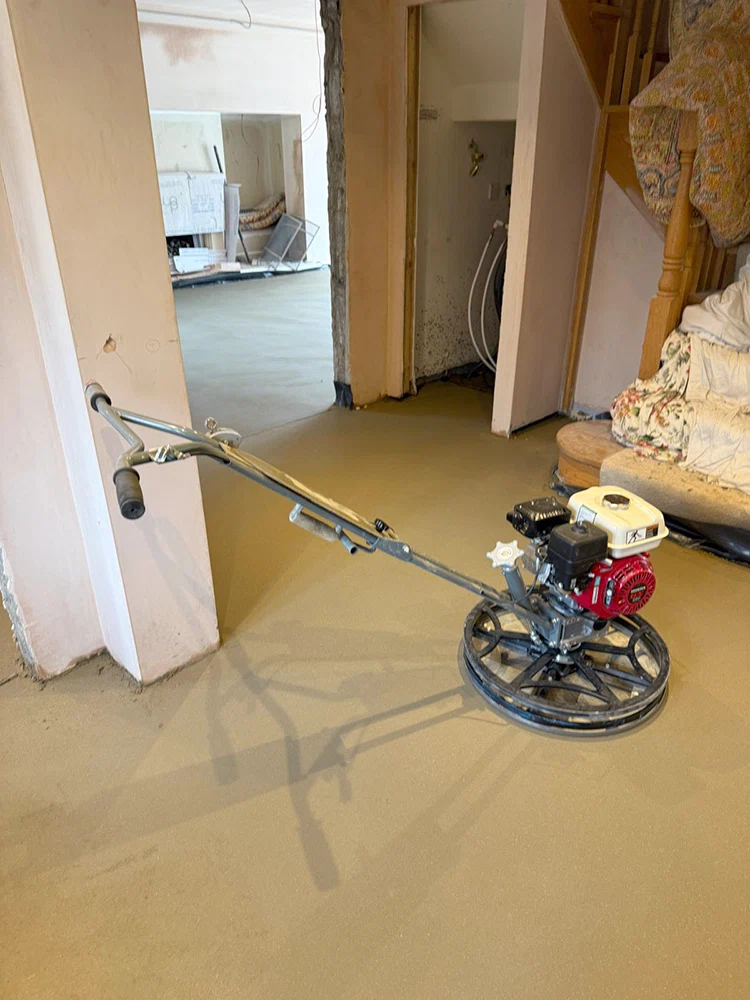
K & B Screeding’s own team, led by director Donatas Bardisevicius. Founded 2019, company 12298780.
See what customers say in our Google reviews and on our testimonials page.
Sand and Cement Screed from Slough to Newport Pagnell
Newport Pagnell is about 38.5 miles north of our Slough base as the crow flies, with postcodes including MK16 and MK14. The nearest towns to it are Milton Keynes (3.3 miles), Bletchley (6.5 miles), Kempston (9.6 miles) and Flitwick (11.3 miles).
More on sand & cement screed, part of our screeding services.
