
Working with period floors in Buckingham's Georgian centre
Only 8% of Buckingham's housing dates from before 1919. The centre itself was rebuilt in Georgian style after the fire, and buildings such as Castle House on West Street and the Town Hall survive among the rebuilding. In a building like that, the first question is not which screed, but whether the floor should be replaced at all.
Often it should not. A local repair to a failed patch, carried out in a way that matches the original construction, is usually kinder to the building than a full new floor. That sort of patching is handled under screed repairs.
Where a solid floor has failed completely, it is dug out and rebuilt. A compacted base, a membrane and insulation go in, then a floating sand and cement screed of about 65mm in a home. On a sound slab that only needs a new top, a bonded screed of 25 to 40mm can be fixed directly to it. For how we arrive at a depth, read the thickness guide for screed.
Sand and cement suits these buildings because it is so adaptable. Rooms are often small and out of square, doorways are narrow, and floors may need to meet old thresholds at different heights. A hand-laid screed can be built up or thinned out as the room demands, which a self-levelling product cannot do. It also needs no pump outside the door.
Terraces, wet rooms and garages around Buckingham
Terraced houses make up 22% of Buckingham's homes. Their back rooms, kitchens and bathrooms are typical sand and cement jobs, being small, awkward to reach and often needing a cement base.
A wet room floor must fall towards its drain, and those falls are formed by hand in sand and cement. A cement base is also what such a room needs, since calcium sulphate does not tolerate water.
Garage conversions are another. Garage slabs tend to be a step down from the house, so the floor is insulated, sealed and screeded up to hall level. The layers are listed in our guide to converting a garage floor.
Expect it to dry more slowly than a pumped floor, at about a day for each millimetre up to 40mm. Adding fibres costs £1 to £3 more per m² and helps resist cracking, while a faster drying mix cuts the wait on a tight programme.
This screed can also take load earlier than some alternatives, which helps when builders need to carry on working in the room. Where a floor will carry heavy equipment, such as a workshop in a converted outbuilding, a higher strength screed is available.
Sand and Cement Screed prices in Buckingham
Sand and cement screed: £18 to £25 per m² supplied and laid (MyJobQuote, August 2026), so £450 to £630 for 25 m². MyJobQuote does not say whether these figures include VAT. See our floor screeding cost guide or screed calculator.
Who lays your sand and cement screed in Buckingham
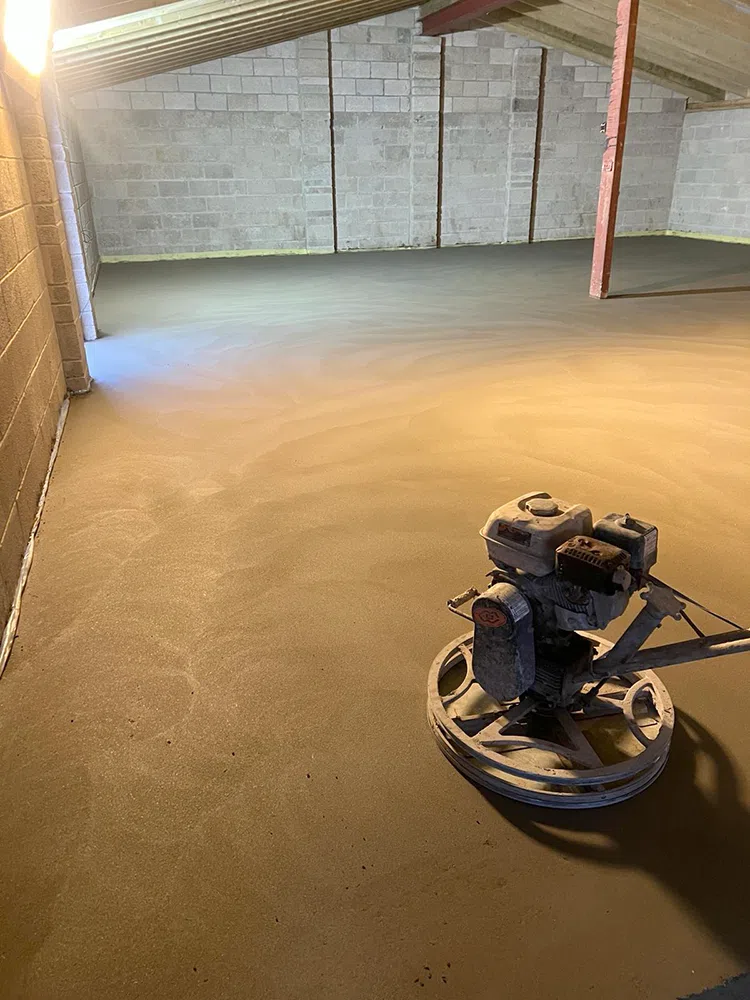
K & B Screeding’s own team, led by director Donatas Bardisevicius. Founded 2019, company 12298780.
See what customers say in our Google reviews and on our testimonials page.
Sand and Cement Screed from Slough to Buckingham
As the crow flies, our yard in Slough is about 35.6 miles from Buckingham, which lies to the north-north-west. Postcodes here include MK18, and Brackley (7.1 miles), Towcester (9 miles), Bicester (10.1 miles) and Milton Keynes (10.3 miles) are close by.
More on sand & cement screed, part of our screeding services.
