
Replacing tired floors in Bure Park and Langford Village
Much of the housing in Bure Park and Langford Village dates from the 1970s to the 1990s, and those ground floors commonly have a cement and sand screed laid on a concrete slab. After thirty or more years, that screed can crack, lose its bond or sound hollow when tapped. The fix depends on how far the damage goes.
Where a patch has failed, screed repairs may be enough. Where the whole floor is breaking up, it is dug out and relaid. On a renovation that also adds insulation, the new build-up needs care, because it must finish at the same height as the rooms around it.
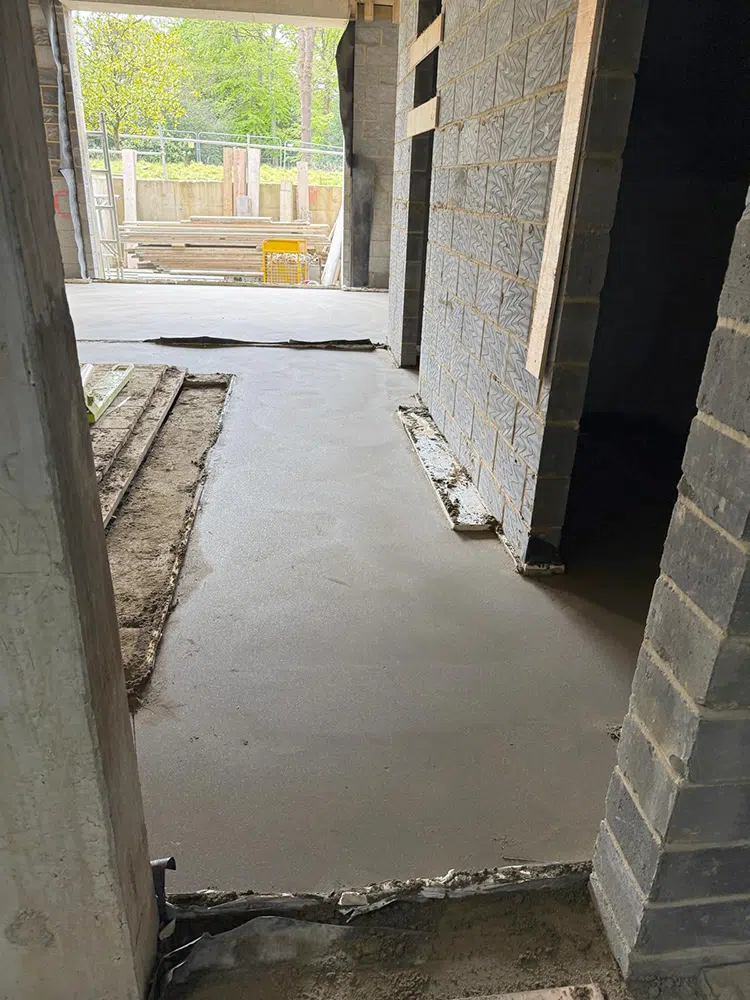
Laid floating on insulation, a traditional screed goes down at 65mm in a home and 75mm in commercial premises. Where height is short, bonding the screed directly onto a sound slab lets it come down to 25 to 40mm. We compact the mix and finish it flat by hand, then power float where the area allows.
This material also suits jobs a flowing screed cannot do well. Small rooms with several doorways, cloakrooms and utility rooms are quicker to lay by hand than to dam and pump. In a wet room the floor has to slope to the drain, and a cement mix can be formed to that slope. It also helps where a floor has to bear weight soon after laying, a converted garage being the usual example. Mixing fibres in, as with fibre reinforced sand and cement, makes the floor less prone to cracking.
Garages and older Bicester houses: depth and drying
Only 3% of Bicester's homes were built before 1919, but those that were often have solid floors with no damp proof membrane at all. When one of those floors is lifted, the rebuild usually means new hardcore, a membrane, insulation where height allows, and a fresh cement screed on top. The same approach suits the odd inter-war house in the town.
Garage conversions are a frequent use for a traditional screed. The existing slab usually sits lower than the house floor, and it may slope towards the door. We lay insulation and a membrane where needed and bring the screed up to meet the hallway. Our article on screeding a converted garage runs through each stage and the depths involved.
Plan for drying time. Hand-laid screed is slower to dry than a pumped one, at around a day per mm through the first 40mm and slower again beyond that. So at 65mm you are looking at weeks before flooring that dislikes moisture can go down, and a hygrometer reading of relative humidity tells you when the floor is ready. Quick drying additives shorten that when a programme is tight.
As a guide, 2026 published UK rates for this kind of screed run from £18 to £25 per m². If the floor underneath is sound but uneven, levelling an existing Bicester floor may be all it needs.
Sand and Cement Screed prices in Bicester
Sand and cement screed: £18 to £25 per m² supplied and laid (MyJobQuote, August 2026), so £450 to £630 for 25 m². MyJobQuote does not say whether these figures include VAT. See our floor screeding cost guide or screed calculator.
Who lays your sand and cement screed in Bicester
K & B Screeding’s own team, led by director Donatas Bardisevicius. Founded 2019, company 12298780.
See what customers say in our Google reviews and on our testimonials page.
Sand and Cement Screed from Slough to Bicester
As the crow flies, our yard in Slough is about 33.3 miles from Bicester, which lies to the north-west. Postcodes here include OX26, and Kidlington (7.8 miles), Brackley (9.4 miles), Buckingham (10.1 miles) and Oxford (11 miles) are close by.
More on sand & cement screed, part of our screeding services.