
Setting out stepped floors on Hardwick and Bretch Hill
A house built into a slope often has a floor that changes height between rooms, or even within one room. Getting a screed right there starts long before any mixing. We take levels from fixed datum points, mark the finished height of each area, and check them against door thresholds, stair treads and the level of any new extension.
On a split-level floor like that, a hand-laid cement screed is the natural choice. It is placed and compacted by hand, so each level can be screeded to its own height with a clean edge at the step, and there is no risk of a flowing material finding its way down to the lower level. It also copes well with small rooms, narrow openings and awkward corners.
On insulation in a house we lay it floating at about 65mm. If the concrete already there is sound and the floor only has to rise a little, a 25 to 40mm layer bonded straight to the prepared slab may do instead. The screed thickness guide explains how the right depth is chosen.
Older homes need the same care. Homes built before 1919 are 9% of Banbury's housing. When one of their old solid floors gives up, we dig it out and start again: insulation first, then a membrane, then fresh screed.
Drying is slower than with a pumped screed. Give each of the first 40mm about a day and the rest longer still, so a 65mm floor needs several weeks before anything is laid on it.
Wet rooms, garages and quick drying mixes in Banbury
However small the room, a few spaces in a Banbury house call for cement. A wet room is the obvious one: we can slope a hand-laid floor down to a drain, and it copes with water in a way calcium sulphate does not. We form the falls by hand, ready for tanking and tiling.
Garage conversions are another. Expect the old garage slab to sit a step below the house; we raise it in layers of insulation, membrane and screed until it lines up with the hall or kitchen. Each layer is explained in screeding a converted garage.
Where a floor needs to take load early, such as a room where other trades will be working soon after, a cement screed is the safer base.
We can change the recipe, too. Adding fibres for crack resistant screed costs £1 to £3 more per m², and a fast drying mix brings the flooring date forward at £20 to £28 per m², where the standard hand-laid floor is £18 to £25.
For a large open room rather than a small or stepped one, compare this with the pumped liquid screed option, which is thinner and quicker to lay over a wide area.
Sand and Cement Screed prices in Banbury
Sand and cement screed: £18 to £25 per m² supplied and laid (MyJobQuote, August 2026), so £450 to £630 for 25 m². MyJobQuote does not say whether these figures include VAT. See our floor screeding cost guide or screed calculator.
Who lays your sand and cement screed in Banbury
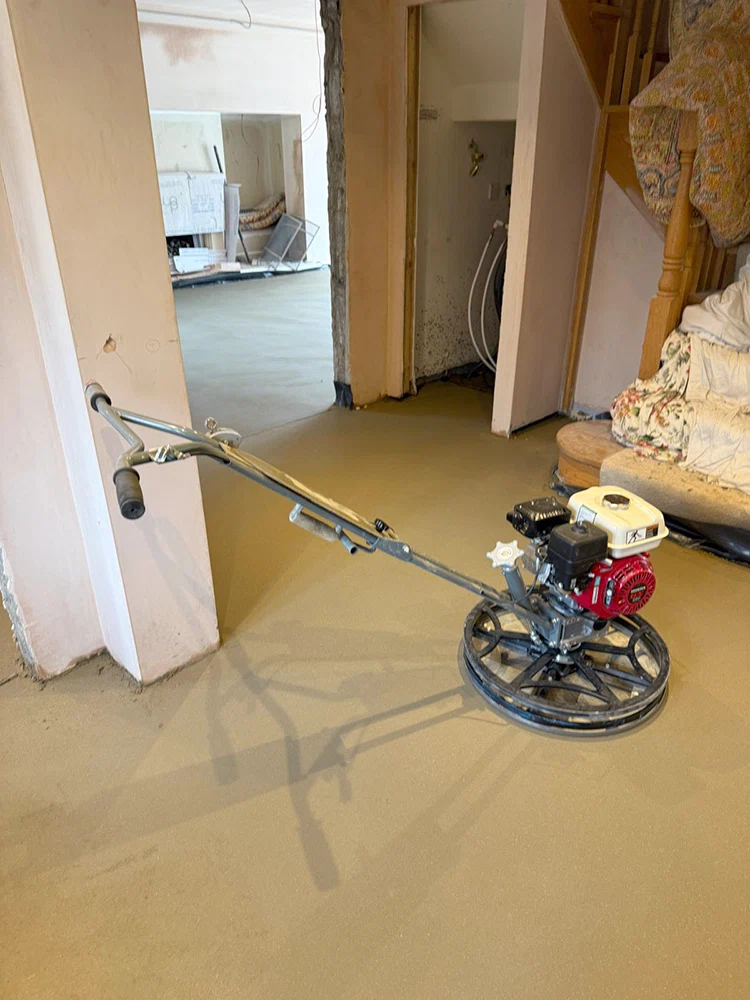
K & B Screeding’s own team, led by director Donatas Bardisevicius. Founded 2019, company 12298780.
See what customers say in our Google reviews and on our testimonials page.
Sand and Cement Screed from Slough to Banbury
On the map, Banbury sits north-west of Slough, about 47 miles from our base in a straight line (postcodes including OX16), next to Brackley (8.3 miles), Bicester (13.8 miles), Buckingham (15.4 miles) and Daventry (15.4 miles).
More on sand & cement screed, part of our screeding services.
