
Rebuilding older floors in Stratford-upon-Avon with sand and cement
A ground floor in an older Stratford house that has cracked, dropped or let damp through is seldom worth patching. Breaking it out is normal, followed by insulation, a membrane and then new screed over the lot. In Stratford-upon-Avon that tends to apply to homes built before 1919 and between the wars, along with post-war houses whose original floors are now tired.
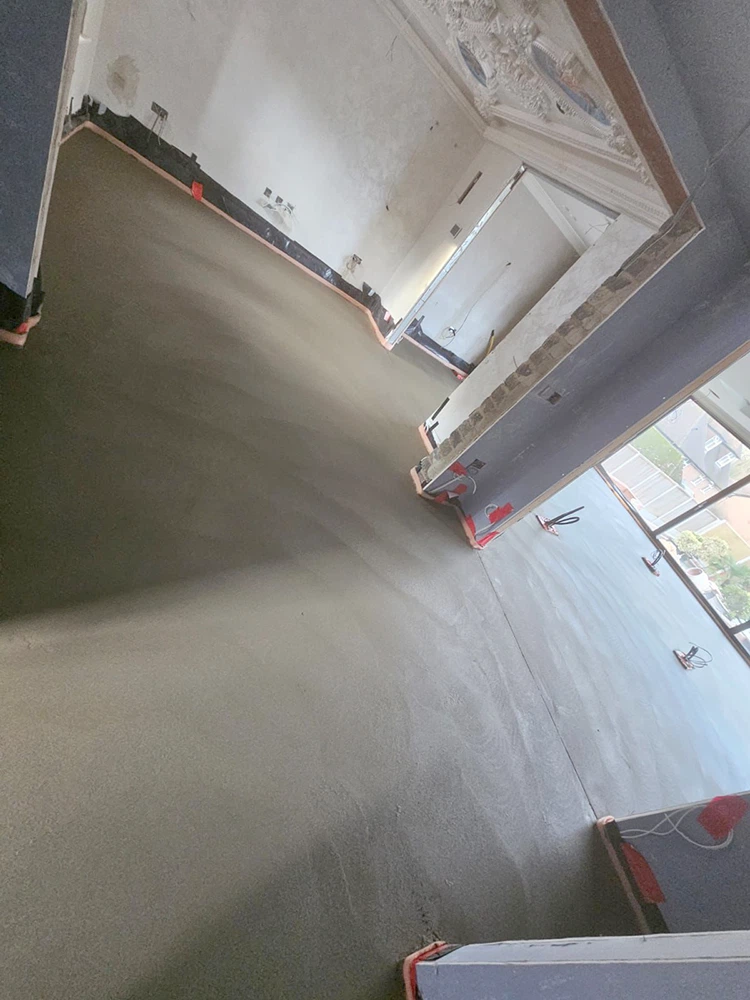
Sand and cement is mixed on site, so each batch suits the area and depth being laid. Once down, it is packed tight and trowelled to a hard, level face. That makes it practical in small rooms, hallways and the odd shapes older houses produce, where setting up a pump for a few square metres would not make sense.
Depth depends on the build. Over insulation, a house floor takes 65mm of floating screed and a commercial one 75mm. Bonded straight onto sound concrete, it can be just 25 to 40mm thick, useful when old doors and thresholds leave no room to build up. Our bonded screed service explains that method.
The listed and timber-framed buildings of the historic centre are a separate case. A heavy screed is not always appropriate there, and consent conditions may decide the build-up, so a thinner system is often the better route. We will say so plainly when it is.
For how depth affects strength and drying, read our screed thickness guide.
Wet rooms, garages and falls in Stratford-upon-Avon homes
Sand and cement is a cement screed, and that matters in rooms that get wet. A wet room, a walk-in shower or a utility that could one day suffer a leak should sit on cement, because calcium sulphate screed does not belong where water can reach it. Being laid by hand, it can also be shaped to slope slightly toward a floor drain.
Then there are garages. Turning one into a room normally involves lifting the floor level, adding insulation and screeding up to meet the house, and the order of work is set out in our guide to screeding a garage floor. A workshop that will carry weight early needs a cement base, and adding fibres through fibre reinforced screed toughens it for £1 to £3 more per m².
Stratford owners should weigh one drawback, which is the wait. Hand-laid cement screed is slower to dry than a liquid one, losing its moisture at about one millimetre daily through the first 40mm and slower past that, so 65mm means weeks of waiting. For a large, open room, liquid screed in Stratford-upon-Avon can be quicker. Where speed matters on a cement floor, quick drying mixes are available.
Sand and Cement Screed prices in Stratford-upon-Avon
Sand and cement screed: £18 to £25 per m² supplied and laid (MyJobQuote, August 2026), so £450 to £630 for 25 m². MyJobQuote does not say whether these figures include VAT. See our floor screeding cost guide or screed calculator.
Who lays your sand and cement screed in Stratford-upon-Avon
K & B Screeding’s own team, led by director Donatas Bardisevicius. Founded 2019, company 12298780.
See what customers say in our Google reviews and on our testimonials page.
Sand and Cement Screed from Slough to Stratford-upon-Avon
On the map, Stratford-upon-Avon sits north-west of Slough, about 64.4 miles from our base in a straight line (postcodes including CV37), next to Warwick (8 miles), Royal Leamington Spa (10 miles), Kenilworth (11.7 miles) and Evesham (12.4 miles).
More on sand & cement screed, part of our screeding services.