
Relaying old floors near Tewkesbury Abbey and the rivers
Homes built before 1919 make up 14% of Tewkesbury's stock, and the most distinctive are the medieval and Tudor timber-framed buildings along the High Street near Tewkesbury Abbey. Solid floors in old buildings like these have often cracked, sunk or never had a membrane at all.
Normally the old slab is broken up and carted away, then a damp proof layer and insulation are put in, with fresh screed laid over them by hand. Because of the flood risk here, the level of that membrane and the finished floor height need extra care, and the details should be agreed with your designer before the screed is priced. That groundwork can be part of our job too, as set out under membranes and insulation.
Sand and cement also works well in the kinds of spaces older buildings are full of: small rooms, awkward doorways and rooms that step up or down. It is mixed in batches to suit each area and depth, so a small job does not need a pump lorry.
Laid floating, a cement screed is around 65mm thick in houses and 75mm in commercial buildings. Bonded straight onto sound concrete it can drop to 25 to 40mm, handy in an old building where the door thresholds leave little room. If the existing floor is basically sound and only uneven, levelling the floor instead may save digging it out.
Wet rooms, garages and falls in Tewkesbury
Cement is the right base wherever a floor will get wet. Showers, wet rooms and utilities need the floor sloping towards the drain, and those falls are shaped with a trowel in sand and cement. Calcium sulphate screed is not suitable in these areas, so even on a house with a flowing screed elsewhere, the wet areas are usually done in sand and cement.
Garage conversions also tend to call for it. Garage slabs usually sit below the house floor, so this screed must raise the level as well as cover fresh insulation. Read screeding a garage floor for how the layers stack up.
It is slower to dry than a pumped floor: for the first 40mm budget about one day per mm, and longer after that. If the build cannot wait, a fast drying screed mix cuts that time down, and fibres to resist cracking add £1 to £3 per m².
Expect £18 to £25 a square metre for a hand-laid floor, going by the published 2026 rates for the UK. If the job is in Gloucester, see sand and cement screed in Gloucester.
Sand and Cement Screed prices in Tewkesbury
Sand and cement screed: £18 to £25 per m² supplied and laid (MyJobQuote, August 2026), so £450 to £630 for 25 m². MyJobQuote does not say whether these figures include VAT. See our floor screeding cost guide or screed calculator.
Who lays your sand and cement screed in Tewkesbury
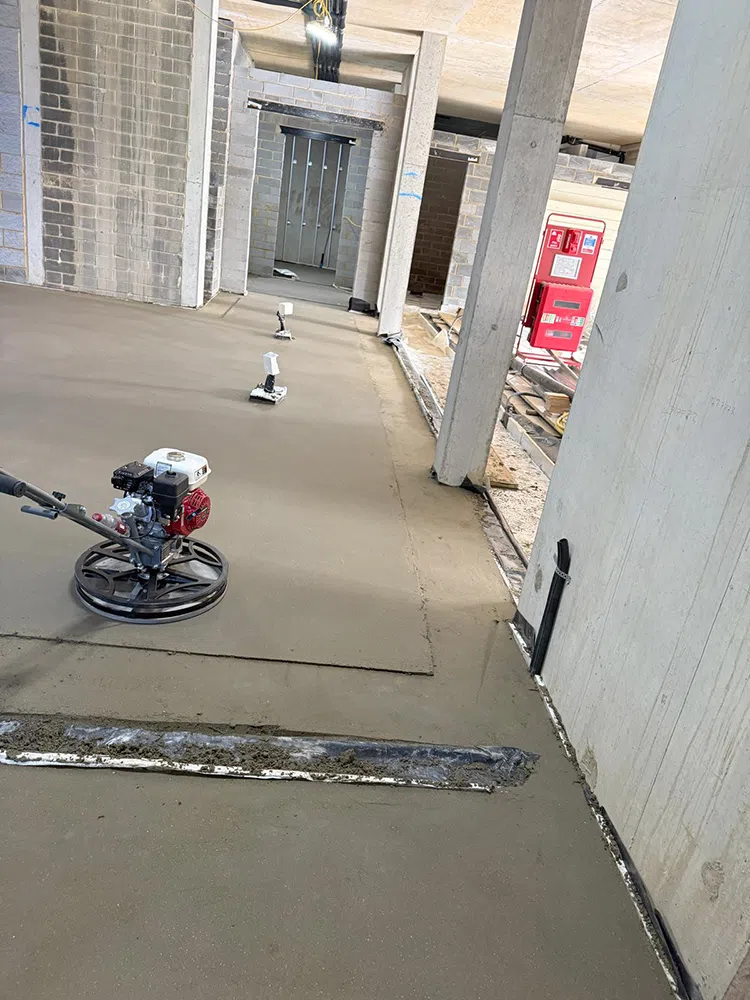
K & B Screeding’s own team, led by director Donatas Bardisevicius. Founded 2019, company 12298780.
See what customers say in our Google reviews and on our testimonials page.
Sand and Cement Screed from Slough to Tewkesbury
On the map, Tewkesbury sits west-north-west of Slough, about 72.3 miles from our base in a straight line (postcodes including GL20), next to Cheltenham (7.2 miles), Gloucester (9.6 miles), Evesham (11.3 miles) and Stroud (17.3 miles).
More on sand & cement screed, part of our screeding services.
