
Basements and ground floors in Montpellier and Pittville
Below stairs in a Montpellier or Pittville townhouse, the floor is rarely simple. Many were laid with no damp-proof membrane, so moisture comes up through the floor and spoils any finish put on it. Turning one of these rooms into usable space starts with taking the old floor out and deciding how damp will be managed.
That decision has to respect the walls. Lime-built walls need to release moisture, and a new floor that seals the ground completely can push damp sideways into them. The membrane, insulation and screed must be detailed at the edges with that in mind, and in some cases a specialist damp or basement design comes first.
With the layers settled, a sand and cement floor laid by hand normally makes most sense down there. It is cement based, so it tolerates damp conditions that would weaken a calcium sulphate screed, and it can be laid in small batches around steps and alcoves. Floated on insulation, a domestic floor goes down at about 65mm, because anything thinner is liable to crack. Bond it straight onto solid concrete instead and 25 to 40mm can work.
Houses built between the wars account for 9% of Cheltenham's homes, and their ground floors can also need rebuilding when they crack or sink. For how we pick each depth, read our guide to screed depths. Clearing and readying the old base is part of our preparation work before screeding.
Wet rooms and small rooms in Cheltenham houses
Being cement based, this screed copes with water, so it goes under Cheltenham bathrooms being turned into wet rooms. We shape the slope to the drain into the screed itself, which hands your tiler a true fall to follow.
Small rooms suit the method too. Terraced houses make up 21% of Cheltenham's homes, and a cloakroom, utility or single ground floor room in one of them rarely justifies setting up a pump. A hand-laid screed can be mixed and placed from a few bags at a time.
A floor facing heavy loads, or one you want better protected against cracks, can take fibres in the mix at an extra £1 to £3 per m². To judge whether your floor needs them, see fibre mixes for screed. Hand-laid sand and cement itself is priced at £18 to £25 per m² across the UK in 2026.
What you trade is time. At 65mm, the floor takes much longer to dry than a thin pumped one, so on a tight programme ask about a quick drying mix.
Sand and Cement Screed prices in Cheltenham
Sand and cement screed: £18 to £25 per m² supplied and laid (MyJobQuote, August 2026), so £450 to £630 for 25 m². MyJobQuote does not say whether these figures include VAT. See our floor screeding cost guide or screed calculator.
Who lays your sand and cement screed in Cheltenham
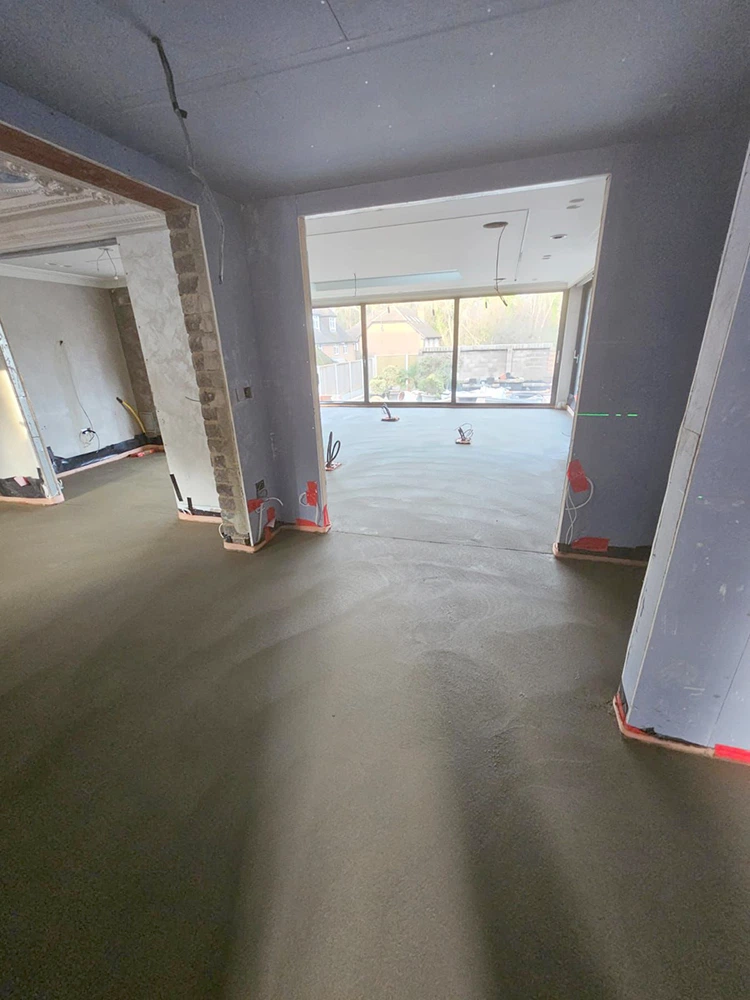
K & B Screeding’s own team, led by director Donatas Bardisevicius. Founded 2019, company 12298780.
See what customers say in our Google reviews and on our testimonials page.
Sand and Cement Screed from Slough to Cheltenham
On the map, Cheltenham sits west-north-west of Slough, about 66.5 miles from our base in a straight line (postcodes including GL50, GL51, GL53 and GL52), next to Tewkesbury (7.2 miles), Gloucester (7.7 miles), Stroud (12.3 miles) and Cirencester (13.5 miles).
More on sand & cement screed, part of our screeding services.
