
Rebuilding floors in Cirencester's Cotswold stone cottages
Stone buildings have a long history here. The wool trade paid for the Church of St John the Baptist and the Cotswold stone buildings on Castle Street, and in Cirencester 16% of homes were built before 1919. Many of the older cottages near the centre sit on flagstones or solid floors with no membrane underneath.
Those floors behave differently from modern ones. Moisture in the ground rises into the floor and evaporates from the surface. Cover that surface with an impermeable build-up and the moisture moves sideways into the walls. So before any screed is laid, the floor build-up has to be planned with breathability in mind, which sometimes means a breathable build-up designed for the house and sometimes means a full dig out with insulation and a carefully detailed membrane.
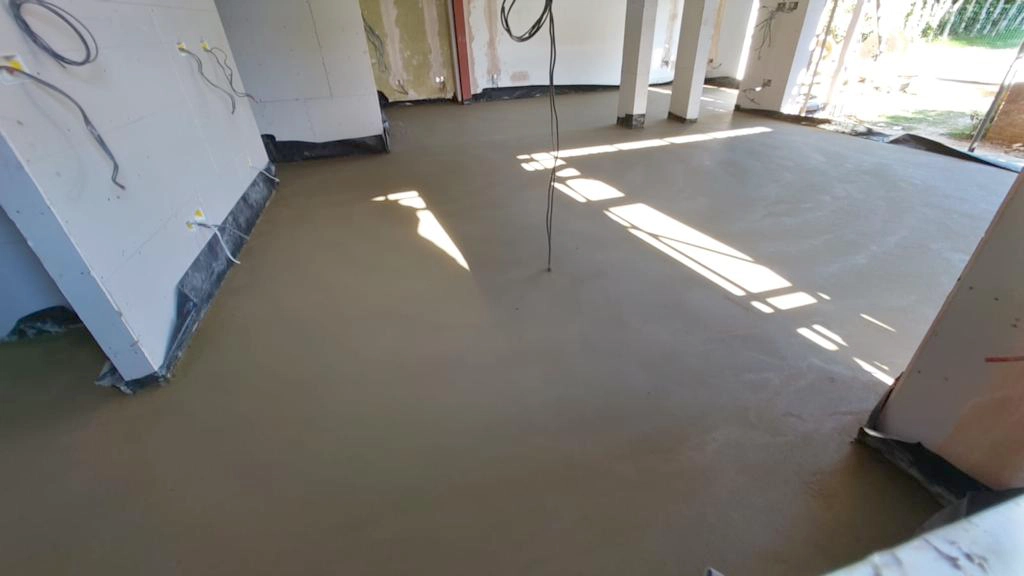
Once a cottage floor has been dug out and rebuilt, the new screed on top is normally sand and cement. It is mixed on site to suit each area and depth, it copes with small rooms, awkward thresholds and uneven walls, and it can be bonded, unbonded or floating. Where it floats over new insulation, a home needs 65mm of it and a commercial floor needs 75mm. Bond it straight onto a sound slab and 25 to 40mm will do, which is how our bonded screeds are laid.
Hand laying also suits the scale of these jobs. A cottage floor is often a few small rooms with thresholds between them, and screed barrowed in and ruled room by room fits that better than a pump.
Wet rooms, garages and slower drying in Cirencester
Sand and cement is the screed to choose wherever water is part of the room. A shower you walk into, or a full wet room, has to fall to its drain, and with a traditional mix we shape that gradient by hand as the floor goes in. Calcium sulphate screed cannot be used in those areas, so a cement substrate is the safe base for tanking and tiles.
Turning a garage into a room is the other job it handles well. A garage slab is often lower than the house floor and may not have insulation, so the build-up has to bring it up to level while adding what the new room needs. Our guide to screeding a garage floor sets out that build-up.
The trade-off is drying. Each mm of the first 40mm needs about a day to dry and the rest takes longer still, so a 65mm cottage floor will be weeks away from most finishes. Where that wait is a problem, a rapid drying additive shortens it; the choices are on our quick drying screed page. Fibres can also be added to reduce cracking, typically adding £1 to £3 per m².
For the same work about 10.9 miles away, see sand and cement screed in Stroud.
Sand and Cement Screed prices in Cirencester
Sand and cement screed: £18 to £25 per m² supplied and laid (MyJobQuote, August 2026), so £450 to £630 for 25 m². MyJobQuote does not say whether these figures include VAT. See our floor screeding cost guide or screed calculator.
Who lays your sand and cement screed in Cirencester
K & B Screeding’s own team, led by director Donatas Bardisevicius. Founded 2019, company 12298780.
See what customers say in our Google reviews and on our testimonials page.
Sand and Cement Screed from Slough to Cirencester
As the crow flies, our yard in Slough is about 58.3 miles from Cirencester, which lies to the west-north-west. Postcodes here include GL7, and Stroud (10.9 miles), Royal Wootton Bassett (12.4 miles), Swindon (13.3 miles) and Cheltenham (13.5 miles) are close by.
More on sand & cement screed, part of our screeding services.
