
Relaying old floors in Swindon's Railway Village terraces
The railway village that the Great Western Railway built for its workers still stands near the old works, and Victorian terraces spread out around it and the town centre. When these houses are renovated, the ground floor is often taken right back. A cracked, damp or uneven solid floor is broken out, and a new concrete base goes in with a damp proof membrane and insulation before the screed.
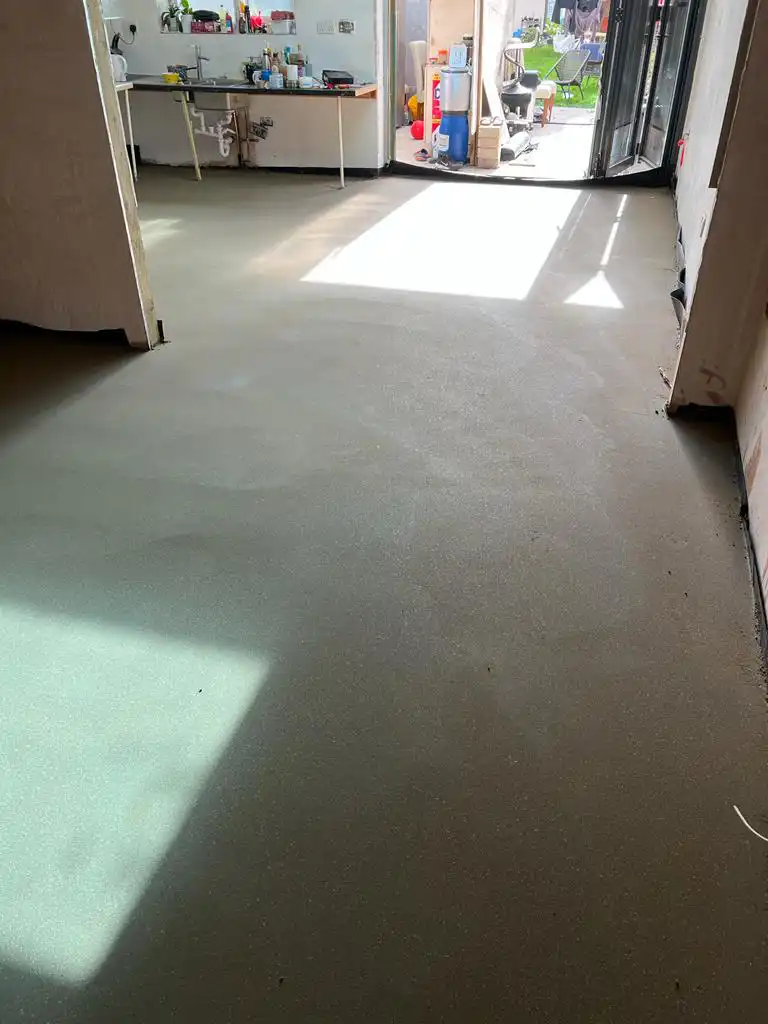
Sand and cement is usually the right screed for that job. It is mixed on site to the depth each room needs, so it can follow small changes in level between a front room, a hallway and a rear kitchen. It can be laid bonded straight onto a sound concrete base at 25 to 40mm, or floating over insulation at about 65mm for a domestic floor. Floating construction is common in a renovation because the insulation goes beneath it.
Hand laying also makes sense where access is tight. A narrow terrace with no front drive and a long hallway is harder to set up for a pump, while sand and cement can be mixed close to the door and barrowed through. Once it is compacted, we float the surface until it is dense and level enough to take tiles, wood or carpet.
If the base itself needs work before any screed goes down, such as removing old coatings or breaking out a failed slab, our floor preparation service covers that stage. Our guide to screed depths explains the thickness choices in more detail.
Wet rooms, garages and slower drying in Swindon
Certain rooms call for a cement based floor however old or new the house is. A wet room or walk-in shower has to slope to its drain, and that slope can be worked into sand and cement by hand. It also tolerates moisture where a calcium sulphate screed cannot, which is why it is the usual choice for bathrooms, utility rooms and ground floors at risk of damp.
It also suits garage conversions. A garage floor is often lower than the house and may need insulation and a membrane before the new screed brings it up to level. See screeding a converted garage for the layers involved, step by step.
Homes built between 1919 and 1944 make up 7% of Swindon's stock, and replacing a kitchen or bathroom in a house of that age can mean relaying the floor as well. Adding fibres, at £1 to £3 per m², gives a thin section or a long room extra protection against cracking.
The catch is how long it takes to dry. Compared with a pumped floor it is slower, at roughly one day per millimetre up to 40mm, so leave a sensible gap between laying a 65mm screed and fitting the flooring. On a tight schedule, a faster drying sand and cement mix cuts that wait down.
Sand and Cement Screed prices in Swindon
Sand and cement screed: £18 to £25 per m² supplied and laid (MyJobQuote, August 2026), so £450 to £630 for 25 m². MyJobQuote does not say whether these figures include VAT. See our floor screeding cost guide or screed calculator.
Who lays your sand and cement screed in Swindon
K & B Screeding’s own team, led by director Donatas Bardisevicius. Founded 2019, company 12298780.
See what customers say in our Google reviews and on our testimonials page.
Sand and Cement Screed from Slough to Swindon
Swindon is about 49.2 miles west of our Slough base as the crow flies, with postcodes including SN1, SN25, SN5 and SN3. The nearest towns to it are Royal Wootton Bassett (5.3 miles), Calne (12.8 miles), Cirencester (13.3 miles) and Wantage (15.6 miles).
More on sand & cement screed, part of our screeding services.
