
What latex screed can cover in Swindon homes
The name causes confusion, so a plain definition helps. Latex screed is not a screed in the usual sense of a 65mm layer of sand and cement. It is a cement based powder blended with a latex liquid in place of water. The result grips strongly and goes down very thin, typically a few millimetres. Its purpose is to put a smooth skin on a floor that is already solid.
Across Swindon that skin has to cover very different bases. In the Victorian terraces near the Railway Village and the town centre, a renovated ground floor may have new concrete in one room and older work in the next, sometimes with a patch of old tiles left in place. Old quarry or ceramic tiles can stay if every one is stuck fast. Once they are degreased and primed, latex hides the grout lines that would otherwise show through sheet vinyl within weeks.
Upstairs, the base is usually timber. Latex never goes straight onto floorboards, because boards flex and the compound cracks along them. The boards are screwed down tight, flooring grade plywood is fixed over them, and the latex is spread on the ply.
Older concrete with shallow dips can be covered too, and so can a thin film of old carpet adhesive if it is firmly bonded and compatible with the primer. Where the base turns out to be a calcium sulphate screed, its laitance is sanded off and it is always primed before any latex goes near it. If the floor needs cleaning back first, our floor preparation work comes before the latex.
When a Swindon floor needs more than latex
Because latex is a finishing layer, it can only be as good as whatever lies under it. Three faults mean it is not the answer on its own, and we test for each one before quoting.
The first is movement. If a board bounces when you stand on it, a few millimetres of compound will not stiffen it. The joists or boards are fixed, or the floor is overboarded, and only then is latex considered.
The second is damp. Latex does not hold back moisture rising from the ground. An older solid floor laid without a membrane has to be checked, and if it is wet the floor is rebuilt with a membrane and a new hand-laid sand and cement floor rather than skimmed.
The third is level. Latex follows the shape of the floor beneath it, so a room that runs badly out of level stays out of level after a thin coat. Deeper compounds and flatness targets are covered on our levelling compound and flatness classes page. A floor that falls further than those products allow needs a new screed, and a cracked patch needs repairing before any topping.
Latex earns its place at the end of that process, giving the floor covering a smooth, dense surface with nothing printing through.
How we price latex screed in Swindon
A fixed written price within 24 hours, once we know the area and the base. See our floor screeding cost guide.
Who lays your latex screed in Swindon
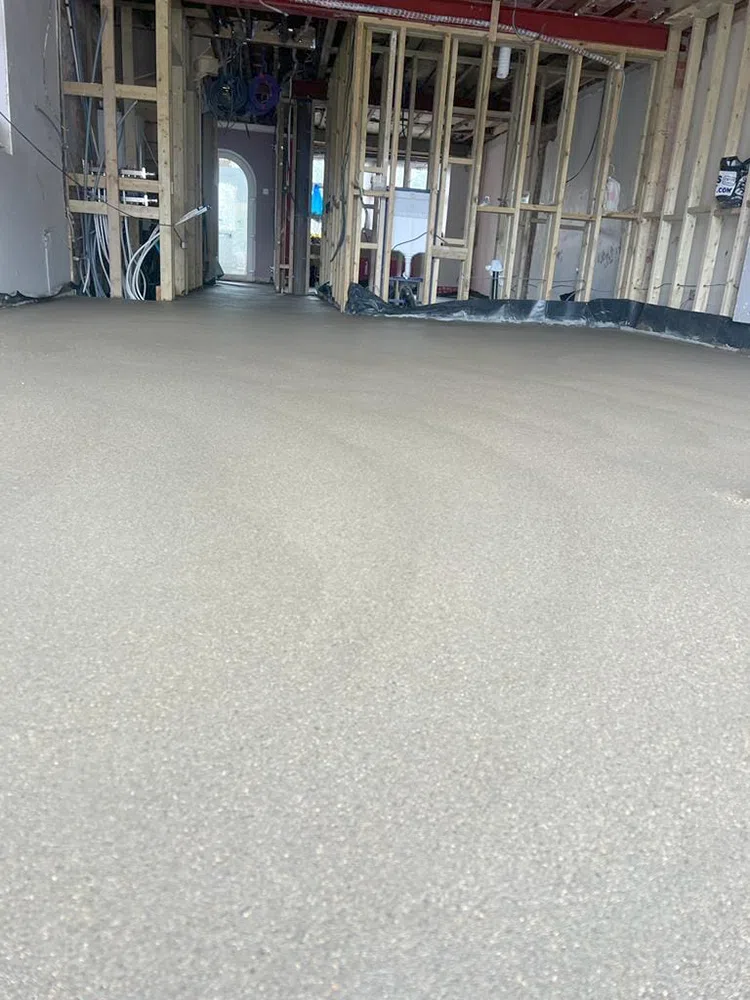
K & B Screeding’s own team, led by director Donatas Bardisevicius. Founded 2019, company 12298780.
See what customers say in our Google reviews and on our testimonials page.
Latex Screed from Slough to Swindon
Swindon is about 49.2 miles west of our Slough base as the crow flies, with postcodes including SN1, SN25, SN5 and SN3. The nearest towns to it are Royal Wootton Bassett (5.3 miles), Calne (12.8 miles), Cirencester (13.3 miles) and Wantage (15.6 miles).
More on latex screed, part of our screeding services.
