
Calcium sulphate grades on Swindon new-build plots
On drawings, anhydrite screed appears as a code set out in the European screed materials standard. In that code, C gives compressive strength and F gives flexural strength, each in N/mm2. On housing drawings three grades appear most often. CA-C20-F4 is for lightly used domestic floors. The normal choice for the majority of homes, flats and offices is CA-C25-F5. Floors expecting harder wear get CA-C30-F6.
Where a developer's engineer has chosen the grade, that exact grade is what goes in, not something close to it. Wichelstowe is planned for up to 4,500 homes, and on schemes of that size the screed is part of a wider specification covering insulation, edge strip and heating.
Other drawings call for an alpha hemihydrate product. Designers pick those when quicker drying or a shallower section is needed. Each one has its own product sheet setting depth, drying and heat-up, and that sheet is what we follow.
The material's low shrinkage is what makes it attractive on apartment floors. Large open bays can be poured with few joints, which suits flats where the whole floor plate goes down in one visit. Any joints, such as across doorways or where one heating zone meets another, are set out and agreed ahead of pouring.
Our anhydrite screed explainer covers the material in more depth.
Sanding, priming and moisture testing in Swindon
A calcium sulphate floor is not ready for flooring as soon as it is dry to walk on. While it cures, the surface develops laitance, a thin and weak top skin. That skin must be sanded away before adhesive or levelling compound goes on. Leave it and the flooring bonds to a weak crust instead of the screed.
After sanding, it gets a primer designed for calcium sulphate. A primer made for cement may not suit it, so the product is matched to the screed and our drying and laitance advice is handed over in writing for the flooring fitter.
Moisture is the next hurdle. Flooring makers often allow less moisture in calcium sulphate than in cement screed, so a reading that would be fine on sand and cement can still be too high on this material. So we take a hygrometer reading instead of going by the calendar. If the floor is heated, force drying with the heating can normally begin from about 7 days.
Keep this material out of rooms that could stay wet. In bathrooms with level access showers or utility rooms with a leak risk, a cement based flowing screed is the alternative. For wet rooms with falls, the hand-laid sand and cement option is usually better. Where the floor will be finished with LVT or vinyl, see smoothing calcium sulphate floors for the final layer.
Anhydrite & Flow Screed prices in Swindon
Liquid flowing screed (which includes anhydrite): £24 to £31 per m² supplied and laid (MyJobQuote, August 2026), so £960 to £1,240 for 40 m². MyJobQuote does not say whether these figures include VAT. See our floor screeding cost guide or screed calculator.
Who lays your anhydrite and flow screed in Swindon
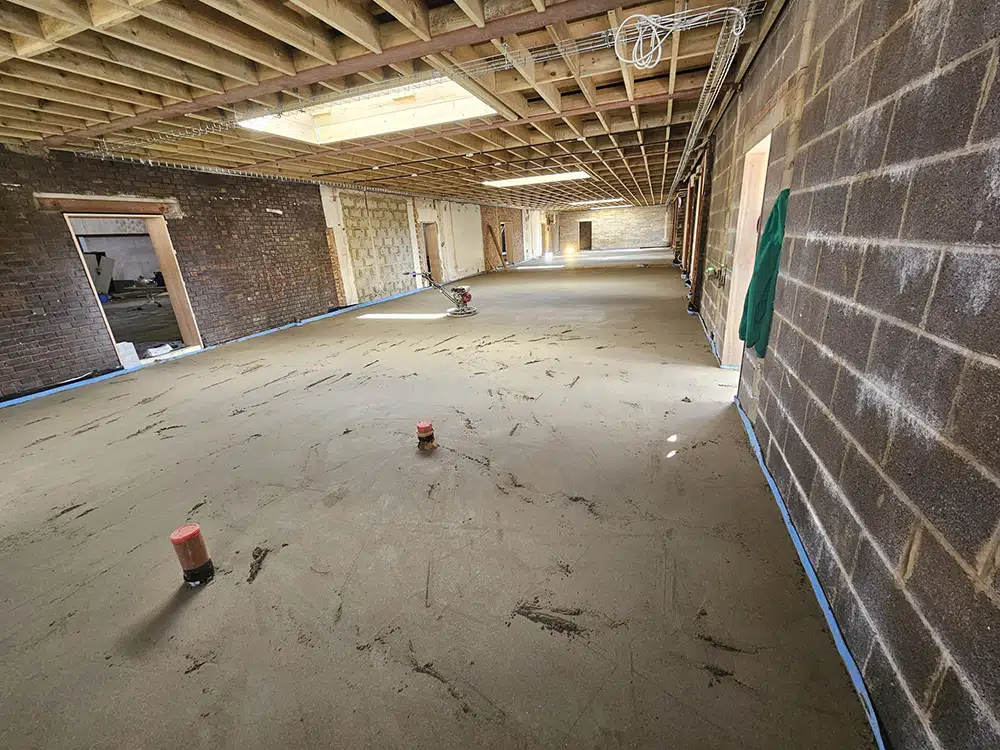
K & B Screeding’s own team, led by director Donatas Bardisevicius. Founded 2019, company 12298780.
See what customers say in our Google reviews and on our testimonials page.
Anhydrite & Flow Screed from Slough to Swindon
Swindon is about 49.2 miles west of our Slough base as the crow flies, with postcodes including SN1, SN25, SN5 and SN3. The nearest towns to it are Royal Wootton Bassett (5.3 miles), Calne (12.8 miles), Cirencester (13.3 miles) and Wantage (15.6 miles).
More on anhydrite screed, part of our screeding services.
