
Anhydrite grades on Carterton plots and flats
The code on a specification tells you exactly what material to expect. CA stands for calcium sulphate. Next, C shows compressive strength and F flexural strength, each in N/mm2 as the European screed standard defines them.
Three grades cover nearly all domestic and light commercial work. Light domestic use calls for CA-C20-F4. The everyday grade for houses, flats and offices is CA-C25-F5. Floors facing harder wear step up to CA-C30-F6. We pour what is specified and do not substitute.
Alpha hemihydrate screeds sit apart from these grades. Designers turn to them when the floor has to dry faster or be laid thinner, and every one has its own data sheet setting depth and drying. Where one is specified, that sheet governs the job.
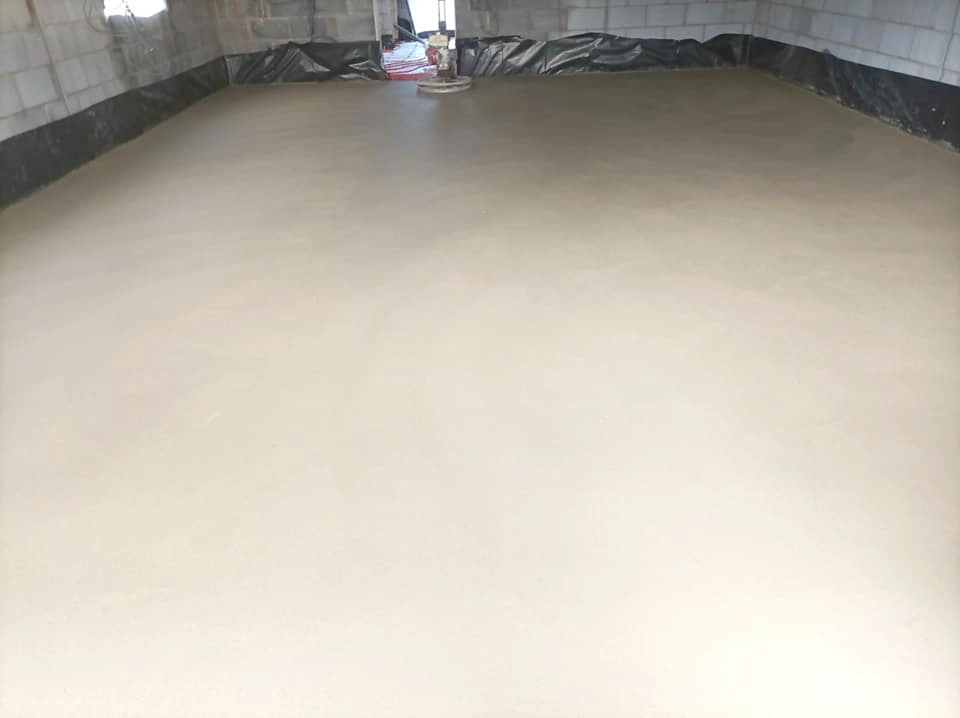
As it cures, calcium sulphate hardly shrinks. Wide bays can therefore be poured with hardly any joints, which suits flats and open-plan ground floors. Purpose-built flats account for 10% of Carterton's homes, and a whole flat can often be poured in one visit. Where a joint is still needed, at a doorway or between two heating zones, we mark it on the layout before any screed goes in.
There is one place anhydrite should not go. Water damages it, so a wet room, or any floor likely to get wet, should have a cement based flowing screed or hand-laid cement screed for Carterton homes. There is more on how the material behaves in our anhydrite screed article.
After the pour: Carterton anhydrite floors
Three things stand between a poured anhydrite floor and a finished one: laitance, moisture and primer.
Laitance first. As calcium sulphate screed settles, a weak, powdery skin rises to the surface. Glue and compound will not grip that skin reliably, so when the floor has dried enough it is sanded back and the dust cleared with a vacuum. On larger floors this is part of floor preparation before flooring.
Moisture next. Flooring makers often allow calcium sulphate less moisture than cement, so a reading that would be fine on a sand and cement floor could still fail on anhydrite. A hygrometer test measures relative humidity and gives the flooring fitter a figure to check against the product's limit. Force drying with underfloor heating, usually possible from about 7 days, speeds this up.
Primer last. Before any adhesive or compound, a primer designed for calcium sulphate goes on. The wrong primer can undo all the careful work above.
We set all this out in writing when we finish, so the builder and the flooring fitter know what has been done and what comes next. About 15 miles away, Abingdon-on-Thames calcium sulphate floors are covered as well.
Anhydrite & Flow Screed prices in Carterton
Liquid flowing screed (which includes anhydrite): £24 to £31 per m² supplied and laid (MyJobQuote, August 2026), so £960 to £1,240 for 40 m². MyJobQuote does not say whether these figures include VAT. See our floor screeding cost guide or screed calculator.
Who lays your anhydrite and flow screed in Carterton
K & B Screeding’s own team, led by director Donatas Bardisevicius. Founded 2019, company 12298780.
See what customers say in our Google reviews and on our testimonials page.
Anhydrite & Flow Screed from Slough to Carterton
Carterton is about 43.7 miles west-north-west of our Slough base as the crow flies, with postcodes including OX18. The nearest towns to it are Witney (5.1 miles), Kidlington (13.8 miles), Wantage (13.9 miles) and Oxford (14.5 miles).
More on anhydrite screed, part of our screeding services.
