
Calcium sulphate grades on Oxford apartment and plot drawings
Grades for calcium sulphate come from the British and European standard for screeds. Look for the C on an Oxford specification: it is compressive strength, F is flexural strength, both stated in N/mm2. Lightly used rooms in a house can have CA-C20-F4. Homes, flats and offices are mostly drawn up at CA-C25-F5. Where wear will be harder, CA-C30-F6 is the step up. We supply the grade the drawing names, not a near substitute.
Designers specify alpha hemihydrate mixes for quicker drying or a slimmer section, and each brand's data sheet sets its own depth, drying and heating limits. On a tight programme, that can be the deciding factor.
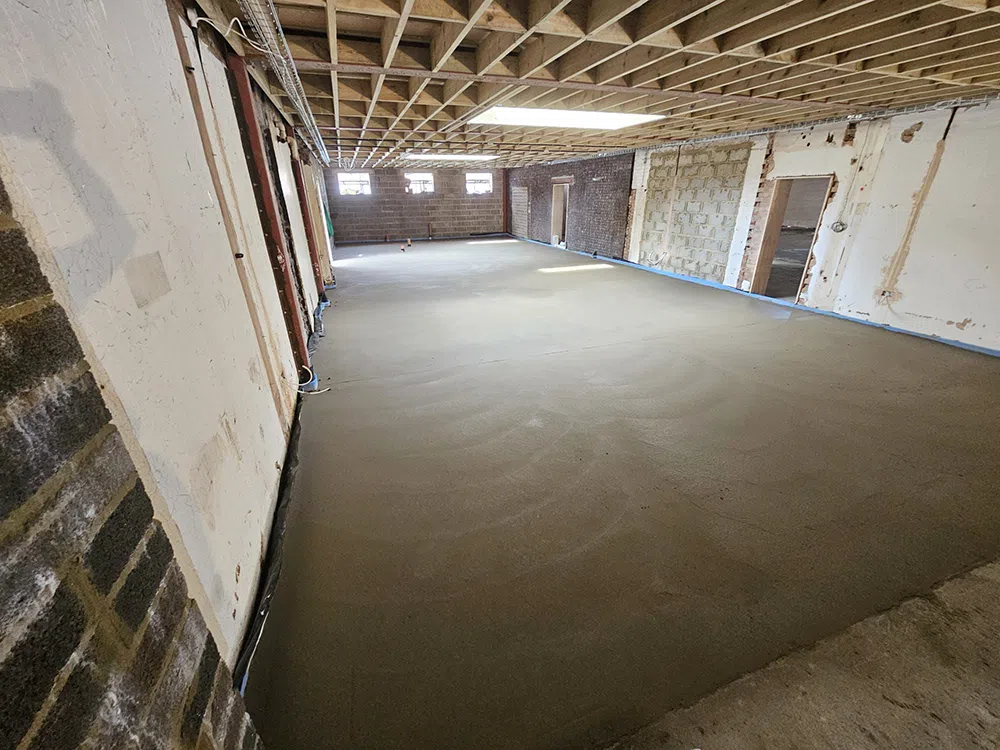
The case for calcium sulphate on an apartment floor is its very low shrinkage. So the bays can be big and the joints few, and an entire Oxford flat often goes down as a single area. We still set bays and joints out in advance, particularly through doorways and over any change in the structure below.
When a later extension or repair ties into one of these floors, matching the material matters, because calcium sulphate and cement screeds need different primers and moisture limits where they meet.
Keep calcium sulphate away from any floor that might be soaked. Bathrooms with a floor drain, wet rooms and similar areas take a cement based flowing screed instead, which we also lay. For the pumping and suitability side of flowing screed, see liquid screed in Oxford.
Laitance, moisture and primers on Oxford anhydrite floors
As an Oxford anhydrite pour settles, a soft film called laitance comes up to the surface. Once the floor is dry it is sanded off to leave a sound surface, because adhesive, primer or compound bonded to laitance can fail.
Moisture testing follows. Flooring brands tend to demand drier calcium sulphate than cement screed, which means an Oxford flat floor can still be too damp at a figure that would let a sand and cement one through. We take the reading with a hygrometer, and where heating loops are in the floor, running them from around day 7 usually speeds things up.
The primer must be compatible with calcium sulphate, particularly under cement based adhesives and levelling compounds. At handover, the flooring contractor gets our drying and laitance advice on paper, so nobody guesses what has been done.
On larger apartment schemes these steps often fall between trades, so agree early who sands, tests and primes. For the full picture on the material, see our anhydrite screed explainer, and if a smoothing coat is needed before sheet flooring, floor levelling in Oxford covers it. Where the floor sits over heating, the Oxford underfloor heating screed page explains commissioning.
Anhydrite & Flow Screed prices in Oxford
Liquid flowing screed (which includes anhydrite): £24 to £31 per m² supplied and laid (MyJobQuote, August 2026), so £960 to £1,240 for 40 m². MyJobQuote does not say whether these figures include VAT. See our floor screeding cost guide or screed calculator.
Who lays your anhydrite and flow screed in Oxford
K & B Screeding’s own team, led by director Donatas Bardisevicius. Founded 2019, company 12298780.
See what customers say in our Google reviews and on our testimonials page.
Anhydrite & Flow Screed from Slough to Oxford
As the crow flies, our yard in Slough is about 30.4 miles from Oxford, which lies to the west-north-west. Postcodes here include OX1, OX3, OX4 and OX44, and Kidlington (5 miles), Abingdon-on-Thames (5.7 miles), Witney (10 miles) and Didcot (10.1 miles) are close by.
More on anhydrite screed, part of our screeding services.
