
Anhydrite grades for Witney flats and plots
Anhydrite is a calcium sulphate binder, and the specification names it by strength class under the European screed standard. C gives its compressive strength and F its flexural strength, each in N/mm2. A lightly used domestic floor gets CA-C20-F4, the bulk of houses, flats and office floors take CA-C25-F5, and harder working floors get CA-C30-F6.
Purpose-built flats make up 14% of Witney's homes, and apartment floors are a common place to meet a specified grade, because they combine a floating build-up, often heating, and limited floor-to-ceiling height. Whether it is a single new house or an apartment block, the engineer or architect chooses the grade, and that is exactly what we deliver.
Each alpha hemihydrate screed comes with its own product sheet to follow. They earn their place when the floor must dry sooner or be slimmer, for instance in a refurbishment where the finished level has to stay put.
What the material offers over cement is stability. Its shrinkage is minimal, which lets a wide floor be poured in big sections with few joints, and they stay level as they cure. Joints still go where the layout demands, at thresholds or between heating zones, and we plan them before the pour. Where there is underfloor heating, it can normally be used to speed drying from around day 7.
The limit matters in Witney. On a ground floor that could flood, or get wet in normal use, we leave calcium sulphate out and use a cement-bound flowing screed, or sand and cement packed by hand. See anhydrite screed explained for more.
Laitance and moisture checks on Witney floors
Looking dry does not make a calcium sulphate floor ready for its finish. Two things have to happen first.
The laitance comes off. Curing brings a thin, feeble layer to the surface. If it stays, adhesives, primers and levelling compounds bond to that layer rather than the screed, and the finish can fail. When the screed has dried, it is sanded down to firm material and given a primer made to work with calcium sulphate.
The moisture is measured. Flooring manufacturers frequently allow calcium sulphate less moisture than cement screed, so a hygrometer figure that passes on sand and cement can fail on anhydrite. Plan for that on a new Witney plot, where the flooring date often sits close to handover. Our drying and laitance advice is given in writing, so the person laying the floor has the right number to aim for.
We pump the screed with our own team, as set out on our screed pumping page, and the same specification work is available as anhydrite screed in Kidlington.
Anhydrite & Flow Screed prices in Witney
Liquid flowing screed (which includes anhydrite): £24 to £31 per m² supplied and laid (MyJobQuote, August 2026), so £960 to £1,240 for 40 m². MyJobQuote does not say whether these figures include VAT. See our floor screeding cost guide or screed calculator.
Who lays your anhydrite and flow screed in Witney
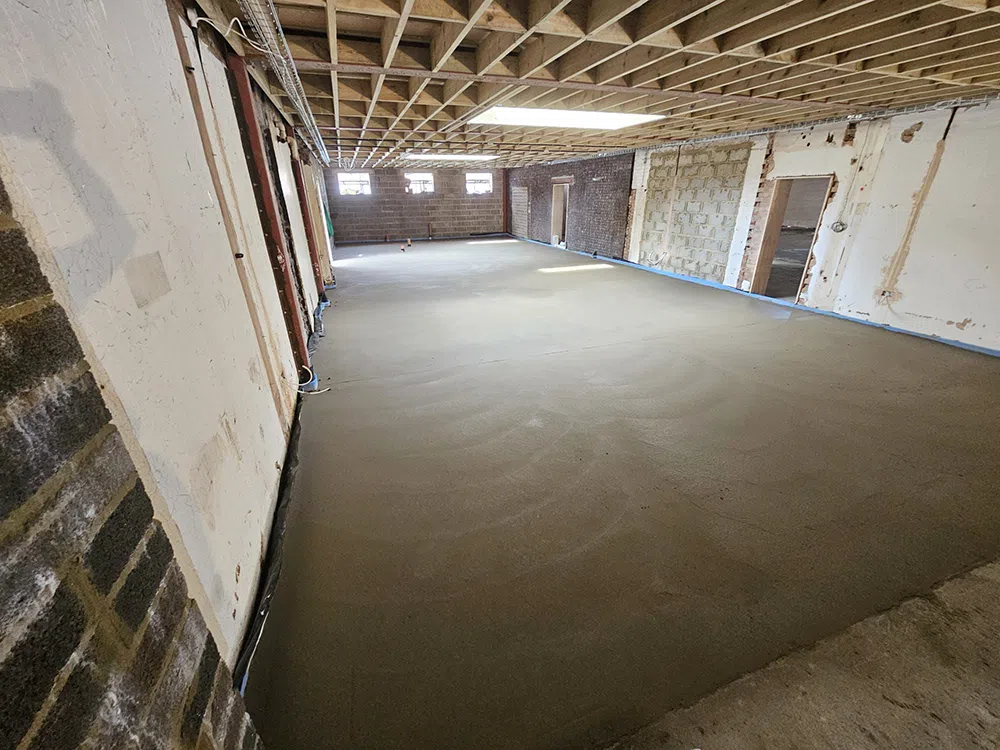
K & B Screeding’s own team, led by director Donatas Bardisevicius. Founded 2019, company 12298780.
See what customers say in our Google reviews and on our testimonials page.
Anhydrite & Flow Screed from Slough to Witney
Witney is about 40.2 miles west-north-west of our Slough base as the crow flies, with postcodes including OX28 and OX29. The nearest towns to it are Carterton (5.1 miles), Kidlington (8.8 miles), Oxford (10 miles) and Abingdon-on-Thames (11.9 miles).
More on anhydrite screed, part of our screeding services.