
Rebuilding cottage floors around Wood Green and West End
Witney's older cottages, around Wood Green and the West End, tend to need damp proofing and insulation before a new floor goes in. Homes from before 1919 are just 7% of the town, yet they are where a solid floor without any membrane under it is most likely to turn up.
Once a cottage floor like that cracks or starts drawing damp, the repair that lasts is to take it out and build it back with a membrane, insulation and fresh screed. Sand and cement suits this. It is mixed in the quantity each room needs, carried through a narrow doorway and compacted by hand, so small, irregular rooms and hallways are straightforward. The new screed floats on the insulation at about 65mm for a home, or 75mm on commercial jobs.
Near the river, the same rebuild needs extra care. The 2007 floods reached Bridge Street and Mill Street and hit the Aquarius development hard. A floor rebuilt in low-lying streets like these needs membrane laps and upstands sealed properly, and a cement based screed, which tolerates damp in a way calcium sulphate cannot. Our membranes and insulation service covers the layers under the screed.
If the concrete underneath is still solid and only the top has broken down, it can be prepared and given a bonded screed of 25 to 40mm, so door thresholds stay at their present height.
Wet rooms, garages and heavy use in Witney
Beyond old floors, a hand-laid cement screed is the right base for three common jobs. Wet rooms are the first. Water must run off a shower floor to the drain, and hand-laid sand and cement can be shaped to that slope, which no self-levelling screed will hold.
Garage conversions are the second. Most garage slabs are lower than the house and cold, with no insulation, so the new layers raise the floor to hallway level and make it warm enough to use as a room. The garage conversion screed guide has the depths.
Third comes any floor that must carry weight early or needs cement beneath it, a workshop, say, or a garage where a vehicle will still be parked. Fibres can be added for crack resistance, or a higher strength mix chosen for heavier use.
The price of that versatility is drying time. A 65mm screed is several weeks from taking tiles or wood, since each of the first 40 millimetres needs about a day and the rest take longer. If the job is up against a deadline, a faster drying screed mix cuts that down. Those mixes cost £20 to £28 per m² on published 2026 UK figures.
Sand and Cement Screed prices in Witney
Sand and cement screed: £18 to £25 per m² supplied and laid (MyJobQuote, August 2026), so £450 to £630 for 25 m². MyJobQuote does not say whether these figures include VAT. See our floor screeding cost guide or screed calculator.
Who lays your sand and cement screed in Witney
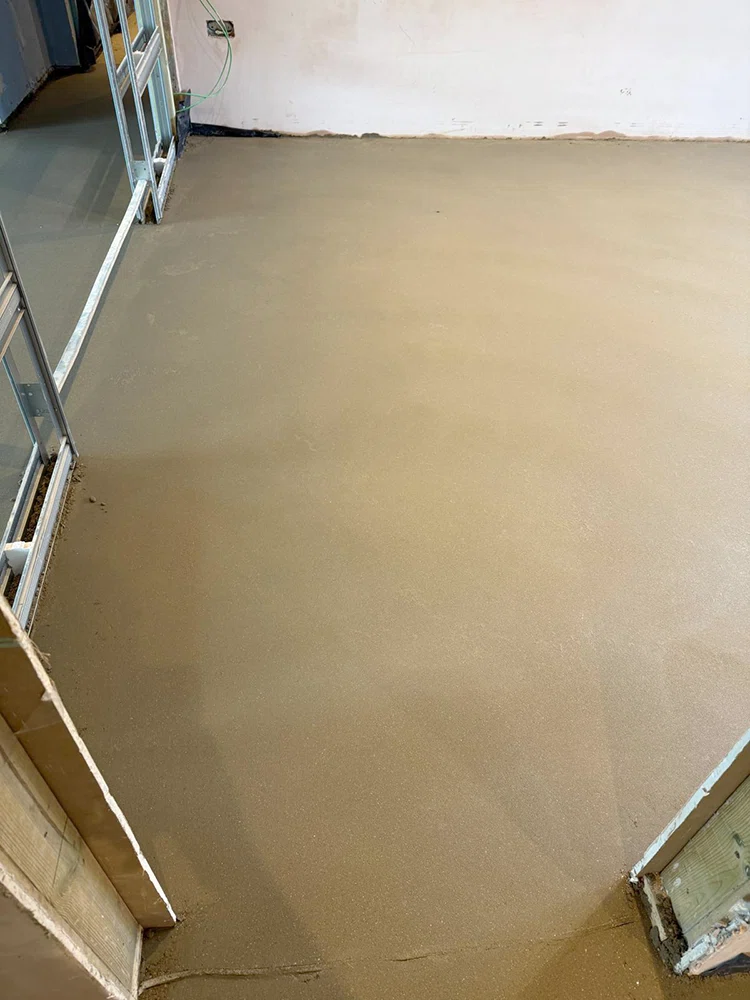
K & B Screeding’s own team, led by director Donatas Bardisevicius. Founded 2019, company 12298780.
See what customers say in our Google reviews and on our testimonials page.
Sand and Cement Screed from Slough to Witney
Witney is about 40.2 miles west-north-west of our Slough base as the crow flies, with postcodes including OX28 and OX29. The nearest towns to it are Carterton (5.1 miles), Kidlington (8.8 miles), Oxford (10 miles) and Abingdon-on-Thames (11.9 miles).
More on sand & cement screed, part of our screeding services.
