
Rebuilding post-war floors in Wantage
Many houses of the 1950s and 1960s have a solid ground floor: a concrete slab with a thin screed or tile over it. Decades later, some of those floors have cracked, sunk at the edges or lost what little damp protection they had. When that happens, a new finish laid on top only hides the problem.
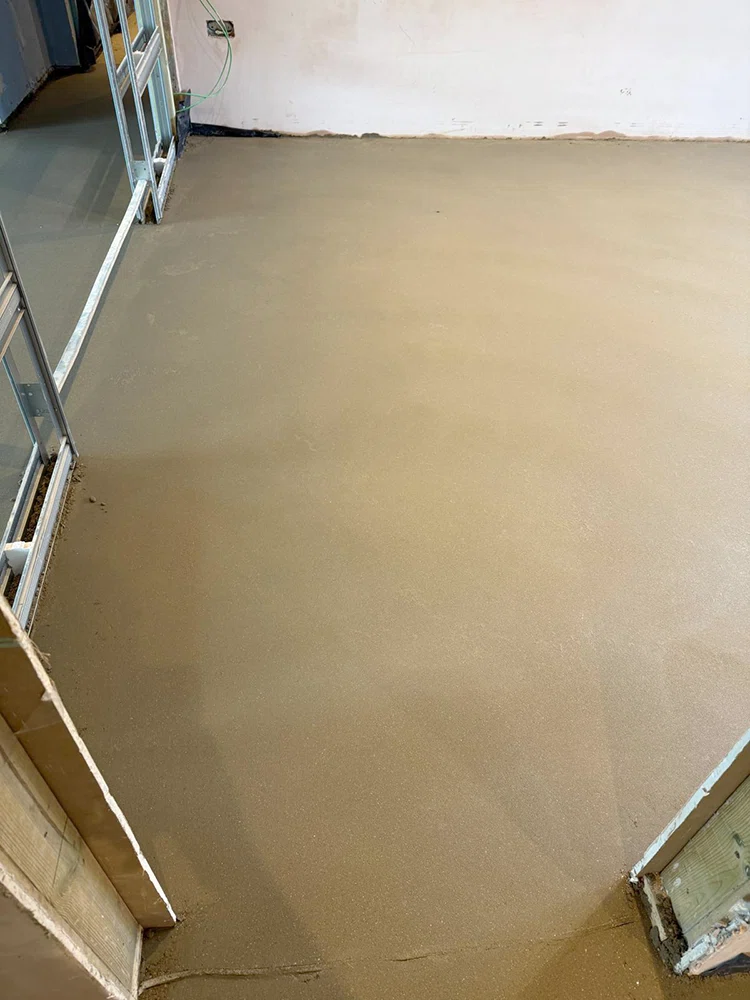
To fix it for good, the old floor is broken out, a membrane and insulation go down, and a new screed goes on top. This is work hand-laid screed is good at. It is mixed in the quantity each room needs, barrowed through a doorway, and compacted and finished by hand, so hallways, small kitchens and rooms with chimney breasts are straightforward. Over insulation it goes down about 65mm thick in a house and 75mm in commercial premises.
Where the old slab is sound and only the surface is worn, a new screed can be bonded directly to it at 25 to 40mm, after the surface is prepared. That keeps floor levels close to where they were, which matters at door thresholds and stairs. Our bonded screed page covers it.
A smaller share of Wantage homes are older still: 10% were built before 1919. Floors in houses of that age need the damp position thought through before any screed goes in, and sometimes floor levelling in Wantage is the gentler route.
Garages, wet rooms and falls in Wantage houses
Garage conversions are a regular reason for a hand-laid screed. Expect the garage slab to sit a step down from the hall with nothing under it to hold heat, so the new layers have to lift it, insulate it and meet the hallway flush. Typical depths are listed in our garage conversion floor guide.
In a wet room, the floor has to run downhill to the drain. A self-levelling product will not hold a fall, but a sand and cement screed can be formed to one by hand. As a cement based material, it also tolerates water in a way that calcium sulphate cannot, which makes it the normal base under tanking and tiles in a shower area.
If the floor must take load early, say in a workshop, or in a garage that still houses a car, cement is the base to use, with fibres or a stronger mix added if needed. Published 2026 UK rates run from £18 to £25 per m², and adding fibres to the mix puts on £1 to £3 per m².
The trade-off is time. Roughly a day per millimetre covers the first 40mm and the remainder dries more slowly, so 65mm takes a lot longer than a thin floor. A quick drying additive can help a tight programme.
Sand and Cement Screed prices in Wantage
Sand and cement screed: £18 to £25 per m² supplied and laid (MyJobQuote, August 2026), so £450 to £630 for 25 m². MyJobQuote does not say whether these figures include VAT. See our floor screeding cost guide or screed calculator.
Who lays your sand and cement screed in Wantage
K & B Screeding’s own team, led by director Donatas Bardisevicius. Founded 2019, company 12298780.
See what customers say in our Google reviews and on our testimonials page.
Sand and Cement Screed from Slough to Wantage
Wantage is about 33.9 miles west of our Slough base as the crow flies, with postcodes including OX12. The nearest towns to it are Didcot (8 miles), Abingdon-on-Thames (8.4 miles), Oxford (13.4 miles) and Newbury (13.7 miles).
More on sand & cement screed, part of our screeding services.
