
Renovating period floors in Jericho, Osney and North Oxford
26% of Oxford's homes are terraced. In the terraces of Jericho and Osney, and in Victorian North Oxford around Park Town, Norham Manor and Walton Manor, solid floors were often laid without a damp proof membrane. When one of those floors fails, the answer is rarely a patch. Instead we break the old floor up, dig down far enough, and build it back as membrane, then insulation, then floating sand and cement over the lot.
For a Jericho or Osney house that top layer is about 65mm thick; commercial floors take about 75mm. The depth is set from the finished floor level so that the new floor meets existing thresholds, hearths and stairs without a lip.
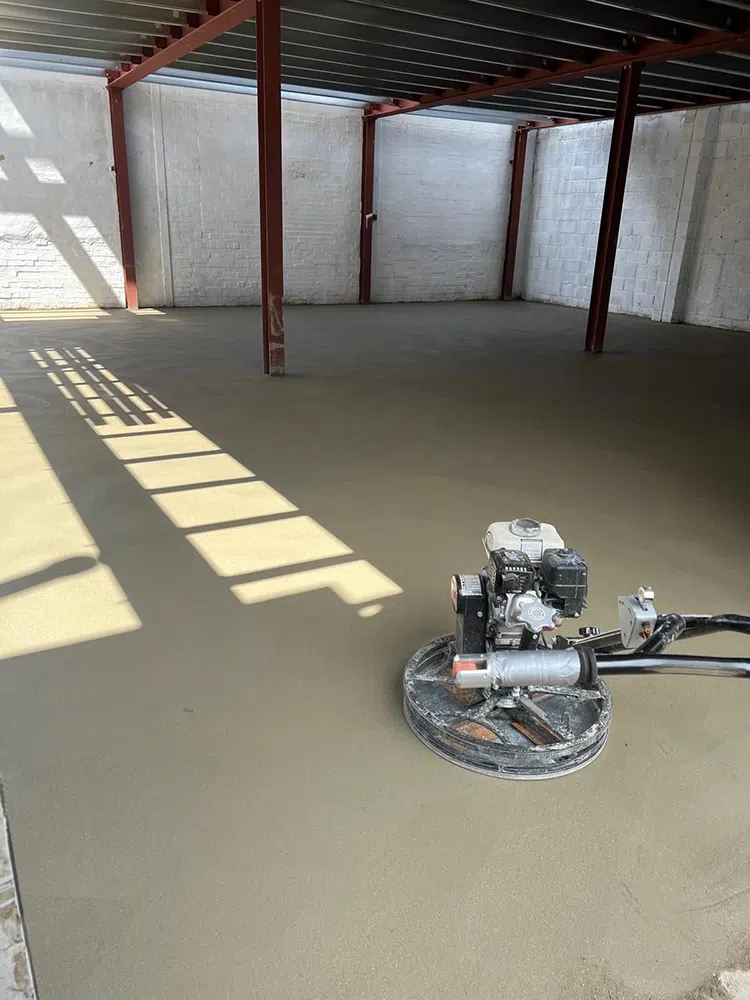
Hand-laid screed is the right tool here because period rooms are usually small and broken up by walls and doorways. It is mixed in small batches to suit each area, placed, compacted and finished by hand, and it gives a cement base that suits stone, tiles or timber once dry. It also copes where a pump would have to snake through several rooms for a few square metres.
If the floor turns out to be sound concrete that is simply uneven, levelling compound for Oxford floors may do instead. Where a slab has to be broken out or repaired first, our concrete floor repair service handles that stage.
Wet rooms, bonded toppings and drying in Oxford
Bathrooms and wet rooms are sand and cement work. Calcium sulphate screed does not tolerate water, while a cement screed can be laid to a fall towards a floor drain and then tanked and tiled. In a small converted flat, getting that fall right in a tight room is a job for hand tools.
Not every floor needs a floating screed. A solid slab that only needs resurfacing can take a bonded screed, 25 to 40mm stuck straight to the prepared concrete, which saves both height and weight. That costs £12 to £18 (trade2base, June 2026) a square metre on 2026 published UK rates, compared with £18 to £25 for floating sand and cement. How the slab is readied for it is set out under our bonded screed service.
Garages turned into rooms need the floor raised with insulation and a membrane, usually in sand and cement; the garage floor screed guide covers height and insulation.
Patience is the price of a hand-laid Oxford floor. Each of the first 40 millimetres takes a day or so to dry and the rest take longer, which leaves a 65mm Oxford floor waiting weeks for its timber or vinyl. Rapid drying additives or fibres can be mixed in where the programme or the floor calls for them.
Sand and Cement Screed prices in Oxford
Sand and cement screed: £18 to £25 per m² supplied and laid (MyJobQuote, August 2026), so £450 to £630 for 25 m². MyJobQuote does not say whether these figures include VAT. See our floor screeding cost guide or screed calculator.
Who lays your sand and cement screed in Oxford
K & B Screeding’s own team, led by director Donatas Bardisevicius. Founded 2019, company 12298780.
See what customers say in our Google reviews and on our testimonials page.
Sand and Cement Screed from Slough to Oxford
As the crow flies, our yard in Slough is about 30.4 miles from Oxford, which lies to the west-north-west. Postcodes here include OX1, OX3, OX4 and OX44, and Kidlington (5 miles), Abingdon-on-Thames (5.7 miles), Witney (10 miles) and Didcot (10.1 miles) are close by.
More on sand & cement screed, part of our screeding services.