
Rebuilding old floors off Thame High Street
Houses that old seldom had any damp proofing or insulation put under the ground floor. When an old solid floor off the High Street or Lower High Street has cracked, sunk or started to let damp through, simply pouring a thick screed over it is usually the wrong answer. It adds depth against doors, thresholds and skirtings, and it can push moisture into the walls. These buildings generally call for careful levelling and damp control first.
Once an old floor like that has given up, taking it out and starting again usually beats patching. That means a membrane, insulation and a new screed, and here sand and cement has the edge. It is mixed on site in the quantity each room needs, barrowed through narrow doorways and compacted by hand around awkward corners, so it copes with small, irregular rooms.
If it floats on insulation, sand and cement needs roughly 65mm in a house, or 75mm in a commercial building. If the slab beneath a cottage floor is still solid and just needs a fresh top, a bonded screed of 25 to 40mm can be laid directly on it, so the floor ends up close to its old height. Our bonded screed service explains the preparation that takes.
Before any of this, the damp and insulation detailing has to be right, and our page on membranes and insulation covers what goes under the screed and how the edges are sealed.
Garages, wet rooms and Thame's 1970s houses
Away from the High Street, the 1970s to 1990s houses bring a different set of jobs. Garage conversions are one. A garage slab normally sits below the level of the house and is uninsulated, so the new floor has to lift it to match and keep the converted room warm. Hand-laid sand and cement does that job well, and the depths are in our guide to screeding a garage floor.
Wet rooms are another. The shower area has to slope to its drain, and a trowelled screed can be formed to that slope, which a self-levelling product will not do. It is also a cement based material, so it tolerates wet areas in a way calcium sulphate does not.
What you give up is speed of drying. Counting about a day for every millimetre to 40mm, and more slowly beyond, 65mm of sand and cement stays wet much longer than a thinner liquid pour. If the build is short of time, a rapid drying additive cuts the wait, and fibres in the mix help it resist cracking.
On published 2026 UK rates this kind of screed costs £18 to £25 per m², plus £1 to £3 per m² if fibres go in. Small and awkward rooms are where this method is most cost effective.
Sand and Cement Screed prices in Thame
Sand and cement screed: £18 to £25 per m² supplied and laid (MyJobQuote, August 2026), so £450 to £630 for 25 m². MyJobQuote does not say whether these figures include VAT. See our floor screeding cost guide or screed calculator.
Who lays your sand and cement screed in Thame
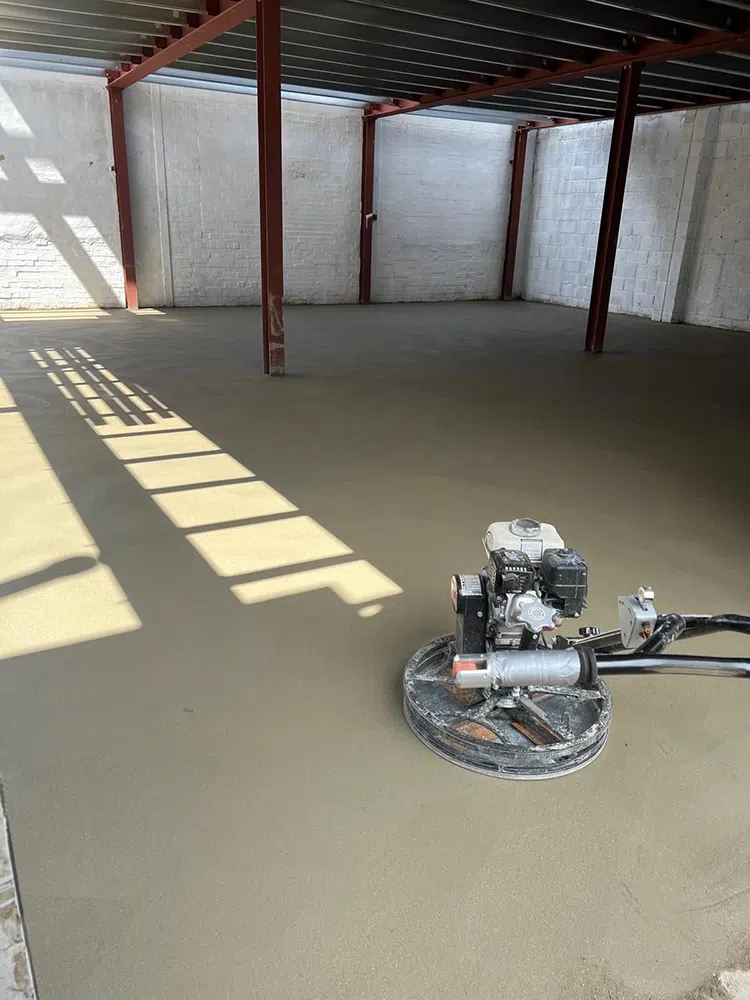
K & B Screeding’s own team, led by director Donatas Bardisevicius. Founded 2019, company 12298780.
See what customers say in our Google reviews and on our testimonials page.
Sand and Cement Screed from Slough to Thame
Thame is about 20.7 miles north-west of our Slough base as the crow flies, with postcodes including OX9. The nearest towns to it are Aylesbury (8.7 miles), Oxford (11.9 miles), Bicester (12.6 miles) and High Wycombe (12.9 miles).
More on sand & cement screed, part of our screeding services.
