
Awkward bases in older Thame kitchens and bathrooms
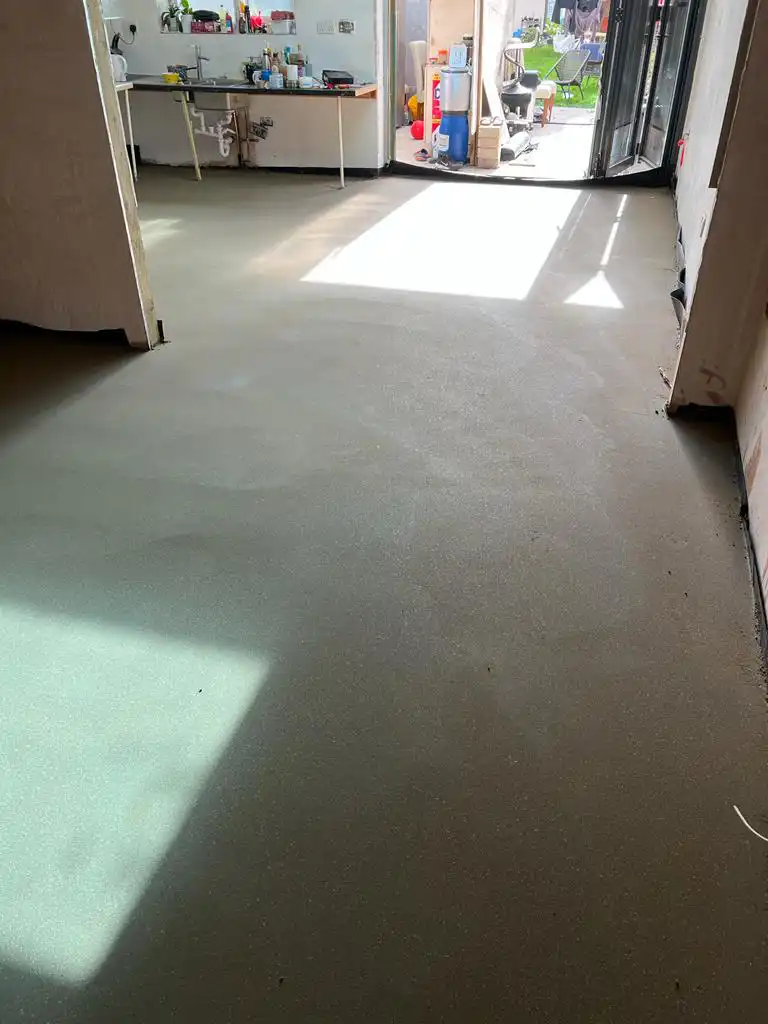
Latex screed is a trade name, not a brand. The powder is cement based, and instead of mixing it with water the fitter stirs in a latex liquid. The result cures into a thin, tough skin with a little give in it, and it grips surfaces that a plain water mixed compound can struggle to hold.
That suits a refit in the older parts of Thame. An older house can have a suspended timber floor in one room and a solid floor in the next, and each needs its own treatment before the new covering goes down.
Timber is the one to watch. Latex never goes straight onto bare boards. They are screwed down tight, any split ones are replaced, and the floor is covered with flooring grade plywood fixed at close centres. The latex then goes over the plywood, filling the sheet joints and screw heads so none of them print through a thin vinyl.
Old quarry and ceramic tiles are a different case. If they are still firmly stuck, there is no reason to hack them up: they are degreased, primed and coated. Uneven older concrete is treated the same way, and so is old adhesive, as long as it is thin and well bonded. Hollow tiles, crumbling patches and soft adhesive are taken off first.
Terraced houses make up 26% of Thame's homes, and 6% went up between 1919 and 1944. Small kitchens, bathrooms and cloakrooms are where sheet vinyl, safety flooring and LVT tend to be chosen, and those finishes show every bump under them.
When latex is wrong for a Thame floor
Latex is a finishing coat. It cannot cure a fault underneath it, and spreading it over one only hides the trouble until the new floor lets go.
Damp is the first check. Older solid floors were often laid with no membrane at all, and buildings off the High Street are the kind where careful damp control is part of any floor work. We test the base before we mix anything, and a damp floor is dealt with first.
Movement is the second. Boards that bounce underfoot will crack a latex layer however carefully it is laid. The fix is to secure the boards and overboard them properly, never to add a thicker coat.
The third is level. Latex smooths a floor; it does not pull one back into line when it falls away across a room. That floor needs deeper levelling or a new screed, and where ridges or high spots are the problem, grinding the concrete back comes before anything else.
Primer is chosen for the base. Where a newer Thame floor was poured in calcium sulphate, its laitance is sanded off and a compatible primer applied before any latex touches it. Our floor preparation page covers that groundwork, and we also lay latex screed in Aylesbury.
How we price latex screed in Thame
A fixed written price within 24 hours, once we know the area and the base. See our floor screeding cost guide.
Who lays your latex screed in Thame
K & B Screeding’s own team, led by director Donatas Bardisevicius. Founded 2019, company 12298780.
See what customers say in our Google reviews and on our testimonials page.
Latex Screed from Slough to Thame
Thame is about 20.7 miles north-west of our Slough base as the crow flies, with postcodes including OX9. The nearest towns to it are Aylesbury (8.7 miles), Oxford (11.9 miles), Bicester (12.6 miles) and High Wycombe (12.9 miles).
More on latex screed, part of our screeding services.
