
Where pumped screed suits Cirencester floors
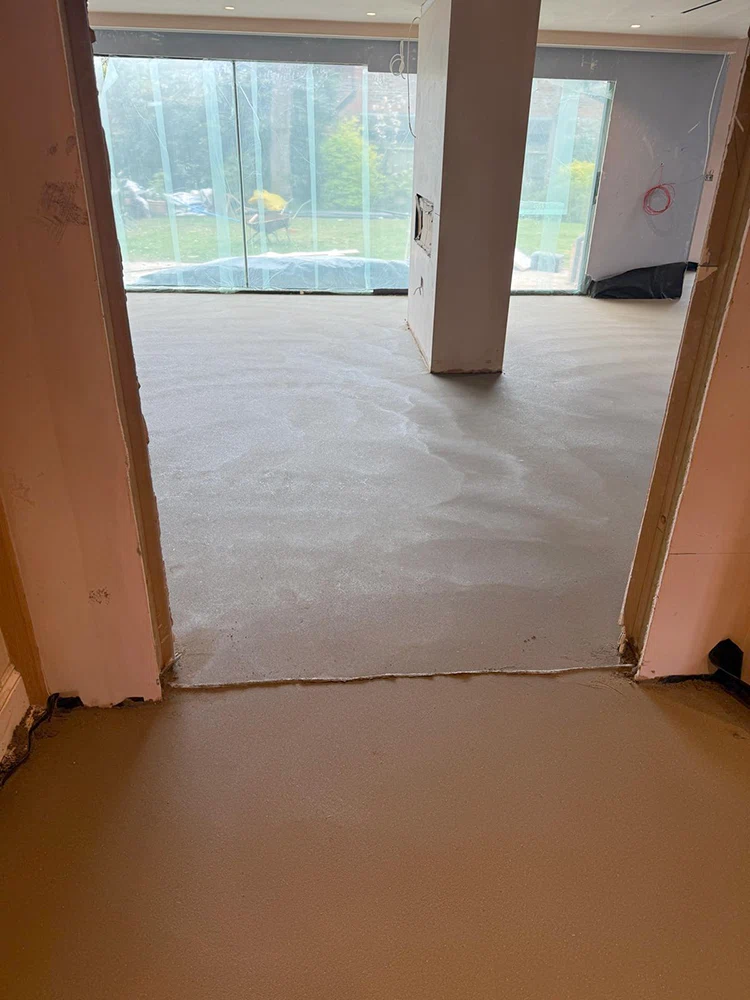
The bigger and more open the room, the more sense a pumped floor makes. It is pumped from the mixer straight into the room, flows out to an even depth and settles flat without the hand compaction a traditional screed needs. SR1 or SR2 flatness comes without much fuss, and that matters if the plan is a thin modern finish such as LVT or large format tiles.
New build plots are the clearest fit. The Steadings, south of Chesterton, and the 280 homes planned west of Kingshill Lane are the sort of schemes where plot after plot has underfloor heating under a pumped screed. Poured screed wraps each pipe without trapping air, so those rooms warm up faster.
It also works in existing homes. Homes from the 1970s to the 1990s in Chesterton and Stratton mostly need extension and kitchen floors, and a rear extension or a knocked-through kitchen gives exactly the open floor that a pump covers quickly. Flats are the other good case. Across Cirencester, 24% of homes are flats, and an upper floor apartment can be poured in one visit by running the hose up the stairs.
Thickness depends on what is underneath. Over insulation, a floating pour starts at roughly 35mm in a house and 40mm in commercial space. There are calcium sulphate and cement based versions, and which one we use depends on the room and what is going on top. Allow roughly one day of drying for each mm up to 40mm, and longer past that, which is why a slimmer pour is ready for its flooring earlier.
Getting the pump to a Cirencester room
The pump is the part people forget to plan for. Our mixer and pump stay outside the house, feeding a hose through to the room. A drive or a site compound makes that easy. On a street where cars park both sides, or where the only way in is through a shared passage, let us know when you ask for a price so we can plan where the kit will stand and how far the hose must run.
A first floor flat is fine too, as the hose goes up the stairs or in through a window. What matters more is that the room is ready: walls plastered, edges fitted with an expansion strip, insulation and membrane laid flat and taped. For context, hiring a pump by itself costs £300 to £600 a day according to figures published for 2026. Our price covers the pump, the crew and the material together, and we do not hire out pumps on their own. How the day of the pour unfolds is set out on our screed pumping page.
Still choosing between liquid and a traditional floor? Our comparison of the two screed types weighs them up side by side. Our liquid screed page for Swindon covers the same work about 13.3 miles away.
Liquid Screed prices in Cirencester
Liquid screed: £24 to £31 per m² supplied and laid (MyJobQuote, August 2026), so £960 to £1,240 for 40 m². MyJobQuote does not say whether these figures include VAT. See our floor screeding cost guide or screed calculator.
Who lays your liquid screed in Cirencester
K & B Screeding’s own team, led by director Donatas Bardisevicius. Founded 2019, company 12298780.
See what customers say in our Google reviews and on our testimonials page.
Liquid Screed from Slough to Cirencester
As the crow flies, our yard in Slough is about 58.3 miles from Cirencester, which lies to the west-north-west. Postcodes here include GL7, and Stroud (10.9 miles), Royal Wootton Bassett (12.4 miles), Swindon (13.3 miles) and Cheltenham (13.5 miles) are close by.
More on liquid screed, part of our screeding services.
