
Screed cover over heating pipes at The Steadings
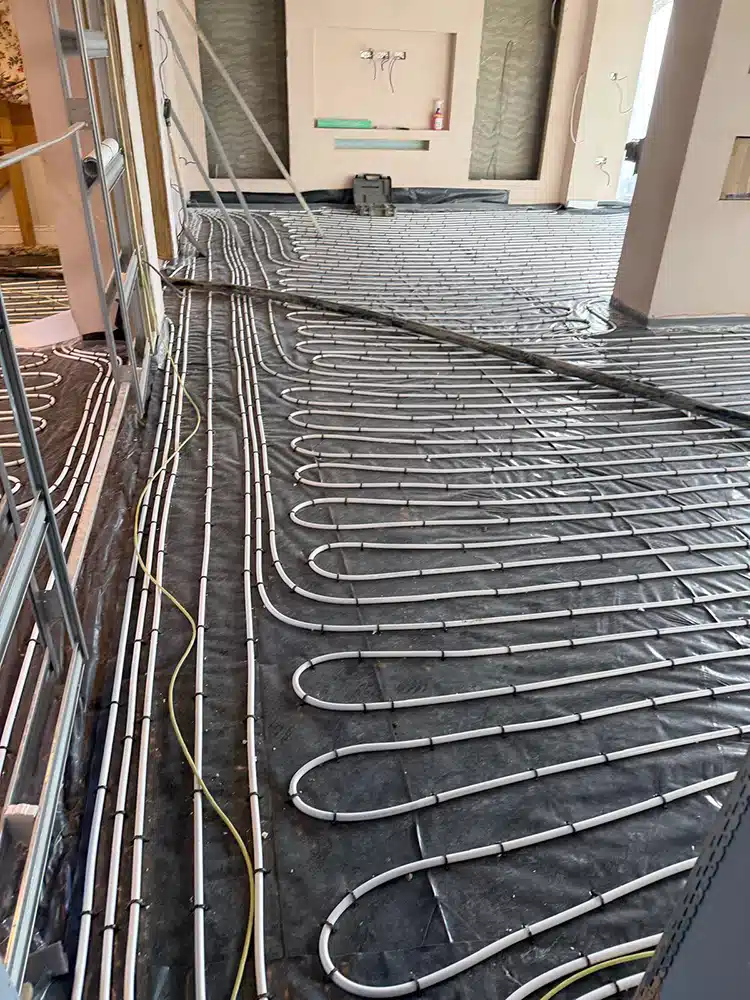
The pipes can be laid perfectly and the room still heat badly if the screed around them is wrong. The pipes need full encapsulation, with no air pockets, and enough screed above them to spread heat evenly and to carry the floor without cracking.
Pour liquid screed and every pipe wants 25mm or more over it, so expect the finished floor to measure 45 to 50mm. Choose sand and cement and that cover rises to around 45mm, which adds depth and weight across the room. On a new plot at The Steadings or west of Kingshill Lane, the build-up is normally set by the drawings and the developer's engineer, and our job is to pour to that depth with the pipes clipped down and held in place.
The layers underneath matter too. Insulation boards must be flat, the membrane taped and lapped up the walls, and an edge strip fitted around the room so the screed can expand. Our crew checks each of those before the pour, and if the boards or membrane are missing we can supply them. Our insulation and membranes service sets out what we lay.
Poured over heating pipes, liquid screed is priced at £20 to £35 a square metre in the UK figures published for 2026. In Cirencester, 8% of homes were built from 2015 onwards, and the plots planned at The Steadings and Kingshill Lane will add many more floors with heating in them.
Heated extensions and retrofits across Cirencester
Fitting pipes into an older Cirencester house is a tighter squeeze than designing them into a new plot. The finished floor has to meet the old floor at the doorway, and in an older house the room height and thresholds leave little space for insulation, pipes and screed together. That is where liquid screed often wins, because its thinner cover keeps the build-up down. The depths involved are on our Cirencester liquid screed page.
For a heated extension or garden room, the same principles apply as on a new plot: flat insulation, a sealed membrane, pipes fixed down and tested, then the pour.
Patience after the pour saves a lot of trouble. A calcium sulphate pour is usually ready for its first warmth after about 7 days. Sand and cement needs longer, no less than 21 days. In both cases that first warm-up is gentle. Water temperature creeps up in stages over several days rather than jumping to maximum, which lets the screed dry out evenly instead of cracking. For more on depths, read the screed thickness guide.
Working a short distance away? Our underfloor heating screed in Cheltenham page covers that town.
Underfloor Heating Screed prices in Cirencester
Liquid screed over underfloor heating: £20 to £35 per m² supplied and laid (trade2base, June 2026), so £700 to £1,230 for 35 m². trade2base gives these figures excluding VAT. See our floor screeding cost guide or screed calculator.
Who lays your underfloor heating screed in Cirencester
K & B Screeding’s own team, led by director Donatas Bardisevicius. Founded 2019, company 12298780.
See what customers say in our Google reviews and on our testimonials page.
Underfloor Heating Screed from Slough to Cirencester
As the crow flies, our yard in Slough is about 58.3 miles from Cirencester, which lies to the west-north-west. Postcodes here include GL7, and Stroud (10.9 miles), Royal Wootton Bassett (12.4 miles), Swindon (13.3 miles) and Cheltenham (13.5 miles) are close by.
More on underfloor heating screed, part of our screeding services.
