
Pipe cover on new build plots around Gloucester
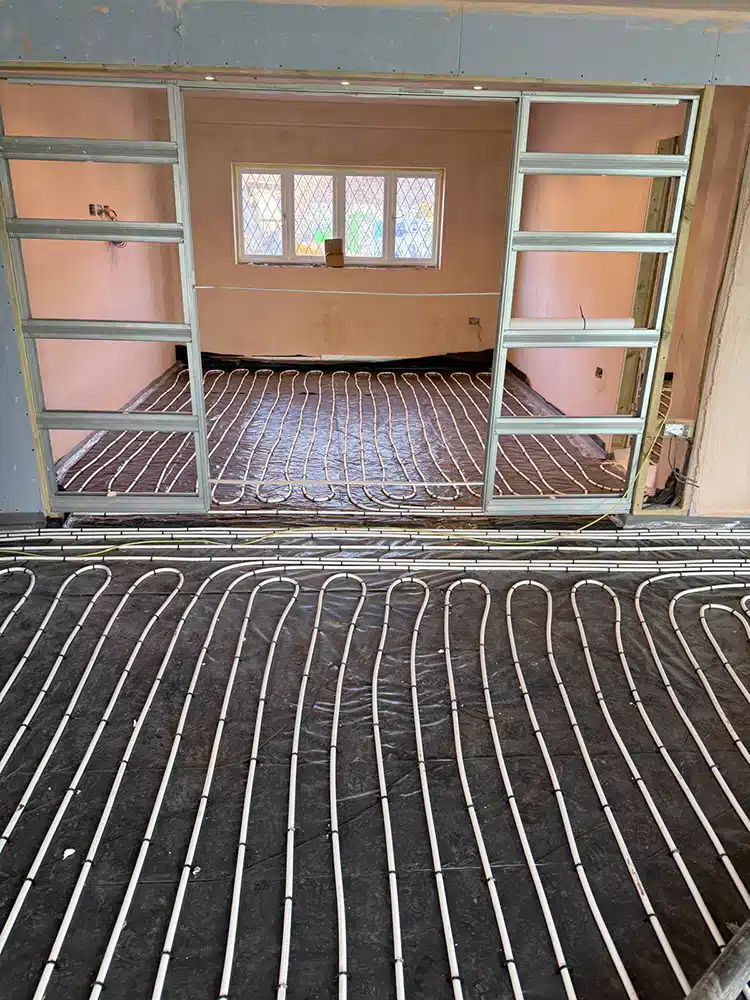
Good pipework can still give a cold, patchy floor if the screed around it is wrong. The pipes need to be fully enclosed, with no air trapped against them, and covered deeply enough for the floor to spread heat evenly and carry its load without cracking.
A liquid pour must bury the pipes under 25mm or more, so the finished layer usually measures 45 to 50mm. Sand and cement wants roughly 45mm on top instead, which makes for a thicker, weightier floor. On an estate plot the depth is fixed by the drawings, and our job is to pour to it, with the pipes clipped down so they do not float.
The layers below the heating are just as important. The insulation must sit flat, the membrane needs taping and turning up at the walls, and an edge strip goes round every room so the screed can expand as it warms. We check those before the pour and can supply insulation and membrane where they are missing; our insulation and membranes page lists what that covers.
Of Gloucester's homes, 13% were built between 2000 and 2014 and 7% from 2015 onwards. The same cover rules apply when one of those newer houses gains a heated rear extension or garden room. Over heating pipes, liquid screed is priced at £20 to £35 per m² on rates published for 2026.
Heated extensions to Gloucester's post-war semis
Post-war semis take much of the extension and open-plan kitchen work in the city, and some owners add a heated floor at the same time. The challenge is height. Where the knocked-through opening joins the old kitchen, both floors have to finish level, and insulation, pipes and screed all have to fit into that fixed height. Liquid screed often solves that because it needs less cover; its depths are set out on our liquid screed in Gloucester page.
Retrofitting heating into an older terrace is harder again, since the old floor usually has to come out first.
After the pour, restraint pays. With anhydrite, low heat can usually start in the second week, from about 7 days; a cement screed holds off until 21 days at least. Commissioning then goes slowly, nudging the water temperature up over several days. Turning it straight to full risks cracking the screed and delaying the flooring. Where those depths come from is explained in our guide to screed thickness.
For the same service about 9.6 miles away, see underfloor heating screed in Tewkesbury.
Underfloor Heating Screed prices in Gloucester
Liquid screed over underfloor heating: £20 to £35 per m² supplied and laid (trade2base, June 2026), so £700 to £1,230 for 35 m². trade2base gives these figures excluding VAT. See our floor screeding cost guide or screed calculator.
Who lays your underfloor heating screed in Gloucester
K & B Screeding’s own team, led by director Donatas Bardisevicius. Founded 2019, company 12298780.
See what customers say in our Google reviews and on our testimonials page.
Underfloor Heating Screed from Slough to Gloucester
On the map, Gloucester sits west-north-west of Slough, about 72.5 miles from our base in a straight line (postcodes including GL1, GL4, GL2 and GL3), next to Cheltenham (7.7 miles), Stroud (8.3 miles), Tewkesbury (9.6 miles) and Cirencester (15.7 miles).
More on underfloor heating screed, part of our screeding services.