
Membranes and pipe cover at Brimscombe Port
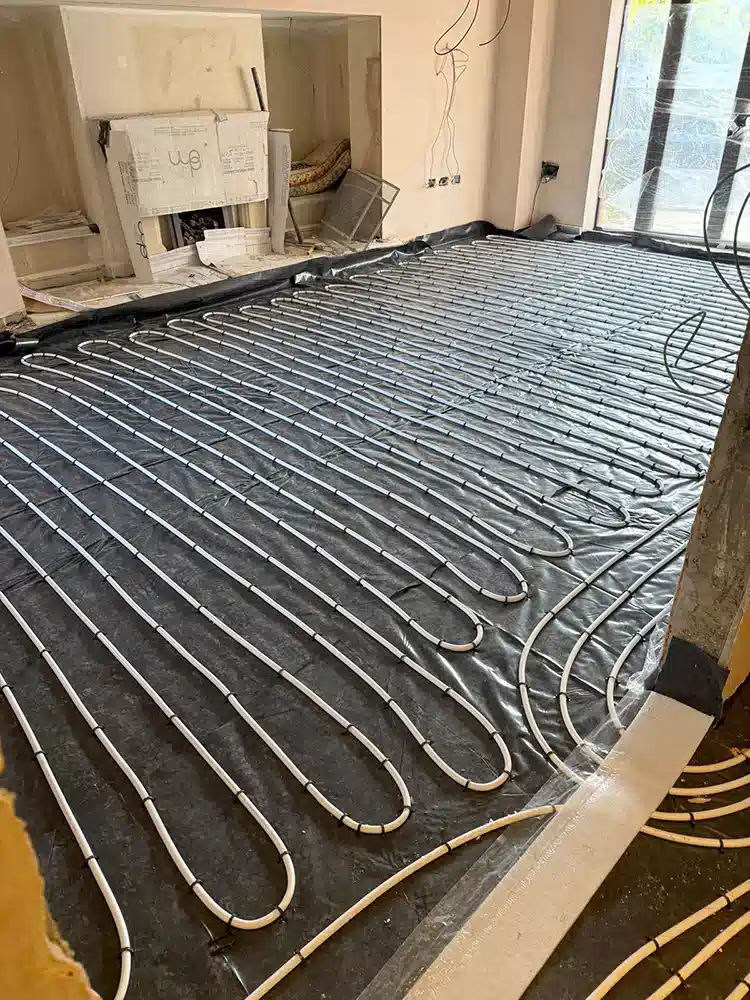
Underfloor heating depends on the screed around it. The pipes need to be fully enclosed with no air trapped against them, and covered deeply enough for the floor to spread heat and carry its load without cracking.
Pumped liquid needs a minimum 25mm blanket over every pipe, which typically makes the floor 45 to 50mm from insulation to surface. Sand and cement asks for around 45mm on top, which builds a thicker floor. On a development such as Brimscombe Port, the depth will be set by the engineer's drawings, and our part is to pour to it with the pipes clipped firmly so they cannot lift.
What sits under the pipes deserves as much care as the pour itself. Near the canal, the insulation and membrane have to be laid with care: boards flat, membrane taped at every lap and turned up the walls, and an edge strip fitted round each room so the screed can expand as it warms. We check all of that before pouring and can supply insulation and membranes where needed; see our insulation and membranes page.
Only 3% of Stroud's homes were built from 2015 onwards and 11% between 2000 and 2014, so in much of the town a heated floor means working with an older house. On published 2026 UK rates, budget £20 to £35 per square metre for liquid screed poured over the pipes.
Retrofit heating in older Stroud houses
Putting heating into an older Stroud house is mainly a question of height. The new floor has to meet the existing floor at the door, and in a stone cottage or terrace there is little room for insulation, pipes and screed together. The old solid floor usually has to come out, and its lack of a membrane means the new build-up must be planned for moisture as well as heat. Liquid screed often helps because its thinner cover keeps the total depth down; liquid screed in Stroud sets out the figures.
Extensions to post-war semis are simpler, since the floor is built new from the ground up.
Once poured, the floor needs patience. Calcium sulphate usually tolerates a low first heat around the 7 day mark, but sand and cement should stand unheated for 21 days or longer. First firing should be patient, with the water temperature lifted in small increments spread over several days. The screed thickness guide explains the depths in more detail, and underfloor heating screed in Cheltenham covers the same work about 12.3 miles away.
Underfloor Heating Screed prices in Stroud
Liquid screed over underfloor heating: £20 to £35 per m² supplied and laid (trade2base, June 2026), so £700 to £1,230 for 35 m². trade2base gives these figures excluding VAT. See our floor screeding cost guide or screed calculator.
Who lays your underfloor heating screed in Stroud
K & B Screeding’s own team, led by director Donatas Bardisevicius. Founded 2019, company 12298780.
See what customers say in our Google reviews and on our testimonials page.
Underfloor Heating Screed from Slough to Stroud
On the map, Stroud sits west-north-west of Slough, about 69.2 miles from our base in a straight line (postcodes including GL5, GL10 and GL6), next to Gloucester (8.3 miles), Cirencester (10.9 miles), Cheltenham (12.3 miles) and Yate (16.6 miles).
More on underfloor heating screed, part of our screeding services.