
Levelling old solid floors on Stroud's slopes
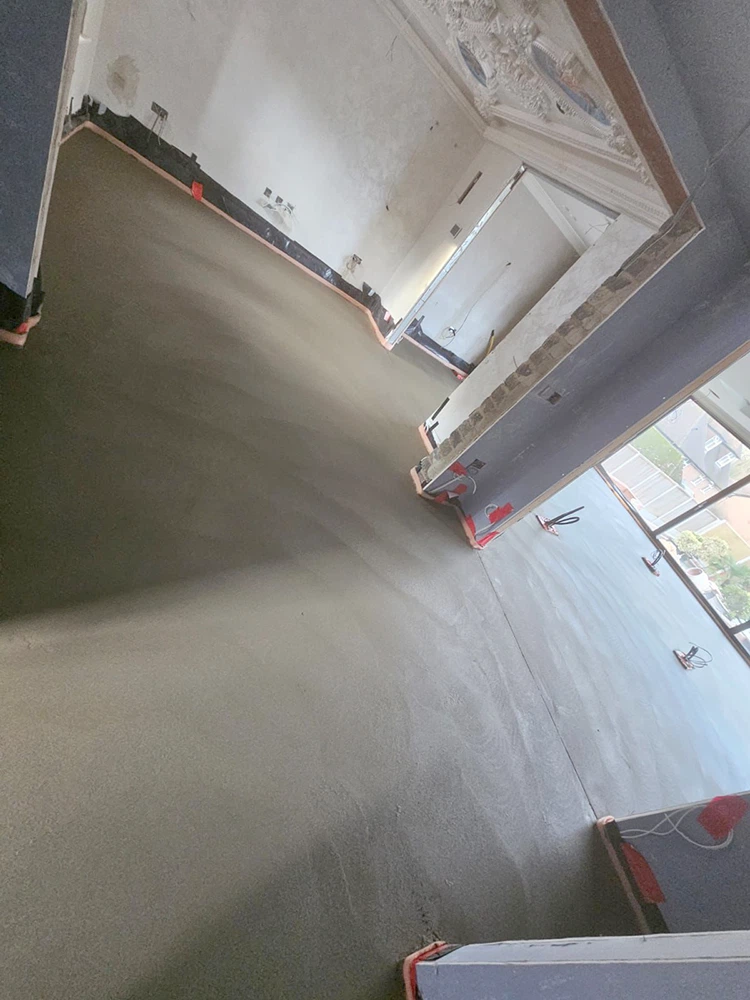
A floor that is sound but uneven does not always need replacing. In a stone terrace or weavers' cottage, digging out a solid floor is disruptive and can upset the way the old building handles moisture. Where the base is firm, a thin layer of self levelling compound can give a flat surface for new flooring without adding much weight or height.
The standard to aim at is set by BS 8204. A 2m straightedge is laid on the floor and the largest gap beneath it is measured: SR1 allows 3mm, SR2 allows 5mm and SR3 allows 10mm. Thin sheet floorings often call for SR1, so a floor bound for LVT or vinyl has to come close to that.
A normal skim runs from roughly 2mm up to about 10mm. First the floor is swept clean and anything loose is taken up, then primed to suit its make-up, as old concrete, sand and cement, calcium sulphate and leftover adhesive each take a different primer. Choosing the wrong primer is the usual cause of compound lifting, and it is the step most worth doing slowly.
The membrane question still applies. Where an old floor has no damp proof membrane, we look at how it is behaving before covering it, and on some floors a breathable approach, or a full rebuild on our sand and cement screed page, is the honest recommendation.
Kitchens, extensions and Stroudwater Business Park units
Homes built between 1945 and 1972 are 30% of Stroud's stock, the largest single age group, and semis are 41% of all homes. Post-war semis are the usual candidates for extension and kitchen work, and the join between old and new is where levelling earns its place. Out the back, the extension has a brand new, flat floor. The original floor beside it has often moved, leaving a step or slope at the opening. A pour of compound evens out that step, letting one floor covering carry straight through.
There is a limit. Compound tops a floor off rather than rebuilding it, and poured thick over a floor that is due for replacement it tends to crack and lift. A hollow floor, or one further out than compound can cope with, needs a repair or a fresh screed first. On a firm floor that is out by just a few millimetres, latex screed is a lighter alternative.
Business floors need the same attention during fit-outs. Stroudwater Business Park at Stonehouse is adding the Stroudwater 13 phase, and business units are planned at Brimscombe Port. Fit-outs in units like those need flat bases, and our concrete floor grinding service prepares worn slabs first. Over in Cirencester, our levelling page for that town covers the same service.
How we price floor levelling in Stroud
A fixed written price within 24 hours, once we know the area and the base. See our floor screeding cost guide.
Who levels your floor in Stroud
K & B Screeding’s own team, led by director Donatas Bardisevicius. Founded 2019, company 12298780.
See what customers say in our Google reviews and on our testimonials page.
Floor Levelling from Slough to Stroud
On the map, Stroud sits west-north-west of Slough, about 69.2 miles from our base in a straight line (postcodes including GL5, GL10 and GL6), next to Gloucester (8.3 miles), Cirencester (10.9 miles), Cheltenham (12.3 miles) and Yate (16.6 miles).
More on floor levelling, part of our screeding services. Not sure whether you need a thin compound or a full flowing screed? See self levelling screed explained.
