
Which Gloucester floors suit a pumped screed
The wider and emptier the floor, the more a pump earns its keep. It leaves the hose as a fluid mix, runs out across the insulation and finds its own level, so there is none of the hand tamping and ruling that a traditional screed needs. Joints are far fewer because shrinkage is low, and the result is a flat, dense floor ready for thin finishes.
Three kinds of Gloucester building fit that description. The first is the new build estate on the city's edge, where each plot gets its heating pipes, then its screed, as the houses go up in sequence. The second is the post-war semi, which accounts for much of the extension and open-plan kitchen work across the suburbs; an extension like that gives a clean, empty floor for a single pour. The third is the flat. Flats make up 19% of homes in Gloucester, and an apartment floor can be poured in one visit with the hose run up through the building.
Depth follows the build-up. Poured as a floating layer on insulation, 35mm or so is the starting depth for a home, rising to 40mm for business premises. Where heating pipes run through it, 25mm of screed above them is the minimum. Both calcium sulphate and cement based liquid screeds are used, with the choice depending on the room, the heating and the floor finish.
Think of drying in days per millimetre: roughly one each up to 40mm, then slower beyond that. A thinner liquid floor therefore reaches the flooring stage well before a thick traditional one.
Pump access in Gloucester streets and blocks
Every liquid pour starts with a question about where the lorry and pump will stand. On a suburban drive in the outer districts it is rarely an issue. On a terraced street with parked cars both sides, or at a block of flats where the only access is a shared courtyard, the plan needs thought. Tell us about permit zones, loading restrictions and how far the hose will run when you ask for a price.
The hose can climb stairwells and reach upper floors, so a second or third storey apartment is normal work. The room needs to be ready: walls plastered, windows in, an edge strip around the perimeter and the membrane laid flat and taped at the joints.
As a yardstick, UK prices published for 2026 put liquid screed at £24 to £31 per m², and simply hiring a pump costs £300 to £600 a day. Ours arrives with the crew and is part of the price, and it is never rented out on its own. More on the pour day is on our screed pumping page, and the drying time guide sets out when flooring can follow. Working about 8.3 miles away? See liquid screed in Stroud.
Liquid Screed prices in Gloucester
Liquid screed: £24 to £31 per m² supplied and laid (MyJobQuote, August 2026), so £960 to £1,240 for 40 m². MyJobQuote does not say whether these figures include VAT. See our floor screeding cost guide or screed calculator.
Who lays your liquid screed in Gloucester
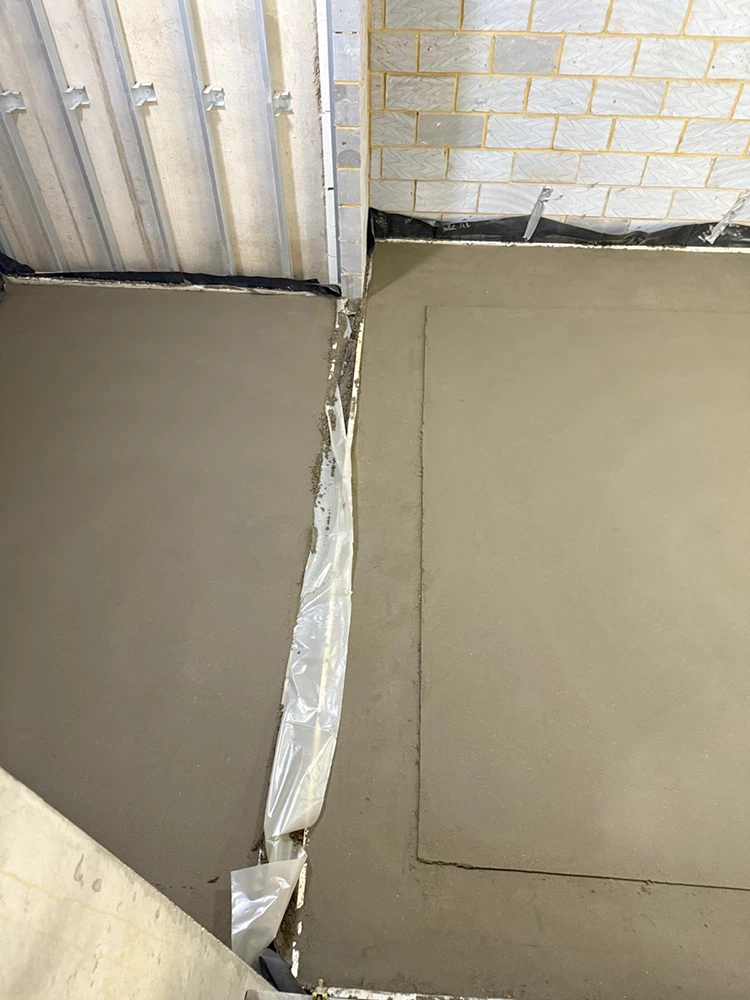
K & B Screeding’s own team, led by director Donatas Bardisevicius. Founded 2019, company 12298780.
See what customers say in our Google reviews and on our testimonials page.
Liquid Screed from Slough to Gloucester
On the map, Gloucester sits west-north-west of Slough, about 72.5 miles from our base in a straight line (postcodes including GL1, GL4, GL2 and GL3), next to Cheltenham (7.7 miles), Stroud (8.3 miles), Tewkesbury (9.6 miles) and Cirencester (15.7 miles).
More on liquid screed, part of our screeding services.
