
Refit floors in Gloucester semis and terraces
Strip out a kitchen in an older Gloucester house and the floor tells its own history. There may be a run of ceramic tiles where the units stood, a concrete patch where a chimney breast came out and a band of old glue from the last vinyl. Each surface takes a finish differently, and a thin sheet floor will mirror every edge.
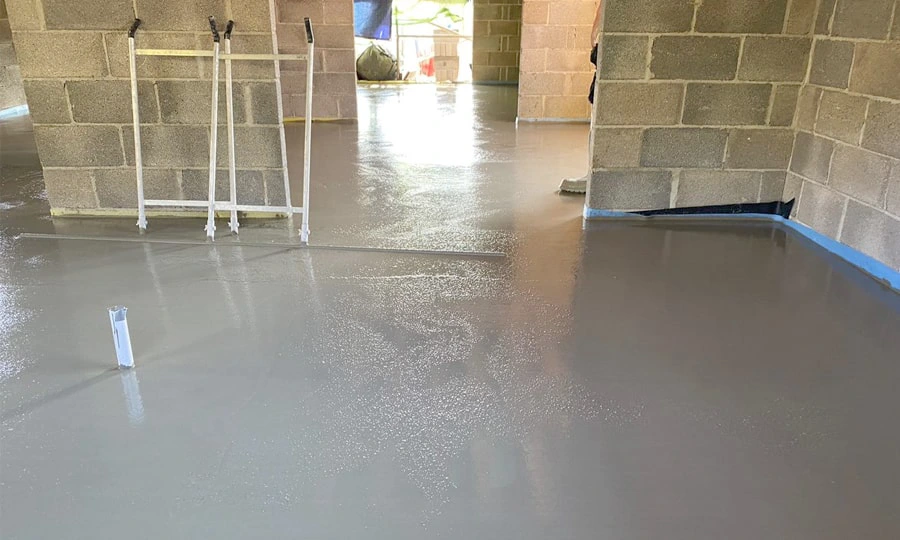
Latex screed ties those surfaces together. The powder is cement based, but it is gauged with a latex liquid instead of water. That gives a layer which bonds well to hard, smooth surfaces and copes with slightly more movement than a water mixed compound. Spread a few millimetres thick, it leaves one even skin across the room.
Tiles can usually stay. If they are stuck fast, clean and dry, they are degreased, primed for a non porous face and covered. Loose or hollow sounding tiles come up first and the gaps are filled. Sound old adhesive can sometimes be left in place, while soft or flaking residue is scraped or ground back to firm concrete.
Terraced houses are 19% of Gloucester's homes. Where an older terrace still has a firm ground floor, latex is a light way to modernise it without digging anything out. A failed ground floor is a separate job and normally has to be broken out and rebuilt. For the wider question of compound against a new screed, our Gloucester floor levelling page sets it out.
Overboarded timber floors across Gloucester
Bathrooms and landings upstairs are usually timber. Latex is never laid on bare floorboards: boards shrink and swell through the year, the gaps open and close, and a thin cement layer cracks along each line. The answer is to screw down any loose boards, then cover the whole floor with flooring grade plywood fixed at close spacing. The latex is spread on the primed plywood, never the boards.
Springy floors need more than that. If a joist has been notched for pipes or a board bounces underfoot, the movement is stopped with packing or new fixings before any overboarding. Latex adds smoothness, not stiffness.
Damp is the other stop sign. The oldest terraces in the city, built before 1919, frequently stand on solid floors laid without a membrane, and moisture keeps rising through them. Under a latex skin and a vinyl finish that moisture is trapped and the adhesive lets go. We check before quoting, and where a floor is damp the honest answer is a rebuild in hand-laid sand and cement with a proper membrane.
Newer houses have their own check. If the screed under a modern floor is calcium sulphate, its surface skin is sanded away and a compatible primer applied first. The same latex work about 9.6 miles away is on our latex screed in Tewkesbury page.
How we price latex screed in Gloucester
A fixed written price within 24 hours, once we know the area and the base. See our floor screeding cost guide.
Who lays your latex screed in Gloucester
K & B Screeding’s own team, led by director Donatas Bardisevicius. Founded 2019, company 12298780.
See what customers say in our Google reviews and on our testimonials page.
Latex Screed from Slough to Gloucester
On the map, Gloucester sits west-north-west of Slough, about 72.5 miles from our base in a straight line (postcodes including GL1, GL4, GL2 and GL3), next to Cheltenham (7.7 miles), Stroud (8.3 miles), Tewkesbury (9.6 miles) and Cirencester (15.7 miles).
More on latex screed, part of our screeding services.
