
Heated floors in new Shottery and Bishopton homes
New housing is where underfloor heating screed is most straightforward. On the Shottery and Bishopton developments, liquid screed over the pipes is the obvious route, because a new ground floor is designed with insulation, a membrane and an edge strip from the start. 20% of Stratford-upon-Avon's homes were built between 2000 and 2014, and an extension added to one of those is designed from scratch, so the full heated build-up can be planned in.
Get the screed wrong and good pipework is wasted. Pipes under liquid screed need 25mm or more on top, landing a floating Shottery floor near 45 to 50mm deep, and sand and cement asks about 45mm over the pipework. Liquid flows around every pipe with no air pockets, giving faster warm-up and better heating efficiency, which is why new-build heated floors so often use it. Hand-laid cement screed is still the pick for a heated floor in a room that could get wet.
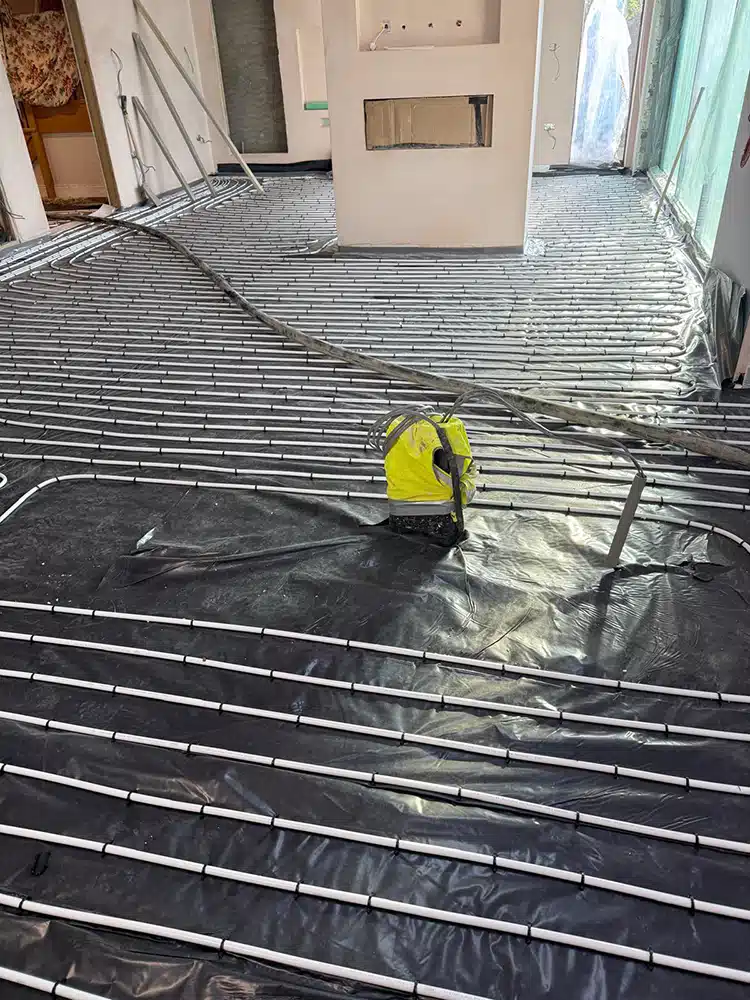
We look over the insulation, membrane and edge strip before pouring and bring them ourselves if any are missing, as set out under insulation and membranes. The pipes need to be pressure tested and filled by your heating engineer first, because K & B does not install underfloor heating pipes.
Garden rooms and rear extensions follow the same rules at a smaller scale. A wide extension floor is a good match for pumped liquid screed for Stratford extensions, and the finish comes out flat enough for tiles, LVT and engineered wood.
Retrofitting heating into older Stratford-upon-Avon floors
Older houses are harder. In a pre-war Stratford house the old solid floor generally has to be dug out to fit insulation, pipes and screed in, yet the finished level must still line up with the existing doors, stairs and thresholds. Every millimetre of build-up counts.
That is where liquid screed earns its place, because its thinner cover keeps the total depth down compared with sand and cement. In the timber-framed and listed buildings of the historic centre, consent conditions come before any heating plan, and thin or lightweight systems tend to be the ones that suit.
Commissioning needs patience. Over calcium sulphate, the system can come on at roughly the one week mark (7 days); a sand and cement floor in an old Stratford house needs 21 days first. In both cases the warmth is stepped up a little at a time across several days, because a sudden jump can crack the floor. You get that warm-up plan from us on paper.
For drying in more detail, read how long screed takes to dry. Where an old floor has to be dug out before anything else happens, floor preparation covers the break-out and the base.
Underfloor Heating Screed prices in Stratford-upon-Avon
Liquid screed over underfloor heating: £20 to £35 per m² supplied and laid (trade2base, June 2026), so £700 to £1,230 for 35 m². trade2base gives these figures excluding VAT. See our floor screeding cost guide or screed calculator.
Who lays your underfloor heating screed in Stratford-upon-Avon
K & B Screeding’s own team, led by director Donatas Bardisevicius. Founded 2019, company 12298780.
See what customers say in our Google reviews and on our testimonials page.
Underfloor Heating Screed from Slough to Stratford-upon-Avon
On the map, Stratford-upon-Avon sits north-west of Slough, about 64.4 miles from our base in a straight line (postcodes including CV37), next to Warwick (8 miles), Royal Leamington Spa (10 miles), Kenilworth (11.7 miles) and Evesham (12.4 miles).
More on underfloor heating screed, part of our screeding services.