
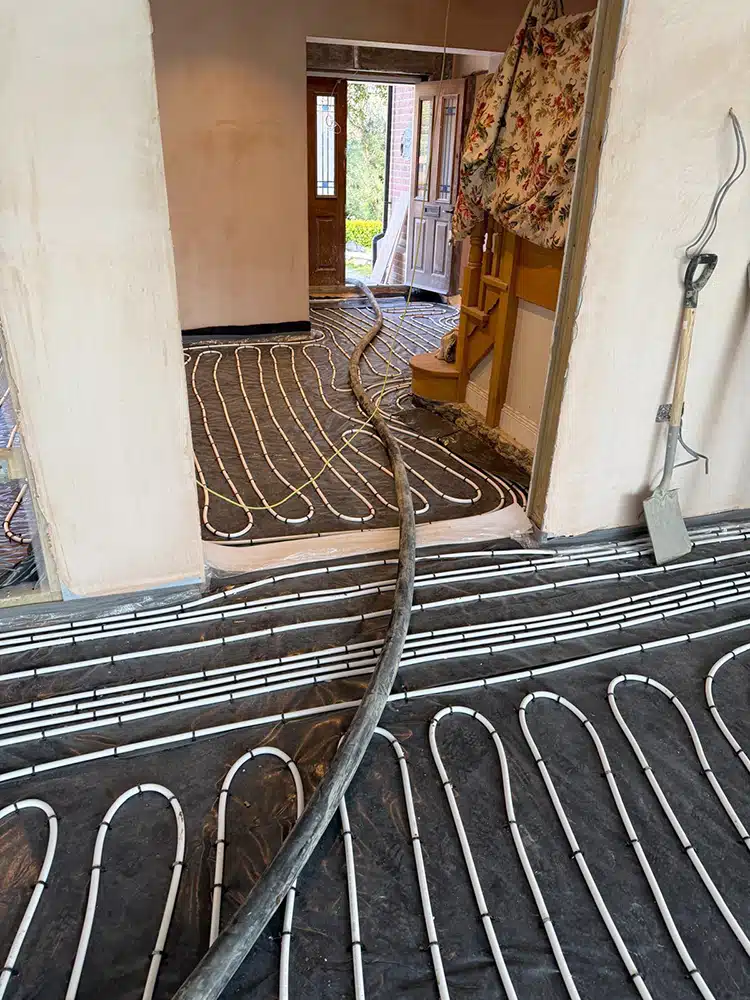
Heated extensions at Warwick Gates in Leamington
An extension or garden room with underfloor heating has one floor doing several jobs. The screed must spread heat evenly, encase the pipes without voids and give a flat base for the finish, all at a depth that lines up with the house.
Most of these floors in Leamington get liquid screed. Poured round the loops, it closes every gap, so there are no trapped pockets of air slowing the heat on its way up. A 25mm layer over the pipe tops is the least it can have, which adds up to a floor of roughly 45 to 50mm. Choose sand and cement and the cover grows to about 45mm, making a thicker floor that takes longer to dry out.
Semis account for 29% of Leamington housing and detached houses for 13%. Where a semi gains a rear extension or a garden room is built at the end of the plot, the heated floor is typically planned from scratch, so insulation, pipes, screed and covering can all be fitted to the finished level. That is far easier than retrofitting.
Before we arrive, the heating engineer should have laid and pressure tested the pipes, with the edge strip and membrane fixed. On arrival our crew looks the whole build-up over before mixing starts. For the screed itself, see our liquid screed page for Royal Leamington Spa, and our screed thickness guide gives the depths for each type.
Retrofitting underfloor heating in older Royal Leamington Spa houses
In a Regency or Victorian house near the Parade, the trouble with adding heating is height, since there is seldom any to spare. Raising the floor by the depth of insulation, pipes and screed would leave steps at every doorway, so the existing floor often has to come out first. In a house built before membranes were standard, that is a chance to put one in, with our insulation and membrane layers below the new screed.
In a converted townhouse, timber upper floors raise a different issue. Heavy screeds are rarely suitable there, and lightweight systems are planned with the designer, along with the sound separation between flats.
After the pour, the heating has to be woken up slowly. On calcium sulphate the first gentle heat can usually go in around day 7. A sand and cement floor in a Leamington semi stays unheated until three weeks, 21 days, have gone by. The flow starts cool, and the temperature creeps upwards bit by bit across several days. Rushing it is a common cause of cracked screed and lifted tiles. Calcium sulphate floors also need their surface sanded before tiling, as our anhydrite screed explained guide describes.
Underfloor Heating Screed prices in Royal Leamington Spa
Liquid screed over underfloor heating: £20 to £35 per m² supplied and laid (trade2base, June 2026), so £700 to £1,230 for 35 m². trade2base gives these figures excluding VAT. See our floor screeding cost guide or screed calculator.
Who lays your underfloor heating screed in Royal Leamington Spa
K & B Screeding’s own team, led by director Donatas Bardisevicius. Founded 2019, company 12298780.
See what customers say in our Google reviews and on our testimonials page.
Underfloor Heating Screed from Slough to Royal Leamington Spa
Royal Leamington Spa is about 64.9 miles north-west of our Slough base as the crow flies, with postcodes including CV32, CV34 and CV31. The nearest towns to it are Warwick (2.3 miles), Kenilworth (3.9 miles), Coventry (8.1 miles) and Stratford-upon-Avon (10 miles).
More on underfloor heating screed, part of our screeding services.