
Pipe cover and depth in a Solihull heated extension
Without the right screed over it, underfloor heating does not perform. It spreads warmth from the pipes evenly across the room, protects them from the weight of furniture and people, and gives a flat base for the finish. Skimp on the cover and cracks can open along the pipe runs; overdo it and warming the room takes longer.
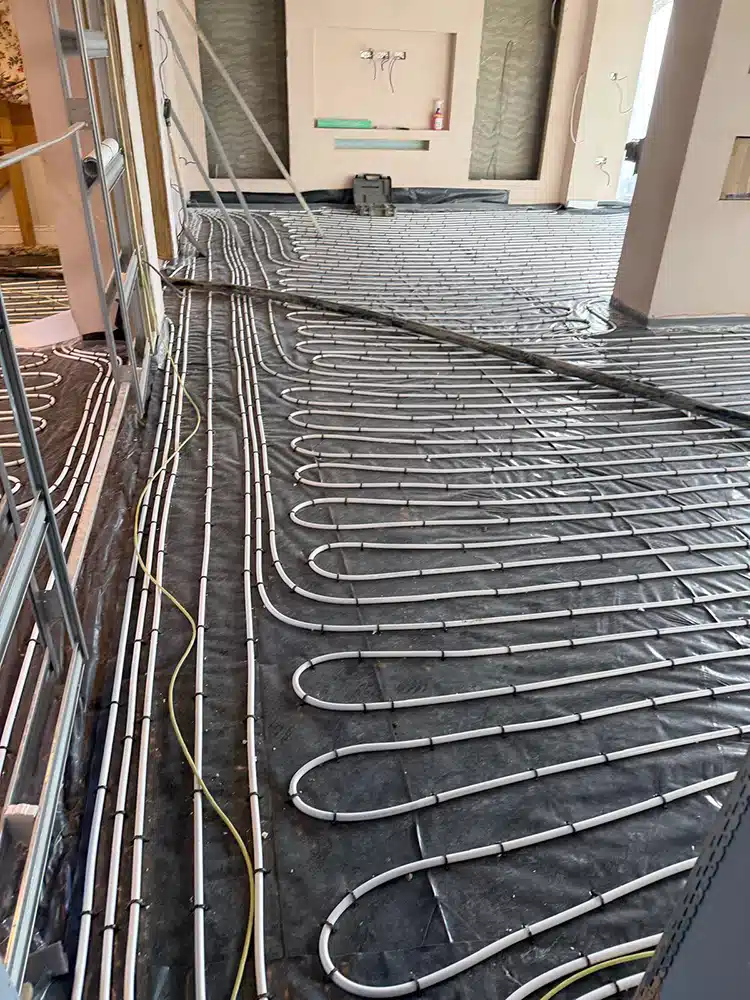
The two screed types need different cover. Liquid needs a minimum of 25mm over the top of the pipes, giving a floor of around 45 to 50mm overall. Sand and cement wants about 45mm over them, so the whole build is thicker. Liquid screed also flows round each pipe with no air pockets, which helps heat transfer, while sand and cement has to be compacted carefully around the loops.
Detached houses make up 28% of Solihull homes, and a heated extension across the back of one can be a large floor. On a floor that size, pumped liquid screed over heating pipes covers the whole area in a single visit with few joints, and the heating can usually be brought into use sooner.
On a smaller semi extension, or where the new floor must step down to meet an old one, sand and cement may still be the right call. We look at the insulation, membrane and edge strip before quoting, and can supply any of them as part of our insulation and membrane work. The depths are broken down further in our guide to screed thickness.
Retrofitting heating under older Solihull floors
In an older Solihull house, the snag with retrofitting a heated floor is height underfoot. Homes built between 1973 and 1999, which make up 21% of the town, and the many inter-war houses before them, were not designed with heated floors in mind. Fitting pipes, insulation and screed usually means digging out the old floor so the new build-up finishes at the same height as the doors and the rooms around it.
When the height is tight, liquid screed tends to get the job because it can sit thinner over the pipes. Where a garden room or a single room is being heated, sand and cement can work well if the depth is there.
Commissioning should not be rushed. Under calcium sulphate, heating can normally come on from about day 7, whereas sand and cement needs 21 days or more. Either way the water temperature should be raised slowly, a few degrees at a time, so the screed is not shocked into cracking. We leave a heat-up schedule with your heating engineer to work through. Royal Leamington Spa has its own heated floor screed page if your project is there.
Underfloor Heating Screed prices in Solihull
Liquid screed over underfloor heating: £20 to £35 per m² supplied and laid (trade2base, June 2026), so £700 to £1,230 for 35 m². trade2base gives these figures excluding VAT. See our floor screeding cost guide or screed calculator.
Who lays your underfloor heating screed in Solihull
K & B Screeding’s own team, led by director Donatas Bardisevicius. Founded 2019, company 12298780.
See what customers say in our Google reviews and on our testimonials page.
Underfloor Heating Screed from Slough to Solihull
On the map, Solihull sits north-west of Slough, about 77.7 miles from our base in a straight line (postcodes including B91, B26, B92 and B90), next to Kenilworth (9.7 miles), Redditch (10.1 miles), Coventry (11.4 miles) and Warwick (12 miles).
More on underfloor heating screed, part of our screeding services.
