
Rebuilding original floors in Solihull's inter-war houses
Replacing a tired original floor follows a set order. The old surface and the material under it come out, the ground is consolidated and a new slab goes in with insulation and a damp proof membrane. The sand and cement screed is the last structural layer, and it sets the finished height for everything above it.
In an older house that height is fixed by things that cannot move: door thresholds, the hearth, the bottom step of the stairs and the floor in the next room. Laying by hand gets round those fixed points. It is mixed on site, placed in bays, compacted by hand and finished with a float or power float to a dense, level surface, and the depth can be eased up or down across a room in a way that pumped screed cannot.
We lay it 65mm thick when it floats over insulation in a house, and 75mm on a commercial floor. It gives up its moisture more slowly than liquid screed, around a day per mm up to 40mm and longer per mm after that, so a 65mm floor in a Solihull semi has to wait before wood or vinyl goes down. Why the lower part of the screed is so slow is covered in our guide to screed drying.
For rooms that will carry heavy furniture or be walked on early, fibres can be added to the mix for £1 to £3 per m², which is covered on our fibre reinforced screed page. Sand and cement also suits small rooms where a pump visit would cost more than the floor is worth.
Wet rooms, garages and thin bonded floors in Solihull
Certain rooms need cement in the screed, whatever goes down elsewhere in the house. A walk-in shower or wet room floor must slope towards the drain, and sand and cement can be trowelled by hand to that fall. It also works in wet areas where a calcium sulphate screed cannot, which makes it the safe choice for bathrooms, utility rooms and anywhere a leak is possible.
A garage conversion is the other one. Turning an integral or attached garage into a study or bedroom usually means raising the floor to the level of the house, adding insulation and laying a screed on top. The layers involved are set out in our guide to screeding a converted garage.
Where the concrete underneath is sound and only a thin layer is needed, a bonded screed can be laid directly onto the prepared slab at 25 to 40mm, using a bonding agent so the two act as one. That keeps floor height down in a room where a full floating screed will not fit. On 2026 published rates a bonded screed runs £12 to £18 per m² (trade2base, June 2026), while a standard sand and cement floor is £18 to £25. Further afield, our page on sand and cement floors in Warwick covers the same work.
Sand and Cement Screed prices in Solihull
Sand and cement screed: £18 to £25 per m² supplied and laid (MyJobQuote, August 2026), so £450 to £630 for 25 m². MyJobQuote does not say whether these figures include VAT. See our floor screeding cost guide or screed calculator.
Who lays your sand and cement screed in Solihull
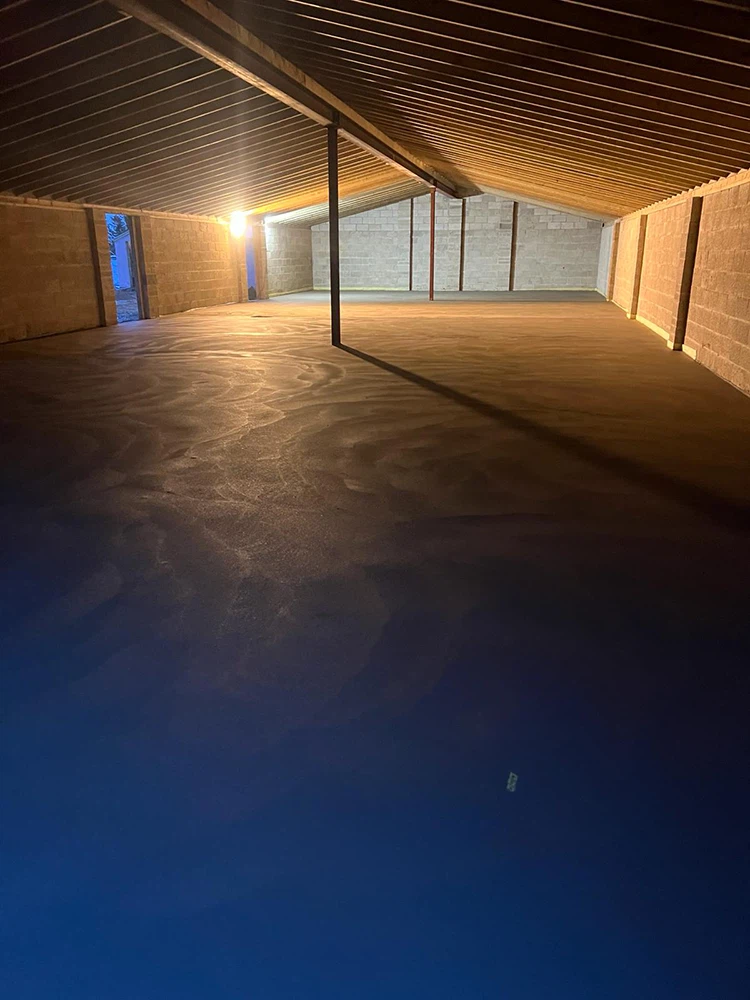
K & B Screeding’s own team, led by director Donatas Bardisevicius. Founded 2019, company 12298780.
See what customers say in our Google reviews and on our testimonials page.
Sand and Cement Screed from Slough to Solihull
On the map, Solihull sits north-west of Slough, about 77.7 miles from our base in a straight line (postcodes including B91, B26, B92 and B90), next to Kenilworth (9.7 miles), Redditch (10.1 miles), Coventry (11.4 miles) and Warwick (12 miles).
More on sand & cement screed, part of our screeding services.