
Renewing tired solid floors in older Warwick houses
A solid ground floor in an older house can fail in a few ways. The concrete cracks or sinks, there is no damp proof membrane, or there is no insulation at all. Patching fixes none of those. Taking the floor out, adding a membrane and insulation, then screeding over them is what lasts.
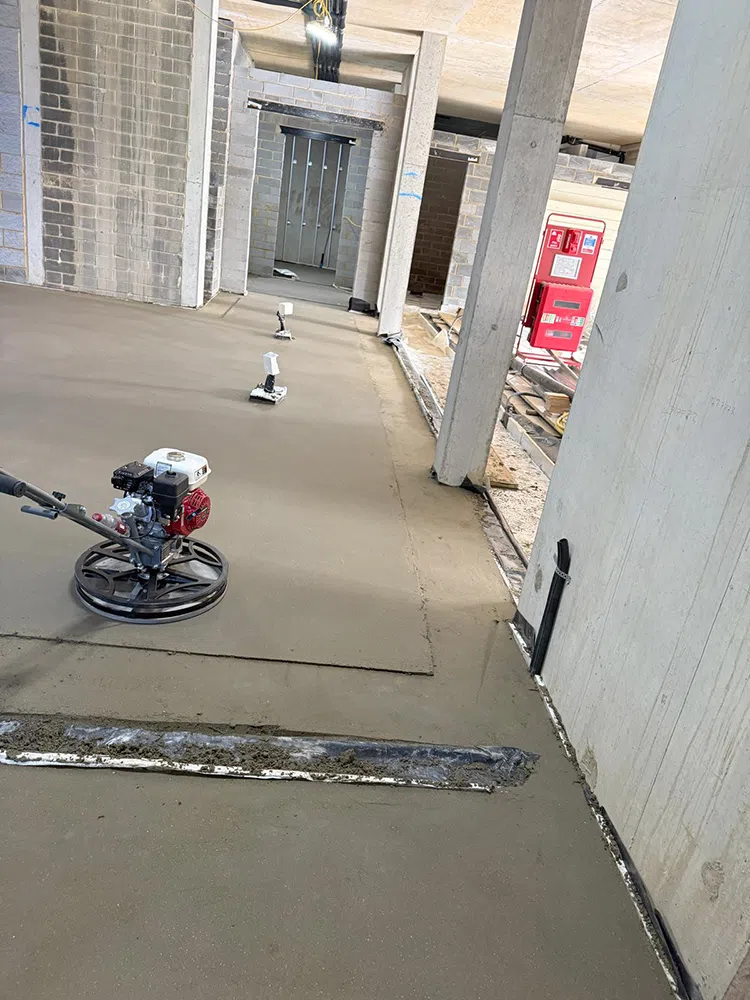
That is hand-laid work by nature, and sand and cement handles it well. Each mix is made on site for the area and depth being laid, and the screed is compacted and finished to a dense, level surface. It copes with a run of small rooms, a hallway and a kitchen at slightly different levels without needing a pump on the street.
Floating over insulation, a Warwick house gets 65mm and a commercial unit 75mm. If you are adding underfloor heating as part of the work, the screed needs about 45mm over the pipes, and the Warwick heated floor screed page explains the rest.
In the centre, Georgian and older townhouses are a different problem. Finished floor heights there often cannot change without trouble at doors and stairs, so a screed bonded to a sound base at 25 to 40mm, or a thin levelling layer, is the usual route. Our bonded screed page explains how a bonded floor is prepared and laid, and why the base matters as much as the screed.
Wet rooms, garages and workshops in Warwick
Cement screed is the right base wherever water is a risk. Calcium sulphate and water do not get on, so a Warwick wet room, walk-in shower or leak-prone utility goes on a cement floor. Laying by hand also means the floor can be tilted gently so water finds the drain.
A Warwick garage being turned into a room is another job that calls for hand-laid screed. The garage floor is normally built up to match the house, with a membrane and insulation tucked beneath the screed, and our guide to garage floor screeding shows how, step by step.
Where a floor must carry load early, such as a workshop or store, sand and cement gives a cement substrate that can be strengthened. Mixing in fibres costs £1 to £3 extra per m², and a stronger mix is an option where loads are heavier.
The catch with a Warwick cement floor is that it asks for patience. It dries slower than liquid, roughly one day to each millimetre through 40mm and slower beneath that, and any heating under it stays off for 21 days at least. For an open, dry room where speed counts, Warwick liquid screed may suit better, and quick drying screed shortens the wait on a cement floor.
Sand and Cement Screed prices in Warwick
Sand and cement screed: £18 to £25 per m² supplied and laid (MyJobQuote, August 2026), so £450 to £630 for 25 m². MyJobQuote does not say whether these figures include VAT. See our floor screeding cost guide or screed calculator.
Who lays your sand and cement screed in Warwick
K & B Screeding’s own team, led by director Donatas Bardisevicius. Founded 2019, company 12298780.
See what customers say in our Google reviews and on our testimonials page.
Sand and Cement Screed from Slough to Warwick
On the map, Warwick sits north-west of Slough, about 65.8 miles from our base in a straight line (postcodes including CV34), next to Royal Leamington Spa (2.3 miles), Kenilworth (4.1 miles), Stratford-upon-Avon (8 miles) and Coventry (9.3 miles).
More on sand & cement screed, part of our screeding services.
