
Replacing worn solid floors in older Rugby houses
The town's school dates from 1567, but it was the railway from 1838 that made Rugby a nationally important rail centre, followed by engineering firms and cement works. Today, terraces are 24% of the houses and flats in Rugby. Ground floors laid before membranes were standard can be damp, cracked or sunk at the edges.
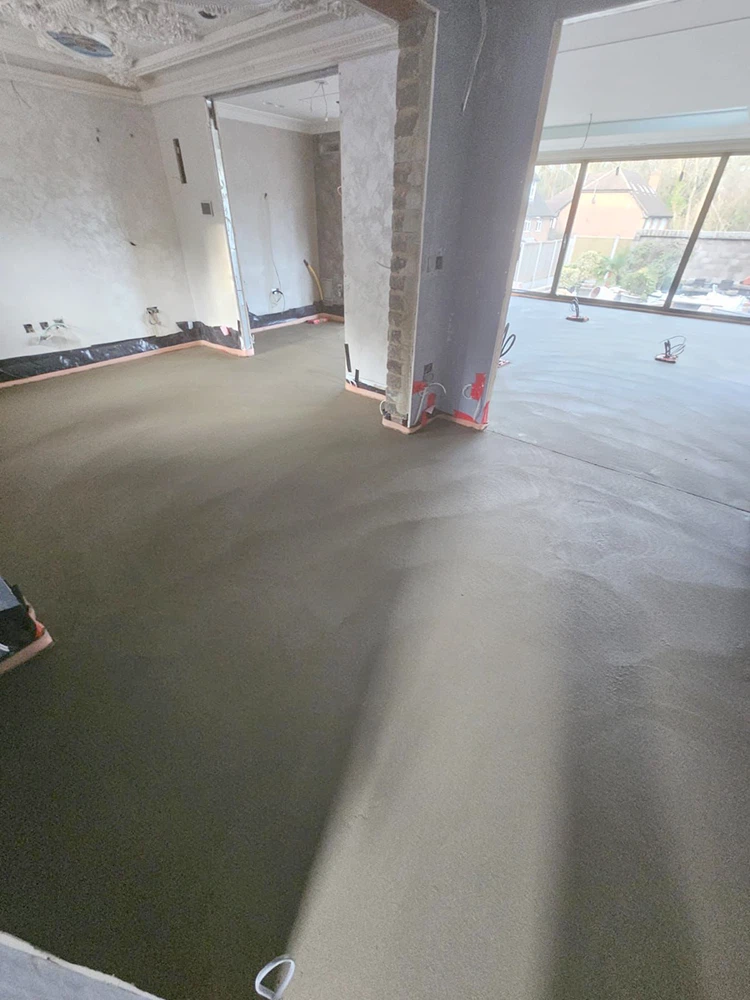
A floor that sounds hollow when tapped, or shows a tide mark at the skirting, is worth checking before any new finish goes down. When a solid floor has failed, patching rarely lasts. The reliable fix follows a set order. We break up the failed slab, cart it off and firm up the ground beneath. On that go the damp proof membrane and the insulation, both laid by us as membrane and insulation work. The new floating screed then follows, around 65mm deep in a house or 75mm in commercial premises, beaten down hard and trowelled until it is tight and level.
A hand-laid floor copes with an irregular plan. The crew mixes for one room at a time, works around steps and chimney breasts, and needs no pump parked outside.
If the concrete is solid and only the top is crumbling, a thinner bonded screed of 25 to 40mm, fixed to the prepared slab, might be all it needs. That saves digging, but the base has to be clean and keyed first, and a loose or damp slab still needs replacing.
Garages, wet rooms and workshops in Rugby
Even in a brand new Rugby house, certain floors still get sand and cement. A level-access shower only works if water heads for the outlet, and a trowelled screed can be given exactly that gradient. Where water sits, calcium sulphate is out, and cement is the material that copes.
Garages are the other common one. Because a garage is normally lower than the rooms beside it, often by a step or more, converting one means building up insulation, membrane and screed, sized so the new floor lands level with the hall. How a garage floor screed is put together shows the layers. A workshop floor that has to take a load early, or a floor needing a cement base for its adhesive, also points this way.
The cost of all this is slower drying than liquid screed. Adding fibres against cracking is roughly £1 to £3 a square metre extra, and a faster drying mix takes weeks off the wait. For a floor that only needs flattening, see floor levelling across Rugby.
Sand and Cement Screed prices in Rugby
Sand and cement screed: £18 to £25 per m² supplied and laid (MyJobQuote, August 2026), so £450 to £630 for 25 m². MyJobQuote does not say whether these figures include VAT. See our floor screeding cost guide or screed calculator.
Who lays your sand and cement screed in Rugby
K & B Screeding’s own team, led by director Donatas Bardisevicius. Founded 2019, company 12298780.
See what customers say in our Google reviews and on our testimonials page.
Sand and Cement Screed from Slough to Rugby
On the map, Rugby sits north-north-west of Slough, about 63.8 miles from our base in a straight line (postcodes including CV21 and CV22), next to Lutterworth (6.3 miles), Daventry (9 miles), Coventry (10.6 miles) and Bedworth (11.5 miles).
More on sand & cement screed, part of our screeding services.