
Underfloor heating screed in new Rugby homes
A heated floor depends on its screed. The screed spreads heat from the pipes across the room and carries the floor finish, and it can only do both at the right depth.
Pumped liquid needs a 25mm minimum over the pipe crowns, and the floor ends up roughly 45 to 50mm deep overall. Hand-laid sand and cement calls for closer to 45mm over them. Liquid screed flows completely around every pipe, leaving no air gaps, so the system warms up faster and runs more efficiently. That is why it is the usual choice over heating in new homes, and our page on pumped liquid screed for Rugby explains how it is laid.
Rugby has 24% detached houses, and 12% of its homes were put up between 2000 and 2014. A large detached house or a wide extension gives a big heated floor area, which a pumped screed can cover in a single day. In an extension, the depth is not a free choice: insulation, pipe clips, screed and floor finish all have to fit the level of the existing house, so the build-up is checked against the drawings before anything is ordered.
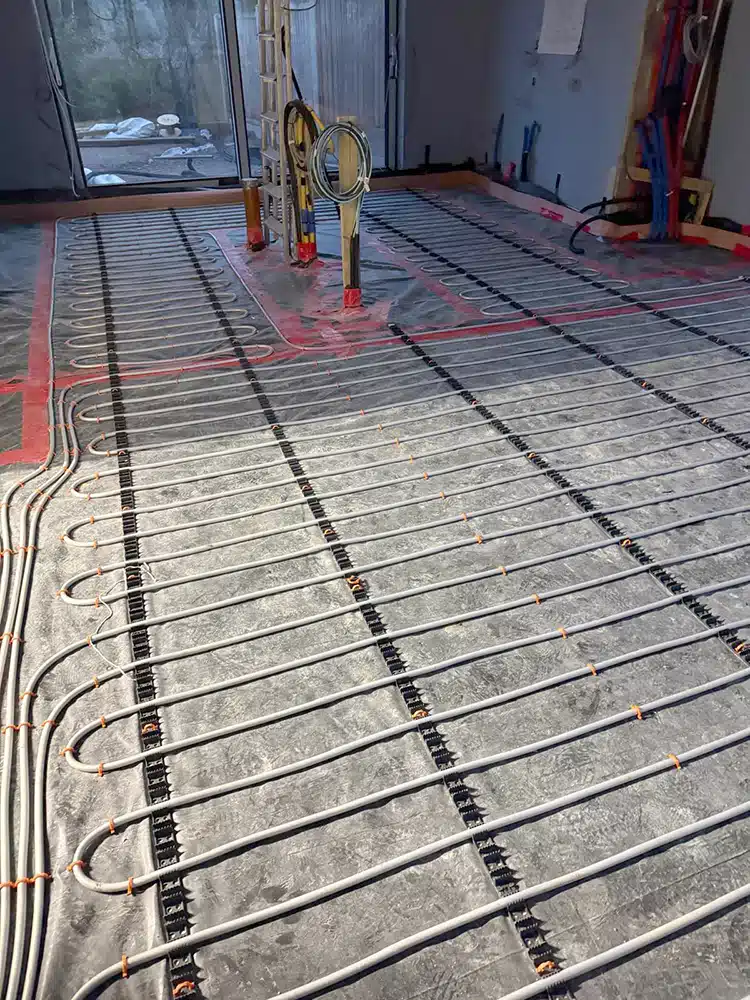
By the time we arrive, the installer should have the loops clipped down and pressure tested over a fitted membrane, with the perimeter strip round the walls. We check the build-up and the levels before the pour. Depths by screed type are tabled in how thick a screed should be, and the pipework itself is never part of our job.
Adding heating to an older Rugby floor
An older Rugby house is a tougher place to add heating than a Houlton new build. Floor height is usually tight: adding insulation, pipes and screed on top of an existing floor would leave steps at every doorway. The usual answer is to take the old floor out, then rebuild it with a membrane, insulation, pipes and new screed. Our insulation and membranes work covers the layers below.
Once the screed is down, the heating must be introduced slowly. A calcium sulphate pour is usually ready for gentle heat a week in, at about 7 days. Sand and cement stays unheated for three weeks, 21 days, at minimum. Whichever it is, the water goes round cool to begin with, is turned up a notch at a time across several days, sits at its peak for a while and is then eased off. Turning the system up too fast can crack the screed.
That programme is written out for you, so your household and your heating engineer are reading from one sheet. A calcium sulphate floor also needs its surface laitance sanded off before tiling; anhydrite screed explained covers why.
Underfloor Heating Screed prices in Rugby
Liquid screed over underfloor heating: £20 to £35 per m² supplied and laid (trade2base, June 2026), so £700 to £1,230 for 35 m². trade2base gives these figures excluding VAT. See our floor screeding cost guide or screed calculator.
Who lays your underfloor heating screed in Rugby
K & B Screeding’s own team, led by director Donatas Bardisevicius. Founded 2019, company 12298780.
See what customers say in our Google reviews and on our testimonials page.
Underfloor Heating Screed from Slough to Rugby
On the map, Rugby sits north-north-west of Slough, about 63.8 miles from our base in a straight line (postcodes including CV21 and CV22), next to Lutterworth (6.3 miles), Daventry (9 miles), Coventry (10.6 miles) and Bedworth (11.5 miles).
More on underfloor heating screed, part of our screeding services.
