
Pipe cover in Earl Shilton extension floors
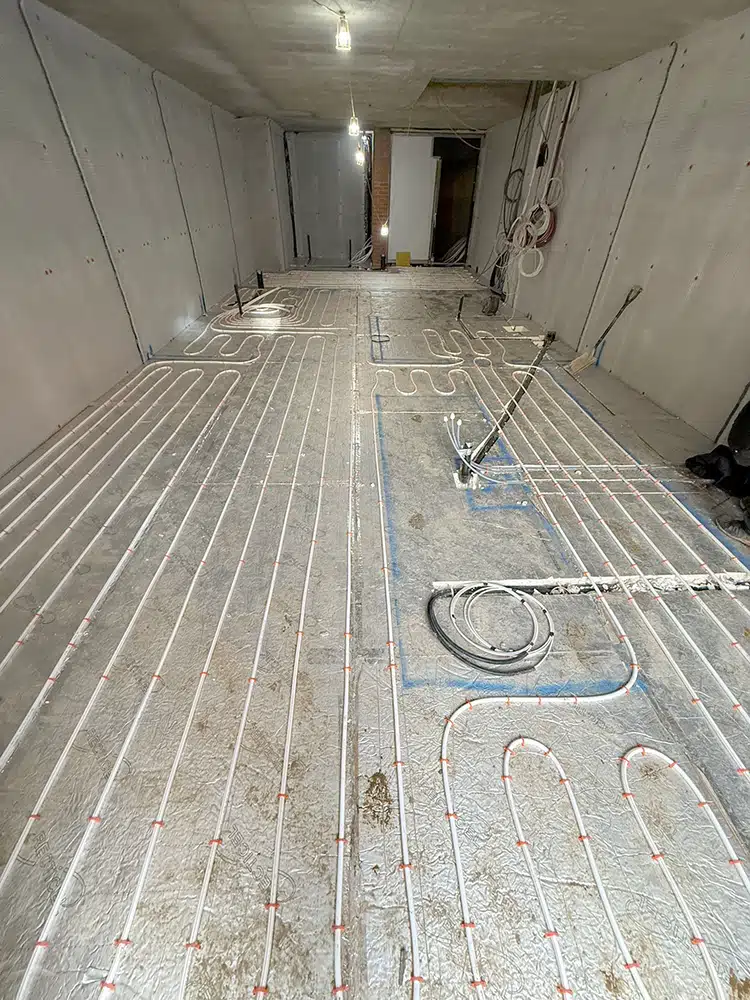
A heated extension floor is built in layers: insulation on the slab, a membrane, heating pipes clipped down, and then the screed. That last layer protects the pipes and spreads their heat evenly across the room, so its depth matters.
Poured screed must sit 25mm or more above the top of the pipes, which normally brings the floor to 45 to 50mm in all. Hand-laid screed calls for roughly 45mm over them, so that build-up is thicker. Skimp on it and cracks can open along the line of each loop. Too much makes the room slow to warm and cool.
Pumped screed closes round each loop and leaves no trapped air, the main reason heated kitchen diners tend to get it. A hand-laid floor is still an option, especially where the base has to be cement, as long as it is tamped tight against the pipes.
On a garage conversion, the depth question is sharper. Insulation, pipes and screed all have to squeeze into the gap between the old garage floor and the hall, and the few millimetres saved by pouring a thinner flowing screed can be what makes it fit.
Before the pour, the heating engineer pressure tests the circuit and leaves it under pressure. On the day we go over the boards, membrane and perimeter strip; if you want us to provide them, see our insulation and membrane supply. As a guide, a heated floor in liquid screed is priced at £20 to £35 per m² on published figures.
Switching the heating on in Earl Shilton homes
Leave the thermostat alone at first. With calcium sulphate, the heating can normally come on around a week after the pour; with sand and cement, give it 21 days as a minimum. From there, edge the flow temperature upwards bit by bit over several days, as the commissioning sheet we hand over describes. Jump straight to full heat and the screed dries too fast and may crack.
Used carefully, the heating then helps the screed dry down to the moisture level the flooring needs. Keep a simple log of the temperatures and dates, because flooring and adhesive makers may ask for it later, and it helps the floor fitter judge when to test. The drying times guide explains how depth and screed type change the wait.
Detached houses make up 25% of Earl Shilton's homes, and retrofitting heating into an existing floor in one of those, or in a semi, comes up against floor height. Unless the old floor is being dug out anyway, there is often little room for insulation plus pipes plus screed under existing doors. In that case a heating system designed for low build-up heights, and a thin liquid screed, is worth discussing with the heating engineer early.
Underfloor Heating Screed prices in Earl Shilton
Liquid screed over underfloor heating: £20 to £35 per m² supplied and laid (trade2base, June 2026), so £700 to £1,230 for 35 m². trade2base gives these figures excluding VAT. See our floor screeding cost guide or screed calculator.
Who lays your underfloor heating screed in Earl Shilton
K & B Screeding’s own team, led by director Donatas Bardisevicius. Founded 2019, company 12298780.
See what customers say in our Google reviews and on our testimonials page.
Underfloor Heating Screed from Slough to Earl Shilton
As the crow flies, our yard in Slough is about 77.6 miles from Earl Shilton, which lies to the north-north-west. Postcodes here include LE9, and Hinckley (3.4 miles), Nuneaton (7.4 miles), Leicester (8.7 miles) and Bedworth (9.4 miles) are close by.
More on underfloor heating screed, part of our screeding services.
