
Adding heated floors to older Leicester houses
If an older house is going to get underfloor heating, the simplest time to fit it is while the old floor is being taken up for other reasons. In the city's pre-1919 houses, a renovation that replaces a suspended timber floor or an unprotected solid floor with an insulated slab and a new membrane leaves a clean build-up, and the heating pipes can go in between insulation and screed.
Height is what decides the method. Over the pipes, liquid screed must give 25mm of cover at the least, which brings the whole screed to about 45 to 50mm. Sand and cement calls for roughly 45mm of cover and so ends up thicker. When height is tight to the millimetre, a thinner pumped screed is normally how the new floor stays level with the hall and the back door.
Post-war semis in and around Braunstone raise the same question at the back of the house, where a kitchen extension or garage conversion is getting its own heated floor that has to line up with the existing rooms.
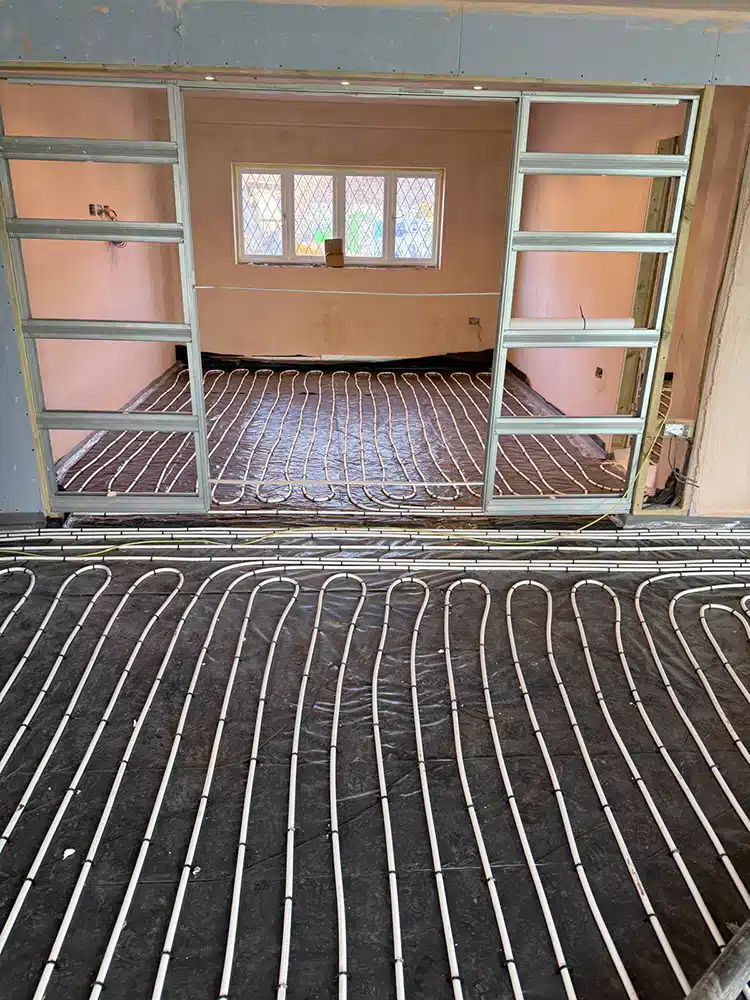
Laying and pressure testing the pipe circuit is the heating engineer's work, not ours, and we screed over it afterwards. We then check that the insulation, the edge strip and the membrane are all in place before pouring. If they are not, our insulation and membranes work can provide them.
Beaumont Leys homes and the first heat-up
The larger modern homes in Beaumont Leys suit liquid screed laid over wet underfloor heating, and heated extensions and garden rooms across the city follow the same approach on a smaller scale. Whatever the building, the rules for bringing the heating on are the same.
With calcium sulphate, the heating can usually come on from about 7 days after pouring. For sand and cement the minimum is 21 days. Then the warm-up goes gently: low water temperature to begin, raised a little at a time over several days, held there, and lowered again before any moisture test. Heat it up all at once and the screed can crack.
You get the commissioning schedule on paper, so heating engineer, builder and homeowner are all following one plan.
Flooring still waits for a moisture reading within the manufacturer's limit, even on a heated floor. Drying timescales are set out in our guide to screed drying times.
Where the house also has a wet room or utility, those areas may need a different screed from the heated living space, so it pays to plan the whole ground floor at once. The same service covers heated floors in Lutterworth and other nearby towns.
Underfloor Heating Screed prices in Leicester
Liquid screed over underfloor heating: £20 to £35 per m² supplied and laid (trade2base, June 2026), so £700 to £1,230 for 35 m². trade2base gives these figures excluding VAT. See our floor screeding cost guide or screed calculator.
Who lays your underfloor heating screed in Leicester
K & B Screeding’s own team, led by director Donatas Bardisevicius. Founded 2019, company 12298780.
See what customers say in our Google reviews and on our testimonials page.
Underfloor Heating Screed from Slough to Leicester
On the map, Leicester sits north-north-west of Slough, about 78.9 miles from our base in a straight line (postcodes including LE1, LE2, LE3 and LE7), next to Earl Shilton (8.7 miles), Hinckley (12 miles), Lutterworth (12.7 miles) and Market Harborough (13.9 miles).
More on underfloor heating screed, part of our screeding services.
