
Replacing old ground floors in Clarendon Park houses
Clarendon Park filled with houses designed by local architects through the 1880s and 1890s. In houses from that era, and across the city's other pre-1919 streets, the original ground floor is often one of two types: suspended timber boards over a void, or a solid floor laid before damp proof membranes were standard. Both can be cold, and the solid kind can be damp.
When a renovation replaces either one, the work runs in a set order. The old floor comes out and the ground is prepared to a firm base, then rigid insulation goes down, followed by a damp proof membrane turned up at the walls. The screed goes on top. Over insulation in a house, the floating screed is laid about 65mm thick, and how deep to dig is worked back from where the finished floor must end up.
Small, divided and irregular rooms are common in these houses, which is where laying by hand pays off. It can be laid around chimney breasts, into bays and through narrow doorways without the dams a flowing screed would need, and it gives a cement surface that most tile adhesives are designed for.
Where the old slab is still sound and only its top has broken down, bonding a 25 to 40mm screed to it may be all that is needed. Our floor preparation service covers breaking out and cleaning the base, and the screed thickness guide shows which depth fits which build-up.
Braunstone garage conversions and Leicester wet rooms
The post-war semis in and around Braunstone are where garage conversions tend to come up. Garage floors usually sit below the house, can slope down to the door and often lack a damp proof membrane. To convert one, the floor is built up in layers of insulation, membrane and screed to meet the hall or kitchen level. Our guide to garage floor screeds goes through the layers.
Wet rooms are another reason to choose sand and cement anywhere in the city. The shower area needs a fall to the drain, formed by hand in the screed, and it must tolerate water, which rules out calcium sulphate. The same applies to many utility rooms.
The catch is drying time. It dries more slowly than liquid screed: allow around a day for every millimetre up to 40mm, and longer beyond. Where a renovation cannot wait, a fast drying sand and cement screed shortens the programme, and published 2026 UK figures put it at £20 to £28 per m².
On heavier or busier floors, fibres can be added to control cracking, and higher strength mixes are available. We will suggest which fits once we know how the room will be used.
Sand and Cement Screed prices in Leicester
Sand and cement screed: £18 to £25 per m² supplied and laid (MyJobQuote, August 2026), so £450 to £630 for 25 m². MyJobQuote does not say whether these figures include VAT. See our floor screeding cost guide or screed calculator.
Who lays your sand and cement screed in Leicester
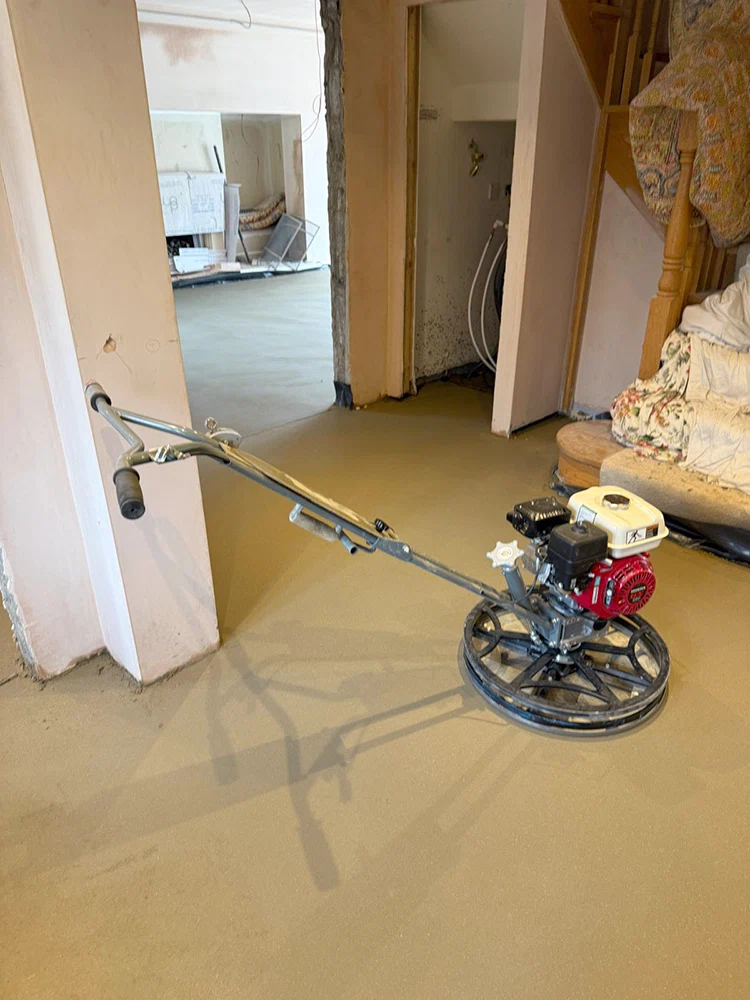
K & B Screeding’s own team, led by director Donatas Bardisevicius. Founded 2019, company 12298780.
See what customers say in our Google reviews and on our testimonials page.
Sand and Cement Screed from Slough to Leicester
On the map, Leicester sits north-north-west of Slough, about 78.9 miles from our base in a straight line (postcodes including LE1, LE2, LE3 and LE7), next to Earl Shilton (8.7 miles), Hinckley (12 miles), Lutterworth (12.7 miles) and Market Harborough (13.9 miles).
More on sand & cement screed, part of our screeding services.
