
Relaying solid floors in Lutterworth's historic core
Lutterworth's centre is a Conservation Area, full of half-timbered buildings and former coaching inns. Only 6% of the town's homes date from before 1919, and those older buildings are where a floor more often needs rebuilding rather than covering.
The signs are familiar to anyone renovating an old building: damp patches at the edges, a floor that is cold underfoot, flooring that lifts or stains. Putting new flooring straight over the top just hides the fault for a time.
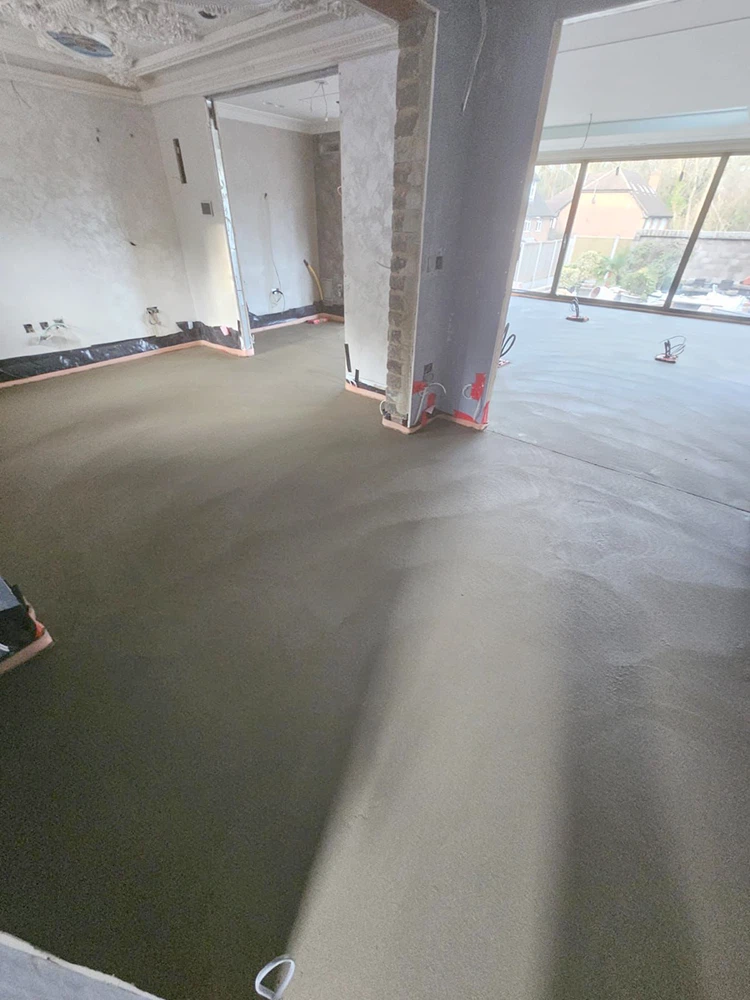
The lasting fix goes in stages. The old floor is broken out to a firm base, which our floor preparation team handles. Rigid insulation goes down, then a damp proof membrane turned up at the walls, and then the screed. The screed itself is about 65mm when floated over insulation in a house, and the dig has to be deep enough for both layers if the finished floor is to meet the thresholds already there.
For this kind of work, sand and cement makes practical sense. Because the mix is made on site area by area and compacted by hand, small rooms, uneven walls and doorways that would need a lot of damming for a flowing screed are no trouble. Most tile adhesives are also made for the cement surface it leaves.
Where the slab below is still sound, a 25 to 40mm bonded screed fixed directly to it can be enough. Our thickness guide explains the options.
Wet rooms, garages and heavier floors in Lutterworth
Some rooms call for sand and cement wherever they are in the town. A wet room shower floor needs a fall to the drain, formed by hand in the screed, and the screed must tolerate water, which calcium sulphate does not. Utility rooms and tiled bathrooms follow the same rule.
Garage conversions raise their own questions. Garage slabs tend to sit lower than the house, may fall towards the door and often have no membrane. Our guide to converted garage floors sets out the layers of insulation, membrane and screed that raise it to the level of the house.
Sand and cement also suits floors that need to carry load early, or where a cement substrate is required. Adding fibres to limit cracking costs £1 to £3 per m², based on published 2026 UK figures, and for heavier use there is a higher strength mix.
Where sand and cement loses out is drying time. A 65mm floor needs several weeks before timber, vinyl or tiles go on, since the first 40mm dry at about a millimetre a day and the rest more slowly. Plan the flooring fitter around that date.
Sand and Cement Screed prices in Lutterworth
Sand and cement screed: £18 to £25 per m² supplied and laid (MyJobQuote, August 2026), so £450 to £630 for 25 m². MyJobQuote does not say whether these figures include VAT. See our floor screeding cost guide or screed calculator.
Who lays your sand and cement screed in Lutterworth
K & B Screeding’s own team, led by director Donatas Bardisevicius. Founded 2019, company 12298780.
See what customers say in our Google reviews and on our testimonials page.
Sand and Cement Screed from Slough to Lutterworth
As the crow flies, our yard in Slough is about 68 miles from Lutterworth, which lies to the north-north-west. Postcodes here include LE17, and Rugby (6.3 miles), Hinckley (9.5 miles), Earl Shilton (9.7 miles) and Bedworth (11.6 miles) are close by.
More on sand & cement screed, part of our screeding services.
