
Rebuilding original floors in Coundon and Cheylesmore
An original solid floor from the inter-war years has usually done its job, but it was not built to modern standards. Often there is no damp proof membrane or insulation under it, and the surface may have cracked or sunk over the decades. In Coundon, Cheylesmore and similar areas, renovations tend to deal with that by starting again.
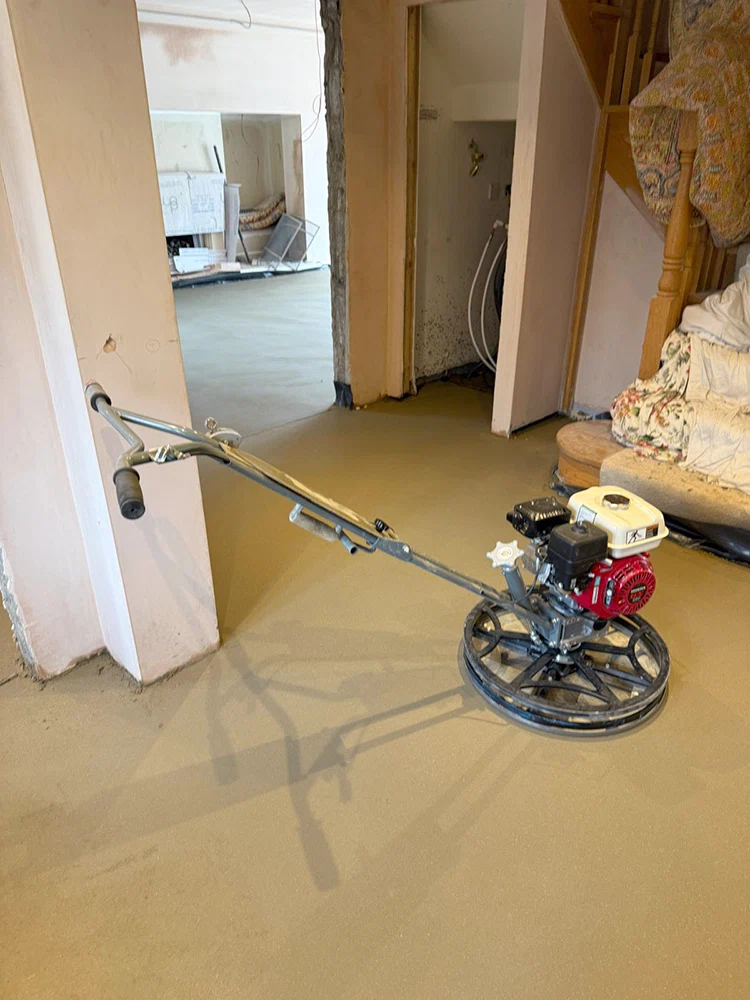
The sequence is straightforward. Out comes the old concrete, in go a damp proof membrane and insulation, and the screed finishes it. A floating sand and cement screed in a home goes down at 65mm, and at 75mm in a commercial building. Each batch is made up outside the house for the room and depth in hand, then packed down by hand and power floated until dense and level.
Sand and cement suits these jobs because of the rooms. An older house tends to have separate rooms, a hallway and a kitchen rather than one open floor, and a hand-laid screed is easy to set to each one without a pump on the street. It is also cost effective on small and awkward areas, where a pump would spend longer setting up than pouring.
If the Coventry slab underneath is still solid and only its surface has worn, a 25 to 40mm bonded screed fixed directly to it keeps the floor low. Our floor preparation service covers the dig-out and the base.
Wet rooms, garages and heated floors in Coventry
Bathrooms and utilities need a cement based floor. Since calcium sulphate cannot cope with water, a Coventry wet room, walk-in shower or utility that might leak goes onto sand and cement, which the screeder can also slope towards the drain.
Garage conversions often join a rebuilt ground floor. Garage slabs normally sit below the house floor, so insulation, a membrane and screed lift them to hall level, as our step-by-step garage screed guide shows.
Heating can go under sand and cement too, with about 45mm of cover over the pipes. With a sand and cement floor over pipes in a Coventry semi, the system stays cold for three weeks, 21 days at the least, and is then warmed up gently, a little more each day. For a wide extension where speed matters, Coventry liquid screed dries sooner and suits an open-plan room.
Drying is the honest drawback. A 65mm floor drying at about 1mm per day through its upper 40mm, then more slowly, keeps tiles and timber waiting for weeks. Quick drying screed mixes shorten that when a kitchen fitter is waiting.
Sand and Cement Screed prices in Coventry
Sand and cement screed: £18 to £25 per m² supplied and laid (MyJobQuote, August 2026), so £450 to £630 for 25 m². MyJobQuote does not say whether these figures include VAT. See our floor screeding cost guide or screed calculator.
Who lays your sand and cement screed in Coventry
K & B Screeding’s own team, led by director Donatas Bardisevicius. Founded 2019, company 12298780.
See what customers say in our Google reviews and on our testimonials page.
Sand and Cement Screed from Slough to Coventry
On the map, Coventry sits north-north-west of Slough, about 70.8 miles from our base in a straight line (postcodes including CV1, CV2, CV5 and CV3), next to Bedworth (5.1 miles), Kenilworth (5.4 miles), Nuneaton (8.1 miles) and Royal Leamington Spa (8.1 miles).
More on sand & cement screed, part of our screeding services.
