
Rebuilding a failed solid floor in a Nuneaton terrace
Terraced houses make up 26% of Nuneaton's homes, and 13% of the town's housing was built before 1919. Floors of that era were rarely laid with a membrane, so damp, cracking and sinking are common reasons to start again.
The order of work is fixed. Step one is breaking out the tired slab and clearing it from the house. The ground is made good, then a damp proof membrane goes down, followed by insulation to the depth the building regulations require. We handle that layer too, through our membrane and insulation work. The new screed is laid on top as a floating screed, which in a house means about 65mm of sand and cement.
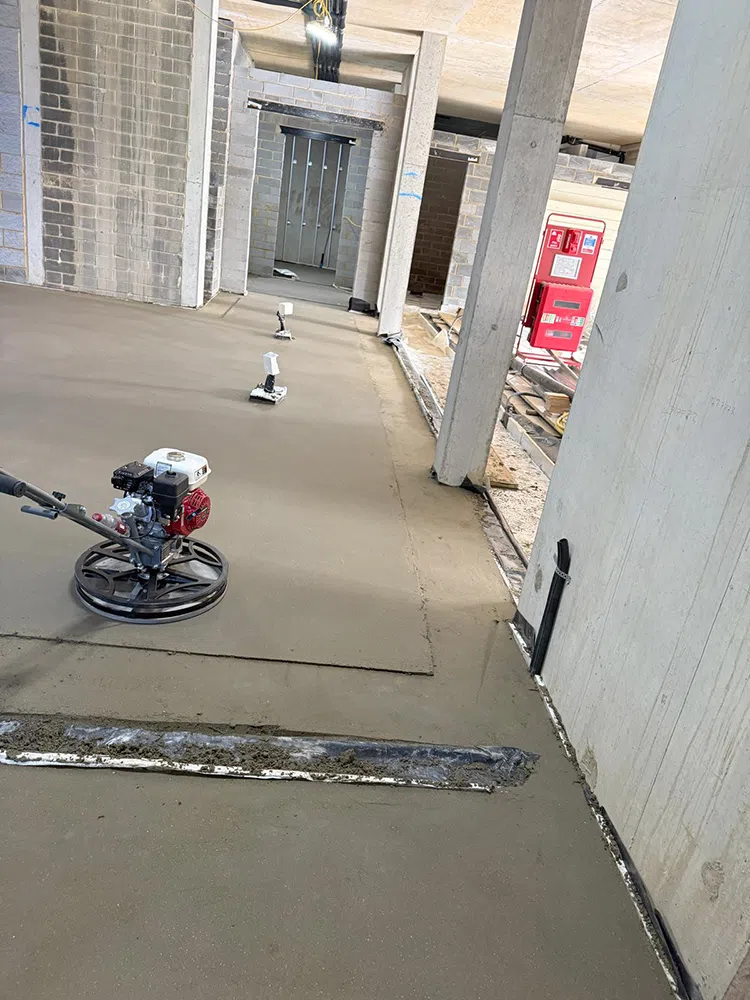
Hand-laid screed suits this kind of job because each room can be mixed and laid in turn. Narrow hallways, steps between rooms, a chimney breast or an old pantry are no obstacle, and nothing depends on a pump standing in the street. Each section is tamped down hard and trowelled flat, leaving a dense top for the floor covering.
Not every terrace needs digging out. If the concrete underneath is solid and only its surface has gone, 25 to 40mm of new screed can be bonded directly to it once it is prepared. That saves digging, but the slab must be clean and keyed first, which is where our floor preparation work comes in. Describe the cracks, damp patches or dips you have now, and we can say which of the two suits the house.
Wet rooms, garages and small rooms in Nuneaton
Some jobs only sand and cement can do. A walk-in shower or wet room relies on a gentle slope towards its gully, and because a hand-laid mix is shaped with a trowel, that fall can be built in exactly. Rooms that get wet also rule out calcium sulphate, so cement is the material there.
Garage conversions are another. To make a garage into a living room, the floor normally has to be raised to the level of the house with insulation and a membrane underneath, and our guide to garage floor screed walks through the layers. If a floor has to carry weight early, or the adhesive specified needs a cement base, that also points to sand and cement.
The catch is the wait. At 65mm, a hand-laid floor takes much longer to dry than a thinner liquid one, so book the tiler and floor fitter with that in mind. Fibres mixed in to resist cracking add roughly £1 to £3 a square metre, while a rapid drying additive trims the weeks. Where the floor is sound and simply uneven, levelling an existing Nuneaton floor is quicker and costs less than rebuilding it.
Sand and Cement Screed prices in Nuneaton
Sand and cement screed: £18 to £25 per m² supplied and laid (MyJobQuote, August 2026), so £450 to £630 for 25 m². MyJobQuote does not say whether these figures include VAT. See our floor screeding cost guide or screed calculator.
Who lays your sand and cement screed in Nuneaton
K & B Screeding’s own team, led by director Donatas Bardisevicius. Founded 2019, company 12298780.
See what customers say in our Google reviews and on our testimonials page.
Sand and Cement Screed from Slough to Nuneaton
Nuneaton is about 76.9 miles north-north-west of our Slough base as the crow flies, with postcodes including CV11 and CV10. The nearest towns to it are Bedworth (3 miles), Hinckley (4.2 miles), Earl Shilton (7.4 miles) and Coventry (8.1 miles).
More on sand & cement screed, part of our screeding services.
