
Digging out old ground floors in Royal Leamington Spa
Terraced houses are 23% of homes in Royal Leamington Spa, and many of the town's older houses have ground floors laid long before membranes were standard. Rising damp, crumbling surfaces and floors that have dropped at the edges are all signs that patching will not hold.
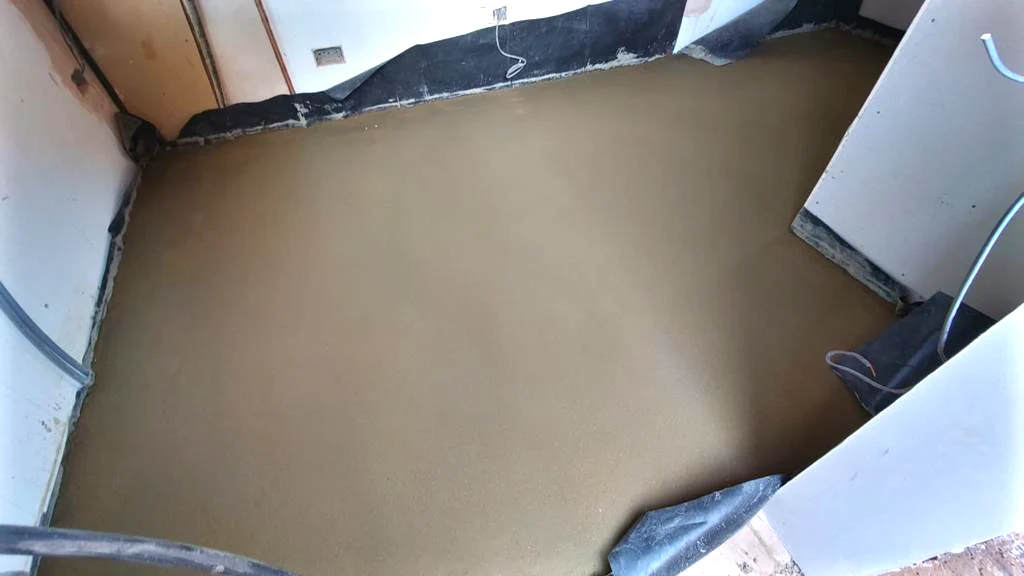
Rebuilding follows a fixed sequence. Out comes the old floor first, broken up and removed. The base is made good, then a damp proof membrane goes down and insulation follows to current standards. Those layers are something we lay as well, as part of our insulation and membrane work. On top goes a floating screed of around 65mm for a house, packed down firmly and trowelled until it is dense and level.
Working by hand also suits the layout of an older house. Alcoves, chimney breasts and changes of level are screeded room by room, with each batch mixed for the space in front of the crew, and no pump has to find room on the street.
Sometimes the concrete is solid and only the skin has failed, and then bonding a fresh 25 to 40mm layer onto the prepared slab can be enough. That avoids digging out, but the surface must be clean and keyed first. Where the house is a conversion with timber floors upstairs, the upper floors are a separate question, usually answered with lightweight or acoustic systems rather than sand and cement.
Wet rooms, falls and garages in Royal Leamington Spa
A few kinds of floor in Royal Leamington Spa end up in sand and cement however old the house is. In a wet room or level-access shower, the screed has to drain towards the outlet, and laying by hand lets the crew build that slope to the millimetre. Calcium sulphate is ruled out where floors get wet, so cement takes over.
Garage conversions are another. A converted garage usually sits lower than the hallway, and bringing it up with insulation and a membrane below is explained in how a garage floor screed is built up. If the floor has to bear weight soon after laying, or the tile adhesive chosen needs a cement base, the answer is the same.
Homes built between 1919 and 1944 are 10% of the stock. A floor from that period is judged on its condition: a sound slab can take a bonded topping, while a damp or broken one is rebuilt.
The price of hand-laying is a long drying time, far slower than liquid screed. Mixing in fibres, as fibre reinforced screed, helps against cracking at roughly £1 to £3 a square metre, and a quick drying screed cuts the wait when the trades are queued up behind it. Working a few miles north? There is a page on hand-laid screed in Kenilworth too.
Sand and Cement Screed prices in Royal Leamington Spa
Sand and cement screed: £18 to £25 per m² supplied and laid (MyJobQuote, August 2026), so £450 to £630 for 25 m². MyJobQuote does not say whether these figures include VAT. See our floor screeding cost guide or screed calculator.
Who lays your sand and cement screed in Royal Leamington Spa
K & B Screeding’s own team, led by director Donatas Bardisevicius. Founded 2019, company 12298780.
See what customers say in our Google reviews and on our testimonials page.
Sand and Cement Screed from Slough to Royal Leamington Spa
Royal Leamington Spa is about 64.9 miles north-west of our Slough base as the crow flies, with postcodes including CV32, CV34 and CV31. The nearest towns to it are Warwick (2.3 miles), Kenilworth (3.9 miles), Coventry (8.1 miles) and Stratford-upon-Avon (10 miles).
More on sand & cement screed, part of our screeding services.
