
Calcium sulphate grades for Royal Leamington Spa apartments
A specification line such as CA-C25-F5 is shorthand. CA is calcium sulphate. After the C comes the strength in compression and after the F the strength in bending, each in N/mm2 and each a class from the European standard for screed materials. Read together, they say how much load the floor was designed for.
Three grades cover most work. A Leamington house whose floors get only gentle wear can take CA-C20-F4, the lightest of the three. The middle grade, CA-C25-F5, is what most homes, apartment blocks and offices are given, and CA-C30-F6 sits at the heavy end. When the grade is on the drawing, that is the product we lay, not a near equivalent. If the drawing names no grade, ask the designer before ordering, because the choice affects strength and the floor build-up.
With a quarter of Leamington homes in purpose-built blocks, calcium sulphate often turns up on flat drawings here. Its shrinkage is low, which lets a whole apartment floor go down in wide bays with hardly any joints, and its surface is flat enough for the thin coverings flats tend to have. In a converted building, the structure around the screed often dictates the specification, so we follow the designer's build-up exactly.
Alpha hemihydrate is its own family, picked when the programme needs quicker drying or the floor must be slimmer. Its data sheet, not the usual depth rules, sets how it is laid. Our team settles the bay and joint layout before pouring, and puts down the insulation, membrane and edge strip itself. Background on how calcium sulphate behaves is in the anhydrite screed guide.
Before flooring goes down in Royal Leamington Spa
Calcium sulphate grows a thin, crumbly skin as it cures, known as laitance. Nothing you stick to the floor will hold well on it, so once dry, the floor is abraded back to firm material, vacuumed and given a calcium sulphate primer. Using the wrong primer is a common route to failed tiles.
Moisture is the other check. Flooring makers often allow calcium sulphate less moisture than cement before their covering goes down, so the floor is only signed off once a hygrometer reading says so. Where pipes run through it, warming the floor from around the seventh day speeds that up.
Only 6% of Leamington's homes have been built since 2015, so fresh new build is a small part of the picture. An anhydrite floor here is just as likely to be going into a refurbished flat or an extension as into a new block.
Bathrooms that get soaked, utilities and the like are no place for calcium sulphate. In those rooms a flowing screed with a cement binder goes in, or sand and cement laid in the traditional way. If the floor will need flattening afterwards, see our Royal Leamington Spa floor levelling page.
Anhydrite & Flow Screed prices in Royal Leamington Spa
Liquid flowing screed (which includes anhydrite): £24 to £31 per m² supplied and laid (MyJobQuote, August 2026), so £960 to £1,240 for 40 m². MyJobQuote does not say whether these figures include VAT. See our floor screeding cost guide or screed calculator.
Who lays your anhydrite and flow screed in Royal Leamington Spa
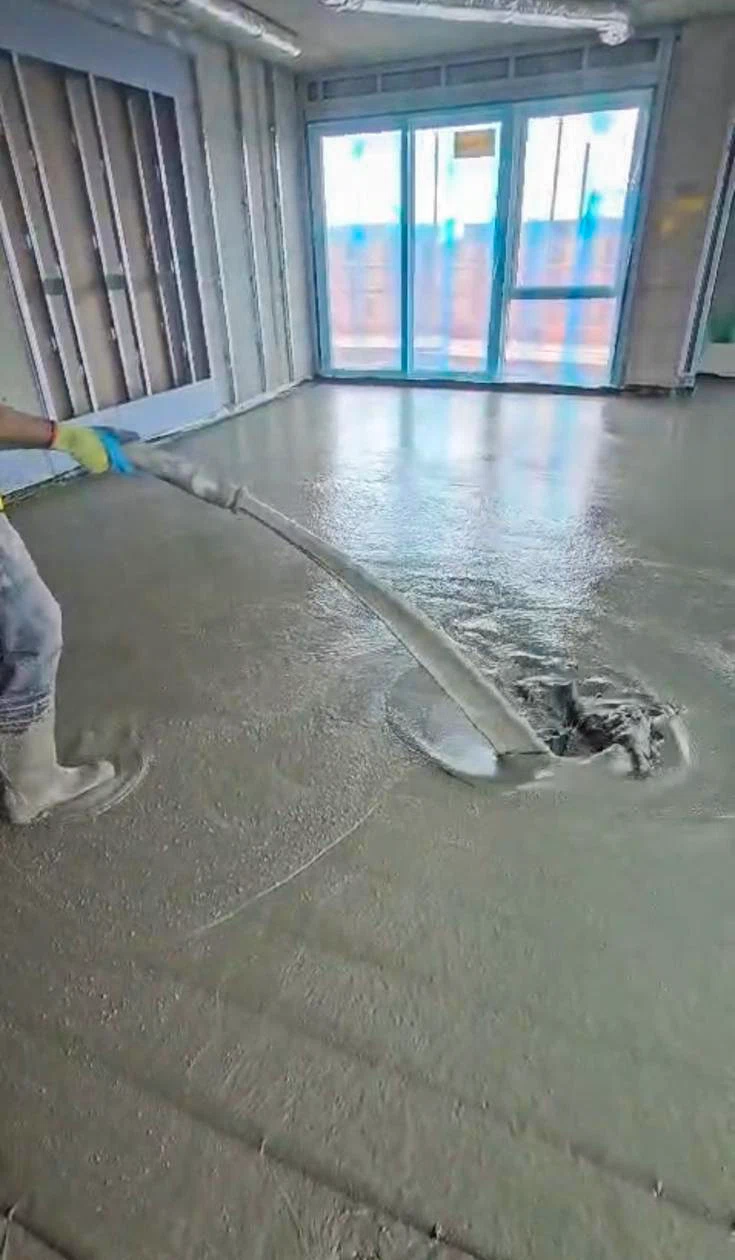
K & B Screeding’s own team, led by director Donatas Bardisevicius. Founded 2019, company 12298780.
See what customers say in our Google reviews and on our testimonials page.
Anhydrite & Flow Screed from Slough to Royal Leamington Spa
Royal Leamington Spa is about 64.9 miles north-west of our Slough base as the crow flies, with postcodes including CV32, CV34 and CV31. The nearest towns to it are Warwick (2.3 miles), Kenilworth (3.9 miles), Coventry (8.1 miles) and Stratford-upon-Avon (10 miles).
More on anhydrite screed, part of our screeding services.
